



OTS964
Based on 15 publication(s) in Google Scholar
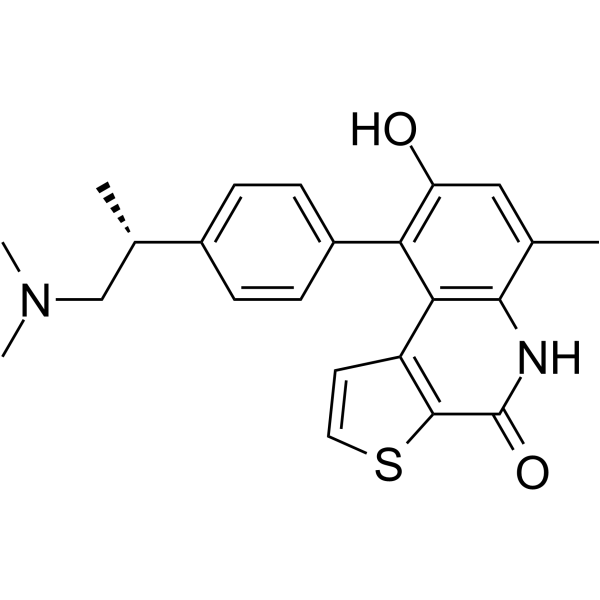
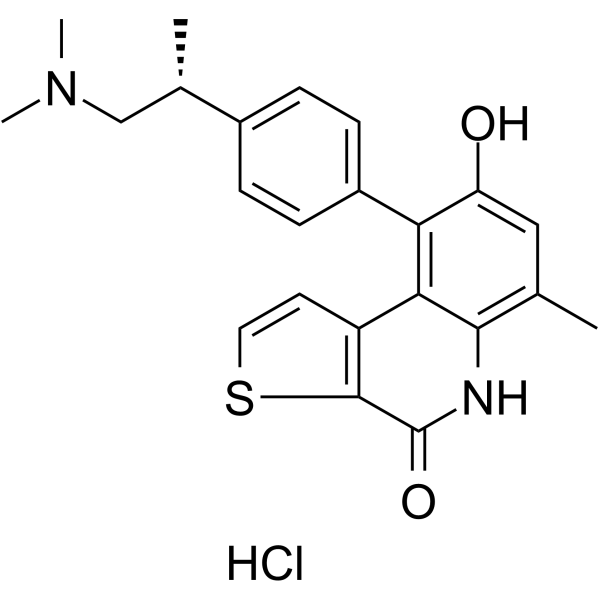
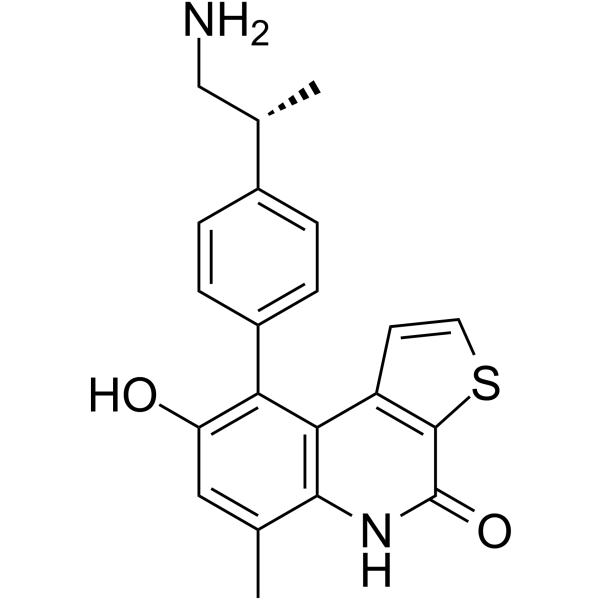
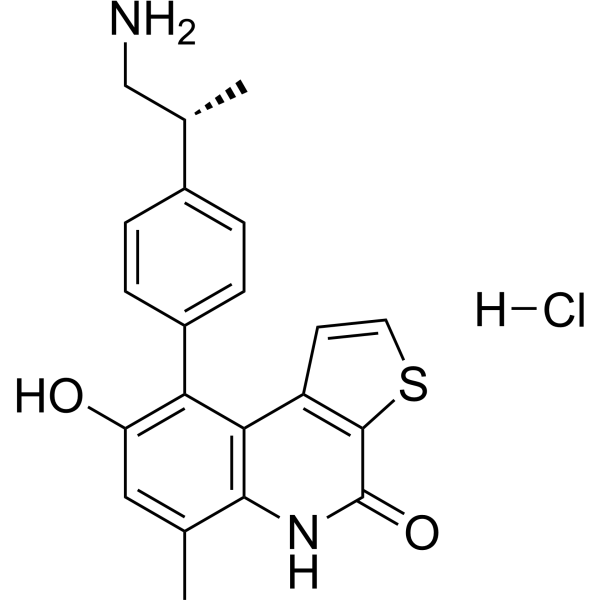
OTS964 is an orally active, high affinity and selective TOPK inhibitor with an IC50 of 28 nM. OTS964 is also a potent inhibitor of the cyclin-dependent kinase CDK11, which binds to CDK11B with a Kd of 40 nM.
For research use only. We do not sell to patients.
- CAS No.: 1338542-14-5
- Formula: C23H24N2O2S
- Molecular Weight:392.51
-
Storage:
Please store the product under the recommended conditions in the Certificate of Analysis.

To place orders, for customer services and technical support, please contact: MedChemExpress USA
Tel: 609-228-6898 E-mail: [email protected] [email protected]


-
 Biological Activity
-
Chemical Information
- Purity & Documentation
- References
-
 Help & FAQs



Publications Citing Use of MedChemExpress (MCE) OTS964
More- Nature. 2022 Sep;609(7928):829-834. [Abstract]
- Cell. 2021 Jun 10;184(12):3143-3162.e32. [Abstract]
- Nat Commun. 2026 Jul 3;17(1):5845.
- Mol Cell. 2025 Sep 4;85(17):3256-3274.e14. [Abstract]
- Adv Sci (Weinh). 2024 Apr;11(14):e2308496. [Abstract]
- Cell Death Dis. 2019 Aug 5;10(8):583. [Abstract]
- J Eur Acad Dermatol Venereol. 2024 May;38(5):851-863. [Abstract]
- Mol Cancer Ther. 2026 Aug 13.
- Mol Cell Proteomics. 2025 Jun;24(6):100991. [Abstract]
- Cancers (Basel). 2026 Jan 14;18(2):261. [Abstract]
- iScience. 2023 Jun 20;26(7):107185. [Abstract]
- bioRxiv. 2026 Mar 26.
- bioRxiv. 2025 Nov 20.
- bioRxiv. 2025 Sep 28.
- SSRN. 2022 Nov 21.
 Customer Validation & Images

-
Cell Proliferation/Viability Assay
-
Flow Cytometry
-
WB
-
WB
-
WB


Biological Activity
Description
|
TOPK 28 nM (IC50) |
CDK11B 40 nM (Kd) |
Cellular Effect
|
Cell Line

|
Type | Value | Description | References |
|---|---|---|---|---|
| A549 | IC50 |
20.41 nM
Compound: OTS964
|
Antiproliferative activity against human A549 cells after 72 hrs by MTT assay
Antiproliferative activity against human A549 cells after 72 hrs by MTT assay
|
[PMID: 30453248] |
| A549 | IC50 |
31 nM
Compound: OTS964
|
Cytotoxicity against human A549 cells assessed as decrease in cell viability after 72 hrs by CCK8 assay
Cytotoxicity against human A549 cells assessed as decrease in cell viability after 72 hrs by CCK8 assay
|
[PMID: 30108692] |
| CWR22R | IC50 |
50 nM
Compound: OTS964
|
Cytotoxicity against human 22Rv1 cells assessed as decrease in cell viability after 72 hrs by CCK8 assay
Cytotoxicity against human 22Rv1 cells assessed as decrease in cell viability after 72 hrs by CCK8 assay
|
[PMID: 30108692] |
| Daudi | IC50 |
25 nM
Compound: OTS964
|
Cytotoxicity against human Daudi cells assessed as decrease in cell viability after 72 hrs by CCK8 assay
Cytotoxicity against human Daudi cells assessed as decrease in cell viability after 72 hrs by CCK8 assay
|
[PMID: 30108692] |
| DU-4475 | IC50 |
53 nM
Compound: OTS964
|
Cytotoxicity against human DU4475 cells assessed as decrease in cell viability after 72 hrs by CCK8 assay
Cytotoxicity against human DU4475 cells assessed as decrease in cell viability after 72 hrs by CCK8 assay
|
[PMID: 30108692] |
| HCT-116 | IC50 |
33 nM
Compound: OTS964
|
Cytotoxicity against human HCT116 cells assessed as decrease in cell viability after 72 hrs by CCK8 assay
Cytotoxicity against human HCT116 cells assessed as decrease in cell viability after 72 hrs by CCK8 assay
|
[PMID: 30108692] |
| HCT-116 | IC50 |
45 nM
Compound: OTS964
|
Antiproliferative activity against human HCT116 cells after 72 hrs by MTT assay
Antiproliferative activity against human HCT116 cells after 72 hrs by MTT assay
|
[PMID: 30453248] |
| HCT-15 | IC50 |
73.08 nM
Compound: OTS964
|
Antiproliferative activity against human HCT15 cells after 72 hrs by MTT assay
Antiproliferative activity against human HCT15 cells after 72 hrs by MTT assay
|
[PMID: 30453248] |
| HepG2 | IC50 |
19 nM
Compound: OTS964
|
Cytotoxicity against human HepG2 cells assessed as decrease in cell viability after 72 hrs by CCK8 assay
Cytotoxicity against human HepG2 cells assessed as decrease in cell viability after 72 hrs by CCK8 assay
|
[PMID: 30108692] |
| Lu-99 cell line | IC50 |
7.6 nM
Compound: OTS964
|
Cytotoxicity against human LU99 cells assessed as decrease in cell viability after 72 hrs by CCK8 assay
Cytotoxicity against human LU99 cells assessed as decrease in cell viability after 72 hrs by CCK8 assay
|
[PMID: 30108692] |
| MDA-MB-231 | IC50 |
73 nM
Compound: OTS964
|
Cytotoxicity against human MDA-MB-231 cells assessed as decrease in cell viability after 72 hrs by CCK8 assay
Cytotoxicity against human MDA-MB-231 cells assessed as decrease in cell viability after 72 hrs by CCK8 assay
|
[PMID: 30108692] |
| MIA PaCa-2 | IC50 |
30 nM
Compound: OTS964
|
Cytotoxicity against human MIAPaCa2 cells assessed as decrease in cell viability after 72 hrs by CCK8 assay
Cytotoxicity against human MIAPaCa2 cells assessed as decrease in cell viability after 72 hrs by CCK8 assay
|
[PMID: 30108692] |
| MKN-1 | IC50 |
38 nM
Compound: OTS964
|
Cytotoxicity against human MKN1 cells assessed as decrease in cell viability after 72 hrs by CCK8 assay
Cytotoxicity against human MKN1 cells assessed as decrease in cell viability after 72 hrs by CCK8 assay
|
[PMID: 30108692] |
| MKN-45 | IC50 |
39 nM
Compound: OTS964
|
Cytotoxicity against human MKN45 cells assessed as decrease in cell viability after 72 hrs by CCK8 assay
Cytotoxicity against human MKN45 cells assessed as decrease in cell viability after 72 hrs by CCK8 assay
|
[PMID: 30108692] |
| T47D | IC50 |
72 nM
Compound: OTS964
|
Cytotoxicity against human T47D cells assessed as decrease in cell viability after 72 hrs by CCK8 assay
Cytotoxicity against human T47D cells assessed as decrease in cell viability after 72 hrs by CCK8 assay
|
[PMID: 30108692] |
| UMUC3 | IC50 |
32 nM
Compound: OTS964
|
Cytotoxicity against human UM-UC-3 cells assessed as decrease in cell viability after 72 hrs by CCK8 assay
Cytotoxicity against human UM-UC-3 cells assessed as decrease in cell viability after 72 hrs by CCK8 assay
|
[PMID: 30108692] |
In Vitro
OTS964 (10 nM; 48 hours) suppresses cancer cell proliferation[1].
OTS964 (10 nM; 48 hours) increases cancer cell death[1].
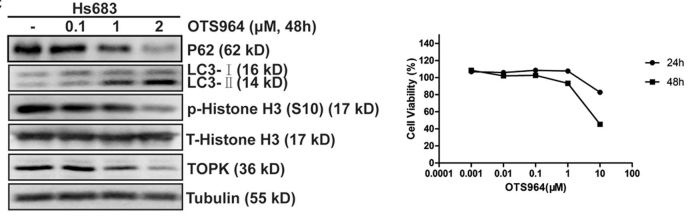
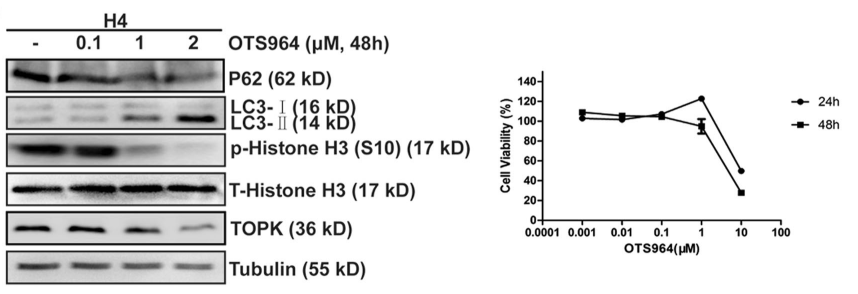
OTS964 (0.1-2 μM; 24 and 48 hours) increases the expression of LC3-II and decreases the expression of P62, both in a dose-dependent manner[3].
MedChemExpress (MCE) has not independently confirmed the accuracy of these methods. They are for reference only.
-
Cell Line:LU-99 cells
-
Concentration:10 nM
-
Incubation Time:48 hours
-
Result:Suppressed cancer cell proliferation.
-
Cell Line:LU-99 cells
-
Concentration:10 nM
-
Incubation Time:48 hours
-
Result:Increased cancer cell death.
-
Cell Line:Hs683 cells, H4 cells
-
Concentration:0.1, 1, 2 μM
-
Incubation Time:24 and 48 hours
-
Result:Increased the expression of LC3-II and decreased the expression of P62, both in a dose-dependent manner.
In Vivo
OTS964 (oral administration; 50 or 100 mg/kg/day for 2 weeks) achieves complete tumor regression[1].
MedChemExpress (MCE) has not independently confirmed the accuracy of these methods. They are for reference only.
-
Animal Model:Nude mice bearing LU-99 lung cancer cells[1]
-
Dosage:40 mg/kg
-
Administration:Intravenously; on days 1, 4, 8, 11, 15, and 18
-
Result:The tumors continued shrinking even after the treatment and finally revealed complete regression.
-
Animal Model:Nude mice bearing LU-99 lung cancer cells[1]
-
Dosage:50 or 100 mg/kg
-
Administration:Oral administration; once every day for 2 weeks
-
Result:Achieved complete tumor regression.


Chemical Information
-
CAS No. 1338542-14-5
-
Molecular Weight 392.51
-
Formula C23H24N2O2S
-
SMILES
O=C(N1)C2=C(C=CS2)C3=C1C(C)=CC(O)=C3C4=CC=C([C@@H](C)CN(C)C)C=C4
-
Shipping
Room temperature in continental US; may vary elsewhere.
-
Storage
Please store the product under the recommended conditions in the Certificate of Analysis.


Publications (15)
-
Journal Impact Factor
-
Most Recent
-
Nature
2022 Sep;609(7928):829-834. PMID: 36104565
OTS964 purchased from MedChemExpress. Usage Cited in: Nature. 2022 Sep;609(7928):829-834. [Abstract]
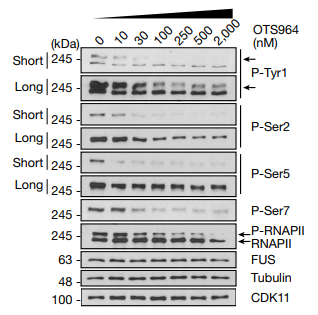
OTS964 hydrochloride (0, 10, 30, 100, 250, 500, 2000 nM; 4 h) decreased the total RNAPIICTD phosphorylation at Tyr1, Ser2, Thr4, Ser5 and Ser7 in HCT116 cells.
-
Cell
The PP2A-Integrator-CDK9 axis fine-tunes transcription and can be targeted therapeutically in cancer. [Abstract]2021 Jun 10;184(12):3143-3162.e32. PMID: 34004147 -
-
Mol Cell
A CDK11-dependent RNA polymerase II pause-checkpoint precedes CDK9-mediated transition to transcriptional elongation. [Abstract]2025 Sep 4;85(17):3256-3274.e14. PMID: 40858114
OTS964 purchased from MedChemExpress. Usage Cited in: Mol Cell. 2025 Sep 4;85(17):3256-3274.e14. [Abstract]
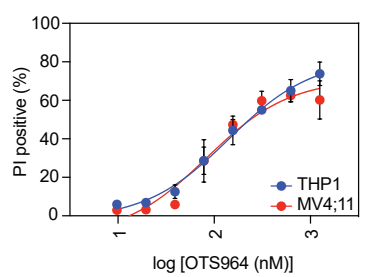
OTS964 hydrochloride (0-1000 nM; 48 h) dose-dependent increases in cell death in THP1 and MV4;11 cells.
OTS964 purchased from MedChemExpress. Usage Cited in: Mol Cell. 2025 Sep 4;85(17):3256-3274.e14. [Abstract]
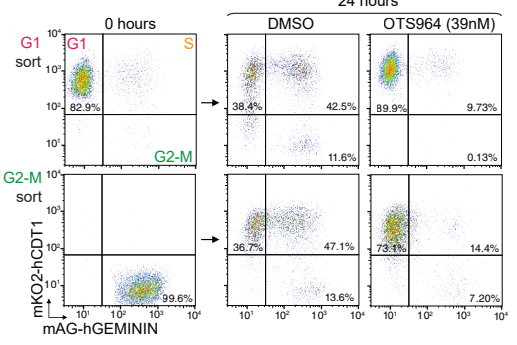
OTS964 hydrochloride (39 nM; 24 h) induced cell cycle arrest at G1 phase in THP1 FUCCI cells.
-
Adv Sci (Weinh)
Zygotic Splicing Activation of the Transcriptome is a Crucial Aspect of Maternal-to-Zygotic Transition and Required for the Conversion from Totipotency to Pluripotency. [Abstract]2024 Apr;11(14):e2308496. PMID: 38308190 -
Cell Death Dis
2019 Aug 5;10(8):583. PMID: 31378785
OTS964 purchased from MedChemExpress. Usage Cited in: Cell Death Dis. 2019 Aug 5;10(8):583. [Abstract]
OTS964 hydrochloride (0, 0.1, 1, 2 μM; 24, 48 h) inhibited cells viability and increased the expression of LC3-II and decreased the expression of P62, and both were in a dose-dependent manner in Hs683 cells.
OTS964 purchased from MedChemExpress. Usage Cited in: Cell Death Dis. 2019 Aug 5;10(8):583. [Abstract]
OTS964 hydrochloride (0, 0.1, 1, 2 μM; 24, 48 h) inhibited cells viability and increased the expression of LC3-II and decreased the expression of P62, and both were in a dose-dependent manner in H4 cells.
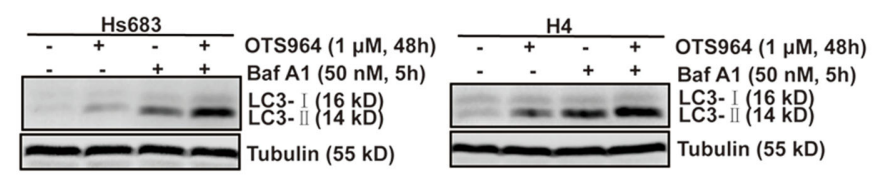
OTS964 purchased from MedChemExpress. Usage Cited in: Cell Death Dis. 2019 Aug 5;10(8):583. [Abstract]
OTS964 hydrochloride (1 μM; 48 h) activated autophagy initiation without affecting autophagic flux in Hs683 (left) and H4 (right) cells. Baf A1 (50 nM) was added 5 h before the cells were harvested.
OTS964 purchased from MedChemExpress. Usage Cited in: Cell Death Dis. 2019 Aug 5;10(8):583. [Abstract]
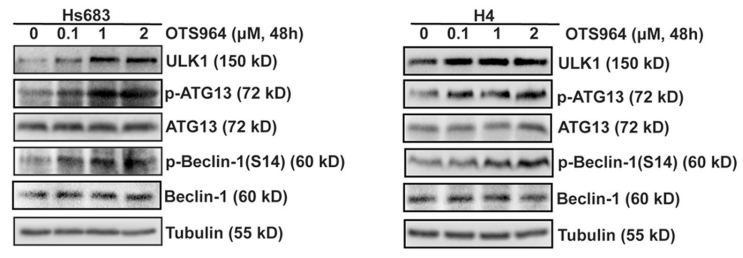
OTS964 hydrochloride (0, 0.1, 1, 2 μM; 48 h) increased the expression of ULK1 and the levels of p-ATG13 and p-Beclin-1 in a dose-dependent manner in Hs683 (left) and H4 (right) cells.
-
J Eur Acad Dermatol Venereol
TOPK promotes the development of psoriasis and worenine alleviates psoriasiform dermatitis by inhibiting TOPK activity. [Abstract]2024 May;38(5):851-863. PMID: 38131517 -
-
Mol Cell Proteomics
Proteomics and Phosphoproteomics Revealed Dysregulated Kinases and Potential Therapy for Liver Fibrosis. [Abstract]2025 Jun;24(6):100991. PMID: 40368138 -
Cancers (Basel)
2026 Jan 14;18(2):261. PMID: 41595181 -
iScience
TOPK mediates immune evasion of renal cell carcinoma via upregulating the expression of PD-L1. [Abstract]2023 Jun 20;26(7):107185. PMID: 37404377 -
-
-
-


Purity & Documentation
References
[1]. Matsuo Y , et al. TOPK inhibitor induces complete tumor regression in xenograft models of human cancerthrough inhibition of cytokinesis. Sci Transl Med. 2014 Oct 22;6(259):259ra145. [Content Brief]
[2]. Lin A, et al. Off-target toxicity is a common mechanism of action of cancer drugs undergoing clinical trials. Sci Transl Med. 2019 Sep 11;11(509). [Content Brief]
[3]. Lu H, et al. TOPK inhibits autophagy by phosphorylating ULK1 and promotes glioma resistance to TMZ. Cell Death Dis. 2019 Aug 5;10(8):583. [Content Brief]

Calculators
Concentration (start) × Volume (start) = Concentration (final) × Volume (final)


OTS964 Related Classifications
HY-19718 Related Classifications
 Powered by Bioz