



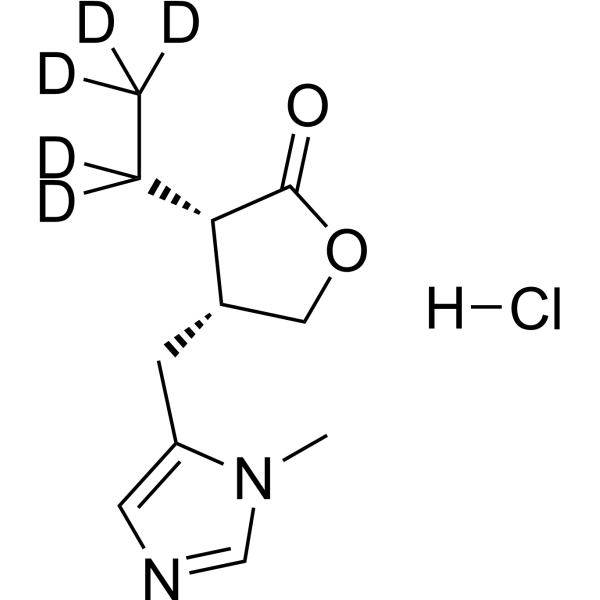
Pilocarpine-d5 hydrochloride
Pilocarpine-d5 hydrochloride is deuterated labeled Pilocarpine hydrochloride (HY-B0726). Pilocarpine Hydrochloride is a potent M3-type muscarinic acetylcholine receptor (M3 muscarinic receptor) agonist.
For research use only. We do not sell to patients.
- Formula: C11H12D5ClN2O2
- Molecular Weight:249.75
-
Storage:
Please store the product under the recommended conditions in the Certificate of Analysis.

To place orders, for customer services and technical support, please contact: MedChemExpress USA
Tel: 609-228-6898 E-mail: [email protected] [email protected]


-
 Biological Activity
-
Chemical Information
- Purity & Documentation
- References
-
 Help & FAQs




Biological Activity
Description
In Vitro
Stable heavy isotopes of hydrogen, carbon, and other elements have been incorporated into drug molecules, largely as tracers for quantitation during the drug development process. Deuteration has gained attention because of its potential to affect the pharmacokinetic and metabolic profiles of drugs[1].
To evaluate the cytotoxicity of Pilocarpine, the morphology and viability of human corneal stromal (HCS) cells are examined by light microscopy and MTT assay, respectively. Morphological observations show that HCS cells exposed to Pilocarpine at a concentration from 0.625 to 20 g/L exhibit dose- and time-dependent proliferation retardation and morphological abnormality such as cellular shrinkage, cytoplasmic vacuolation, detachment from culture matrix, and eventually death, while no obvious difference is observed between those exposed to Pilocarpine below the concentration of 0.625 g/L and controls. Results of MTT assay reveal that the cell viability of HCS cells decrease with time and concentration after exposing to Pilocarpine above the concentration of 0.625 g/L (P<0.01 or 0.05), while that of HCS cells treated with Pilocarpine below the concentration of 0.625 g/L show no significant difference to controls[3]. The partial muscarinic agonist, Pilocarpine, evokes concentration-dependent relaxation with an EC50 of 2.4 mM in isolated segments of rat tail artery that were constricted with Penylephrine (10 to 200 nM)[4].
MedChemExpress (MCE) has not independently confirmed the accuracy of these methods. They are for reference only.
In Vivo
MedChemExpress (MCE) has not independently confirmed the accuracy of these methods. They are for reference only.
Application
1. This compound can be used as a tracer
2. This compound can be used as an internal standard for quantitative analysis by NMR, GC-MS, or LC-MS.


Chemical Information
-
Unlabeled CAS 54-71-7
-
Molecular Weight 249.75
-
Formula C11H12D5ClN2O2
-
SMILES
O=C1OC[C@H](CC2=CN=CN2C)[C@@H]1C([2H])([2H])C([2H])([2H])[2H].[H]Cl
-
Shipping
Room temperature in continental US; may vary elsewhere.
-
Storage
Please store the product under the recommended conditions in the Certificate of Analysis.


Purity & Documentation
References
[1]. Russak EM, et al. Impact of Deuterium Substitution on the Pharmacokinetics of Pharmaceuticals. Ann Pharmacother. 2019 Feb;53(2):211-216. [Content Brief]
[2]. Tonta MA, et al. Pilocarpine-induced relaxation of rat tail artery by a non-cholinergic mechanism and in the absence of an intact endothelium. Br J Pharmacol. 1994 Jun;112(2):525-32. [Content Brief]
[3]. Matsuzaki K, et al. Daily voluntary exercise enhances pilocarpine-induced saliva secretion and aquaporin 1 expression in rat submandibular glands. FEBS Open Bio. 2017 Dec 7;8(1):85-93. [Content Brief]
[4]. Wang RF, et al. Post-treatment with the GLP-1 analogue liraglutide alleviate chronic inflammation and mitochondrial stress induced by Status epilepticus. Epilepsy Res. 2018 Mar 9;142:45-52. [Content Brief]
[5]. Yuan XL, et al. Cytotoxicity of pilocarpine to human corneal stromal cells and its underlying cytotoxic mechanisms. Int J Ophthalmol. 2016 Apr 18;9(4):505-11. [Content Brief]

Calculators
Concentration (start) × Volume (start) = Concentration (final) × Volume (final)


Pilocarpine-d5 hydrochloride Related Classifications
HY-B0726S1 Related Classifications
 Powered by Bioz