



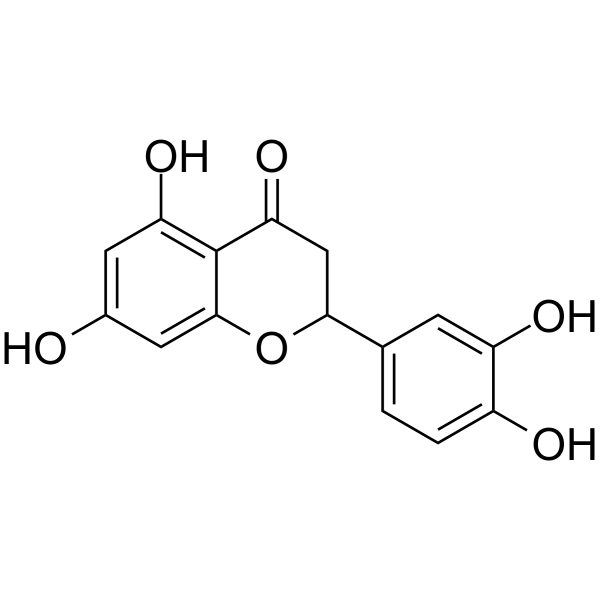
(±)-Eriodictyol

Based on 1 Customer Validation
(±)-Eriodictyol ((±)-Huazhongilexone; Dihydroluteolin) is an orally active TRPV1 receptor antagonist (IC50=44-47 nM, rTRPV1) with antioxidant and anti-inflammatory activities. (±)-Eriodictyol effectively inhibits lipid peroxidation and the release of proinflammatory cytokines by specifically antagonizing the TRPV1 receptor and activating the Nrf2 signaling pathway. (±)-Eriodictyol reduces the levels of ICAM-1, VEGF, eNOS and TNF-α in the retina and maintains the integrity of the blood-retinal barrier. (±)-Eriodictyol alleviates oxidative stress-induced apoptosis and hyperalgesia, enhances the activity and cytotoxicity of immune cells (such as B lymphocytes, NK cells and macrophages), and increases the levels of antioxidant enzymes simultaneously. (±)-Eriodictyol can be used in the research of diabetic retinopathy, acute lung injury and various pain-related diseases.
For research use only. We do not sell to patients.
- Purity : 99.9%
- CAS No.: 4049-38-1
- Formula: C15H12O6
- Molecular Weight:288.25
-
Storage:
4°C, sealed storage, away from moisture and light
* In solvent : -80°C, 6 months; -20°C, 1 month (sealed storage, away from moisture and light)

To place orders, for customer services and technical support, please contact: MedChemExpress USA
Tel: 609-228-6898 E-mail: [email protected] [email protected]


-
 Biological Activity
-
Chemical Information
-
Solvent & Solubility
- Purity & Documentation
- References
-
 Help & FAQs





Biological Activity
Description
IC50 & Target
|
rTRPV1 |
Cellular Effect
|
Cell Line

|
Type | Value | Description | References |
|---|---|---|---|---|
| B16-4A5 | IC50 |
48 μM
Compound: 1
|
Inhibition of melanogenesis in theophylline-stimulated mouse B16-4A5 cells after 72 hrs by microplate reader analysis
Inhibition of melanogenesis in theophylline-stimulated mouse B16-4A5 cells after 72 hrs by microplate reader analysis
|
[PMID: 25987378] |
| Neutrophil | IC50 |
1.4 μM
Compound: 5b
|
Inhibition of oxidative burst in PMA-stimulated human neutrophils assessed as inhibition of HOCl-induced oxidation of APF after 6 mins by fluorescence assay
Inhibition of oxidative burst in PMA-stimulated human neutrophils assessed as inhibition of HOCl-induced oxidation of APF after 6 mins by fluorescence assay
|
[PMID: 23871908] |
| Neutrophil | IC50 |
15.5 μM
Compound: 5b
|
Inhibition of oxidative burst in PMA-stimulated human neutrophils assessed as inhibition of superoxide anion radical-induced lucigenin oxidation incubated for 5 mins prior to PMA challenge by chemiluminescence assay
Inhibition of oxidative burst in PMA-stimulated human neutrophils assessed as inhibition of superoxide anion radical-induced lucigenin oxidation incubated for 5 mins prior to PMA challenge by chemiluminescence assay
|
[PMID: 23871908] |
| Neutrophil | IC50 |
18 μM
Compound: 5b
|
Inhibition of oxidative burst in PMA-stimulated human neutrophils assessed as inhibition of ROS-induced luminol oxidation incubated for 5 mins prior to PMA challenge by chemiluminescence assay
Inhibition of oxidative burst in PMA-stimulated human neutrophils assessed as inhibition of ROS-induced luminol oxidation incubated for 5 mins prior to PMA challenge by chemiluminescence assay
|
[PMID: 23871908] |
| Neutrophil | IC50 |
4 μM
Compound: 5b
|
Inhibition of oxidative burst in PMA-stimulated human neutrophils assessed as inhibition of H2O2-induced oxidation of amplex red incubated for 5 mins prior to PMA challenge by fluorescence assay
Inhibition of oxidative burst in PMA-stimulated human neutrophils assessed as inhibition of H2O2-induced oxidation of amplex red incubated for 5 mins prior to PMA challenge by fluorescence assay
|
[PMID: 23871908] |
In Vitro
(±)-Eriodictyol inhibits LPS-induced inflammatory cytokine protein production and mRNA expression in C57BL/6 mouse bone marrow-derived macrophages[2].
(±)-Eriodictyol (3-300 nM) acts as a functional TRPV1 antagonist in rat spinal cord synaptosomes, inhibiting capsaicin-induced calcium influx with an IC50 of 44 nM, and does not alter baseline calcium levels on its own[3].
(±)-Eriodictyol (1-300 μM; 30 min) has cell-free antioxidant activity, scavenging ABTS radicals with an IC50 of 1.7 μM[3].
(±)-Eriodictyol (2.5-20 μM; 48 h) dose-dependently inhibits LPS-induced NO production in murine peritoneal macrophages, reducing NO to 31.8 μM at 20 μM over 48 h[4].
(±)-Eriodictyol (2.5-20 μM; 48 h) dose-dependently inhibits lysosomal enzyme activity in murine peritoneal macrophages, with significant suppression at 2.5, 5, 10, and 20 μM over 48 h[4].
(±)-Eriodictyol (6.25-50 μM; 1 h) exhibits dose-dependent cellular antioxidant activity in murine splenocytes and macrophages, with EC50 values of 13 μM and 14 μM, respectively, in the CAA assay[4].
(±)-Eriodictyol (5-20 μM; 24 h) dose-dependently suppresses the production of proinflammatory cytokines TNF-α and IL-8 in high glucose-stimulated rat RGC-5 retinal ganglial cells[5].
(±)-Eriodictyol (5-20 μM; 24 h) dose-dependently represses apoptosis in high glucose-stimulated rat RGC-5 retinal ganglial cells by modulating the expression of pro- and anti-apoptotic proteins[5].
(±)-Eriodictyol (5-20 μM; 24 h) enhances activation of the Nrf2/HO-1 pathway in high glucose-stimulated rat RGC-5 retinal ganglial cells, which is required for its protective effects against oxidative stress, inflammation, and apoptosis[5].
MedChemExpress (MCE) has not independently confirmed the accuracy of these methods. They are for reference only.
-
Cell Line:rat RGC-5 retinal ganglial cells
-
Concentration:5-20 μM (pretreated, then incubated with HG); 5-20 μM (incubated with NG)
-
Incubation Time:24 h
-
Result:Showed no effect on RGC-5 cell viability under NG conditions.
Improved RGC-5 cell viability in a dose-dependent manner under HG conditions, with significant increases observed at all tested concentrations.
-
Cell Line:rat RGC-5 retinal ganglial cells
-
Concentration:5-20 μM (pretreated, then incubated with HG)
-
Incubation Time:24 h
-
Result:Dose-dependently reduced the HG-induced increases in TNF-α and IL-8 levels in RGC-5 cell supernatants.
-
Cell Line:rat RGC-5 retinal ganglial cells
-
Concentration:5-20 μM (pretreated, then incubated with HG)
-
Incubation Time:24 h
-
Result:Dose-dependently reduced HG-induced apoptosis.
Reversed the HG-induced changes in apoptosis-related protein expression: increased bcl-2 levels and decreased bax and cleaved caspase-3 levels.
-
Cell Line:rat RGC-5 retinal ganglial cells
-
Concentration:5-20 μM (pretreated, then incubated with HG); 20 μM (pretreated, then incubated with HG for Nrf2/HO-1 Western blot quantification)
-
Incubation Time:24 h
-
Result:Enhanced HG-induced nuclear translocation of Nrf2 and HG-induced HO-1 protein expression in RGC-5 cells.
Knockdown of Nrf2 attenuated the protective effects of eriodictyol on HG-induced cell viability reduction, ROS production, TNF-α elevation, and apoptosis.
In Vivo
(±)-Eriodictyol (30 mg/kg; p.o.; single dose; 2 days prior to LPS exposure) significantly attenuates LPS-induced acute lung injury in female C57BL/6 mice via anti-inflammatory and antioxidative mechanisms, including improved survival, reduced inflammatory cytokine production, and activation of the Nrf2-Trx1 pathway[2].
(±)-Eriodictyol (0.45-13.5 mg/kg; p.o.; single dose; 1 hour before capsaicin injection; 1-30 nmol/site; i.t.; single dose; 15 minutes before capsaicin injection) induces antinociception in intraplantar capsaicin-induced nociception in mice, with a maximal oral inhibition of 49% (ID50=2.3 mg/kg) and maximal intrathecal inhibition of 64% (ID50=2.2 nmol/site)[3].
(±)-Eriodictyol (4.5 mg/kg; p.o.; single dose; 1 hour before intrathecal capsaicin injection) inhibits intrathecal capsaicin-induced nociception in mice by 71%[3].
(±)-Eriodictyol (4.5 mg/kg; p.o.; single dose; 1 hour before nociception testing) fully reverses thermal hyperalgesia and reduces mechanical allodynia by 64% in CFA-induced inflammatory pain in mice[3].
(±)-Eriodictyol (4.5 mg/kg; p.o.; single dose; 1 hour before intraplantar capsaicin injection) prevents intraplantar capsaicin-induced spinal oxidative stress in mice by preserving non-protein thiol levels and blocking 3-nitrotyrosine formation[3].
(±)-Eriodictyol (combined with hesperidin and eriocitrin) enhances systemic antioxidant capacity and reduces markers of inflammation and oxidative stress in high-fat diet-fed C57BL/6J mice[5].
MedChemExpress (MCE) has not independently confirmed the accuracy of these methods. They are for reference only.
-
Animal Model:albino Swiss mice (three-month-old male, 25-35 g)[3]
-
Dosage:4.5 mg/kg
-
Administration:p.o.; 1 hour before intrathecal capsaicin injection; single dose
-
Result:Produced a 71 ± 5% inhibition of intrathecal capsaicin-induced nociception.
-
Animal Model:albino Swiss mice (three-month-old male, 25-35 g)[3]
-
Dosage:4.5 mg/kg
-
Administration:p.o.; 1 hour before nociception testing; single dose
-
Result:Fully reversed CFA-induced thermal hyperalgesia (100% inhibition).
Partially reduced CFA-induced mechanical allodynia (64 ± 7% inhibition).
-
Animal Model:albino Swiss mice (three-month-old male, 25-35 g)[3]
-
Dosage:4.5 mg/kg
-
Administration:p.o.; 1 hour before intraplantar capsaicin injection; single dose
-
Result:Prevented the capsaicin-induced loss of non-protein thiols in the spinal cord.
Prevented the capsaicin-induced increase in spinal 3-NT levels.
Did not alter basal non-protein thiol or 3-NT levels in mice receiving intraplantar vehicle.
-
Animal Model:albino Swiss mice (three-month-old male, 25-35 g)[3]
-
Dosage:4.5 mg/kg
-
Administration:p.o.; single dose
-
Result:Did not produce a significant change in rectal temperature at any measured time point compared to basal levels.


Chemical Information
-
CAS No. 4049-38-1
-
Appearance Solid
-
Molecular Weight 288.25
-
Formula C15H12O6
-
Color White to off-white
-
SMILES
O=C1CC(C2=CC=C(O)C(O)=C2)OC3=CC(O)=CC(O)=C13
-
Synonyms
(±)-Huazhongilexone; Dihydroluteolin
-
Structure Classification
-
Initial Source
-
Shipping
Room temperature in continental US; may vary elsewhere.
-
Storage
4°C, sealed storage, away from moisture and light
* In solvent : -80°C, 6 months; -20°C, 1 month (sealed storage, away from moisture and light)


Solvent & Solubility
In Vitro:
DMSO : 100 mg/mL (346.92 mM; Need ultrasonic; Hygroscopic DMSO has a significant impact on the solubility of product, please use newly opened DMSO)
Please refer to the solubility information to select the appropriate solvent. Once prepared, please aliquot and store the solution to prevent product inactivation from repeated freeze-thaw cycles.
Storage method and period of stock solution: -80°C, 6 months; -20°C, 1 month (sealed storage, away from moisture and light). When stored at -80°C, please use it within 6 months. When stored at -20°C, please use it within 1 month.
Please refer to the solubility information to select the appropriate solvent. Once prepared, please aliquot and store the solution to prevent product inactivation from repeated freeze-thaw cycles.
Storage method and period of stock solution: -80°C, 6 months; -20°C, 1 month (sealed storage, away from moisture and light). When stored at -80°C, please use it within 6 months. When stored at -20°C, please use it within 1 month.
Concentration (start) × Volume (start) = Concentration (final) × Volume (final)
In Vivo:
Select the appropriate dissolution method based on your experimental animal and administration route.
- For the following dissolution methods, please ensure to first prepare a clear stock solution using an In Vitro approach and then sequentially add co-solvents:
- To ensure reliable experimental results, the clarified stock solution can be appropriately stored based on storage conditions. As for the working solution for In Vivo experiments, it is recommended to prepare freshly and use it on the same day.
- The percentages shown for the solvents indicate their volumetric ratio in the final prepared solution. If precipitation or phase separation occurs during preparation, heat and/or sonication can be used to aid dissolution.
Add each solvent one by one: 10% DMSO 40% PEG300 5% Tween-80 45% Saline
Solubility: ≥ 2.5 mg/mL (8.67 mM); Clear solution
This protocol yields a clear solution of ≥ 2.5 mg/mL (saturation unknown).
Taking 1 mL working solution as an example, add 100 μL DMSO stock solution (25.0 mg/mL) to 400 μL PEG300, and mix evenly; then add 50 μL Tween-80 and mix evenly; then add 450 μL Saline to adjust the volume to 1 mL.
Preparation of Saline: Dissolve 0.9 g sodium chloride in ddH₂O and dilute to 100 mL to obtain a clear Saline solution.
Add each solvent one by one: 10% DMSO 90% (20% SBE-β-CD in Saline)
Solubility: ≥ 2.5 mg/mL (8.67 mM); Clear solution
This protocol yields a clear solution of ≥ 2.5 mg/mL (saturation unknown).
Taking 1 mL working solution as an example, add 100 μL DMSO stock solution (25.0 mg/mL) to 900 μL 20% SBE-β-CD in Saline, and mix evenly.
Preparation of 20% SBE-β-CD in Saline (4°C, storage for one week): 2 g SBE-β-CD powder is dissolved in 10 mL Saline, completely dissolve until clear.
In Vivo Dissolution Calculator
Please enter the basic information of animal experiments:
-
-
-
-
Recommended: Prepare an additional quantity of animals to account for potential losses during experiments.
Please enter your animal formula composition:
-
%DMSO +
Recommended: Keep the proportion of DMSO in working solution below 2% if your animal is weak.
-
%+
-
+%Tween-80 + +
-
%Saline +
The co-solvents required include: DMSO, . All of co-solvents are available by MedChemExpress (MCE). , Tween 80. All of co-solvents are available by MedChemExpress (MCE).
Working solution concentration: 0.22 mg/mL
Method for preparing stock solution: mg drug dissolved in μL DMSO. Stock solution concentration: mg/mL. * In solvent : -80°C, 6 months; -20°C, 1 month (sealed storage, away from moisture and light)
1. Take μL DMSO stock solution;
2. Add μL .
μL , mix evenly;
3. Then add μL Tween 80, mix evenly;
4. Then add μL
Please ensure that the stock solution in the first step is dissolved to a clear state, and add co-solvents in sequence. You can use ultrasonic heating (ultrasonic cleaner, recommended frequency 20-40 kHz), vortexing, etc. to assist dissolution.


Purity & Documentation
-
Data Sheet (286 KB)
-
SDS (396 KB)
- English - EN (396 KB)
- Français - FR (396 KB)
- Deutsch - DE (396 KB)
- Norwegian - NO (396 KB)
- Español - ES (396 KB)
- Swedish - SV (396 KB)
- Italian - IT (396 KB)
- Korean - KR (396 KB)
- Portuguese - PT (396 KB)
-
Handling Instructions (2659 KB)
References
[1]. Bucolo C, et al. Eriodictyol prevents early retinal and plasma abnormalities in streptozotocin-induced diabetic rats. Biochem Pharmacol. 2012;84(1):88-92. [Content Brief]
[2]. Zhu GF, et al. Eriodictyol, a plant flavonoid, attenuates LPS-induced acute lung injury through its antioxidative and anti-inflammatory activity. Exp Ther Med. 2015;10(6):2259-2266. [Content Brief]
[3]. Rossato MF, et al. Eriodictyol: a flavonoid antagonist of the TRPV1 receptor with antioxidant activity. Biochem Pharmacol. 2011;81(4):544-551. [Content Brief]
[4]. Mokdad-Bzeouich I, et al. Investigation of immunomodulatory and anti-inflammatory effects of eriodictyol through its cellular anti-oxidant activity. Cell Stress Chaperones. 2016;21(5):773-781. [Content Brief]
[5]. Lv P, et al. Eriodictyol inhibits high glucose-induced oxidative stress and inflammation in retinal ganglial cells. J Cell Biochem. 2019;120(4):5644-5651. [Content Brief]


Complete Stock Solution Preparation Table
Please refer to the solubility information to select the appropriate solvent. Once prepared, please aliquot and store the solution to prevent product inactivation from repeated freeze-thaw cycles.
Storage method and period of stock solution: -80°C, 6 months; -20°C, 1 month (sealed storage, away from moisture and light). When stored at -80°C, please use it within 6 months. When stored at -20°C, please use it within 1 month.
| Optional Solvent | Concentration Solvent Mass | 1 mg | 5 mg | 10 mg | 25 mg |
|---|---|---|---|---|---|
| DMSO | 1 mM | 3.4692 mL | 17.3461 mL | 34.6921 mL | 86.7303 mL |
| 5 mM | 0.6938 mL | 3.4692 mL | 6.9384 mL | 17.3461 mL | |
| 10 mM | 0.3469 mL | 1.7346 mL | 3.4692 mL | 8.6730 mL | |
| 15 mM | 0.2313 mL | 1.1564 mL | 2.3128 mL | 5.7820 mL | |
| 20 mM | 0.1735 mL | 0.8673 mL | 1.7346 mL | 4.3365 mL | |
| 25 mM | 0.1388 mL | 0.6938 mL | 1.3877 mL | 3.4692 mL | |
| 30 mM | 0.1156 mL | 0.5782 mL | 1.1564 mL | 2.8910 mL | |
| 40 mM | 0.0867 mL | 0.4337 mL | 0.8673 mL | 2.1683 mL | |
| 50 mM | 0.0694 mL | 0.3469 mL | 0.6938 mL | 1.7346 mL | |
| 60 mM | 0.0578 mL | 0.2891 mL | 0.5782 mL | 1.4455 mL | |
| 80 mM | 0.0434 mL | 0.2168 mL | 0.4337 mL | 1.0841 mL | |
| 100 mM | 0.0347 mL | 0.1735 mL | 0.3469 mL | 0.8673 mL |


(±)-Eriodictyol Related Classifications
HY-N0637A Related Classifications
 Powered by Bioz