



ACE2 Protein, Mouse (HEK293, His)

Based on 1 Customer Validation
ACE2 protein is an important carboxypeptidase in the renin-angiotensin system, which can regulate blood volume and vascular resistance and maintain cardiovascular homeostasis. It converts angiotensin I to the antihypertrophic angiotensin 1-9 and angiotensin II to the vasodilatory angiotensin 1-7, thereby opposing vasoconstriction. ACE2 Protein, Mouse (HEK293, His) is the recombinant mouse-derived ACE2 protein, expressed by HEK293, with C-His labeled tag.
- Species: Mouse
- Source: HEK293
-
Storage:Stored at -20°C for 2 years from date of receipt. After reconstitution, it is stable at 4°C for 1 week or -20°C for longer (with carrier protein). It is recommended to freeze aliquots at -20°C or -80°C for extended storage.


To place orders, for customer services and technical support, please contact: MedChemExpress USA
Tel: 609-228-6898 E-mail: [email protected] [email protected]


-
 Biological Activity
-
Technical Parameters
-
Product Properties
- Documentation
- References
- Help & FAQs




Biological Activity
Description
ACE2 protein is an important carboxypeptidase in the renin-angiotensin system, which can regulate blood volume and vascular resistance and maintain cardiovascular homeostasis. It converts angiotensin I to the antihypertrophic angiotensin 1-9 and angiotensin II to the vasodilatory angiotensin 1-7, thereby opposing vasoconstriction. ACE2 Protein, Mouse (HEK293, His) is the recombinant mouse-derived ACE2 protein, expressed by HEK293, with C-His labeled tag.
Background
Angiotensin-converting enzyme ACE2 is a metallopeptidase. As an important counter-regulatory carboxypeptidase of the renin-angiotensin system, it converts angiotensin I into angiotensin 1-9, which is anti-cardiac hypertrophy, and angiotensin II into angiotensin 1-7, which has vasodilatory and anti-proliferative properties, thereby counteracting the contractile effect of angiotensin II, regulating blood volume, systemic vascular resistance and cardiovascular homeostasis. At the same time, as a binding partner of the amino acid transporter SLC6A19, it regulates its cell surface transport and activity, participates in amino acid transport, and can regulate a variety of vasoactive peptides such as neurotensin and kinesin, as well as biological peptides such as apelins and casomorphin. It is a key player in cardiovascular disease and amino acid homeostasis. In addition, ACE2 is also a functional receptor for SARS-CoV and the new coronavirus (SARS-CoV-2). It can be immunoprecipitated by the S1 domain of SARS-CoV and promote viral replication. Its large presence in human lung and small intestinal epithelial cells provides a possible entry route for the virus. It is also an important regulator of cardiac function and blood pressure control, and may function as a natural counterpart of ACE1.
Verified Bioactivity
Measured by its ability to cleave a fluorogenic peptide substrate, Mca-YVADAPK(Dnp)-OH. The specific activity is ≤462.95 pmol/min/µg, as measured under the described conditions.
MCE Validation Data
-
Purity - SDS-PAGE
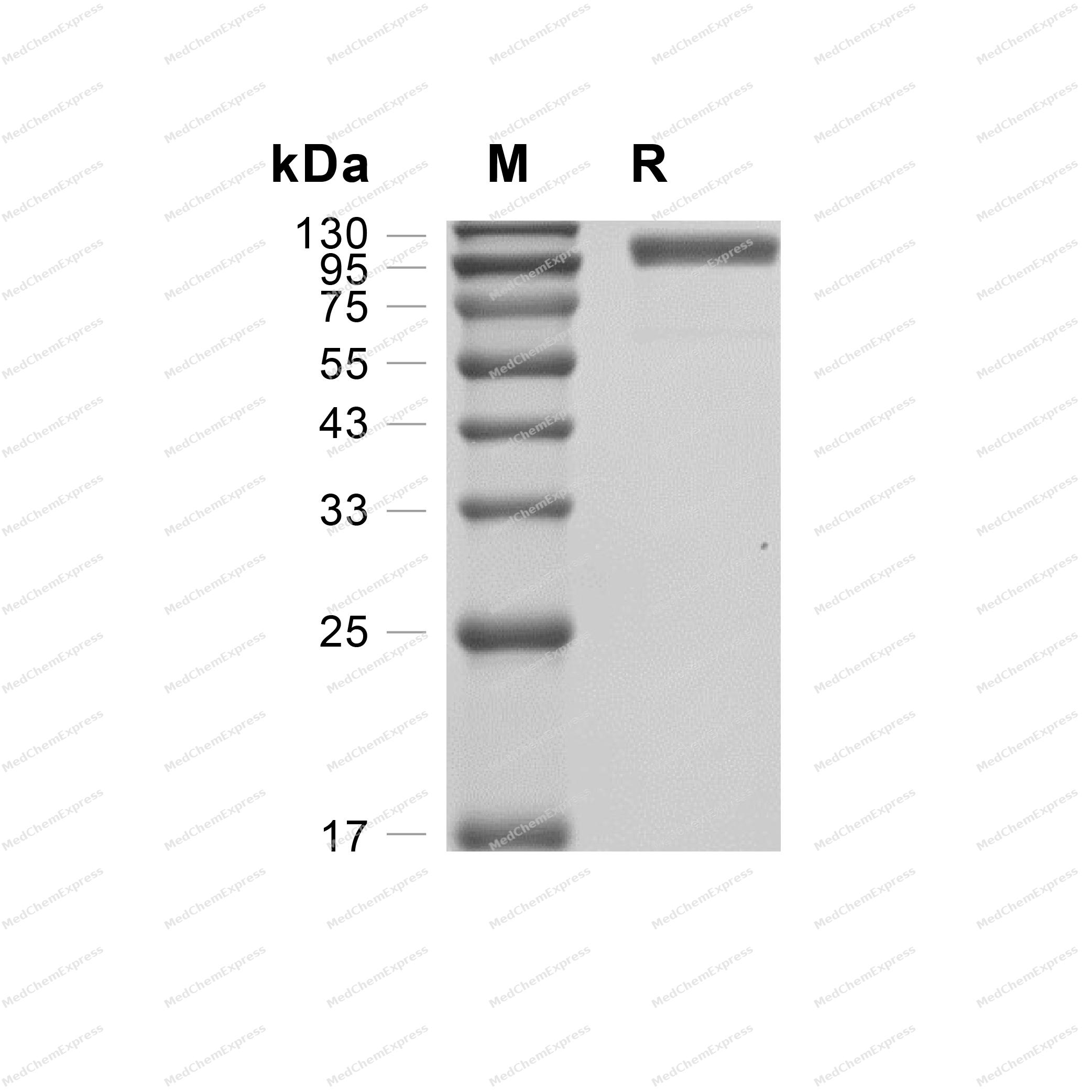
Purity - SDS-PAGE

Assay Procedure
Materials
Assay buffer: 50 mM Tris, 1 M NaCl, pH 7.0
Test Protein: ACE2 Protein, Mouse (HEK293, His) (HY-P74434)
Substrate: Mca-YVADAP-Lys(Dnp)-OH TFA (HY-P2616A), dissolved in DMSO to 2 mM
Standard: MCA-Pro-Leu-OH
Procedure
1. Dilute MCA-Pro-Leu-OH with assay buffer to 50, 25, 12.5, 6.25, 3.125, 1.5625, 0.78, 0.39, and 0 μmol/L respectively. Add 100 μL of each dilution to the wells to initiate the reaction. Measure with excitation and emission wavelengths of 320 nm and 405 nm (top read) in kinetic mode for 5 minutes. Plot a standard curve using the standard concentrations as the x-axis and the measured RFU as the y-axis, and obtain the standard curve equation.
2. Dilute ACE2 to 0.5 μg/mL with assay buffer.
3. Dilute the substrate to 20 μM with assay buffer.
4. Add different concentrations of ACE2 to a black well plate at 50 μL per well, and initiate the reaction by adding 50 μL of 20 μM substrate. For blank wells, add 50 μL of assay buffer and 50 μL of 20 μM substrate.
5. Measure in kinetic mode for 5 minutes with excitation and emission wavelengths of 320 nm and 405 nm respectively.
6. Calculate the specific activity:
Specific Activity (pmol/min/μg) = | Adjusted Vmax* (RFU/min) x Conversion Factor ** (pmol/RFU) |
| amount of enzyme (μg) |
*Adjusted for Control
**Derived using calibration standard
Per Well:
Human ACE2: 0.025 μg
Substrate: 10 μM


Technical Parameters
-
Species Mouse
-
Source HEK293
-
Tag C-His
-
Accession
Q8R0I0-1 (Q18-T740)
-
Molecular Construction
-
N-term
-
ACE2 (Q18-T740)
Accession # Q8R0I0-1 -
His
-
C-term
-
-
Protein Length
Extracellular Domain
-
Synonyms
ACE2; Angiotensin I Converting Enzyme 2; Angiotensin Converting Enzyme 2; Angiotensin-Converting Enzyme 2; ACEH; ACE-Related Carboxypeptidase; Angiotensin I Converting Enzyme (Peptidyl-Dipeptidase A) 2; Metalloprotease MPROT15; Angiotensin-Converting Enzy
-
AA Sequence
QSLTEENAKTFLNNFNQEAEDLSYQSSLASWNYNTNITEENAQKMSEAAAKWSAFYEEQSKTAQSFSLQEIQTPIIKRQLQALQQSGSSALSADKNKQLNTILNTMSTIYSTGKVCNPKNPQECLLLEPGLDEIMATSTDYNSRLWAWEGWRAEVGKQLRPLYEEYVVLKNEMARANNYNDYGDYWRGDYEAEGADGYNYNRNQLIEDVERTFAEIKPLYEHLHAYVRRKLMDTYPSYISPTGCLPAHLLGDMWGRFWTNLYPLTVPFAQKPNIDVTDAMMNQGWDAERIFQEAEKFFVSVGLPHMTQGFWANSMLTEPADGRKVVCHPTAWDLGHGDFRIKMCTKVTMDNFLTAHHEMGHIQYDMAYARQPFLLRNGANEGFHEAVGEIMSLSAATPKHLKSIGLLPSDFQEDSETEINFLLKQALTIVGTLPFTYMLEKWRWMVFRGEIPKEQWMKKWWEMKREIVGVVEPLPHDETYCDPASLFHVSNDYSFIRYYTRTIYQFQFQEALCQAAKYNGSLHKCDISNSTEAGQKLLKMLSLGNSEPWTKALENVVGARNMDVKPLLNYFQPLFDWLKEQNRNSFVGWNTEWSPYADQSIKVRISLKSALGANAYEWTNNEMFLFRSSVAYAMRKYFSIIKNQTVPFLEEDVRVSDLKPRVSFYFFVTSPQNVSDVIPRSEVEDAIRMSRGRINDVFGLNDNSLEFLGIHPTLEPPYQPPVT
-
Molecular Weight
Approximately 85-110 kDa, based on SDS-PAGE under reducing conditions, due to the glycosylation.
-
Glycosylation
Yes
-
Purity
≥ 95%, as determined by reducing SDS-PAGE.


Product Properties
Lyophilized powder
1.Lyophilized from a 0.22 μm filtered solution of 25 mM Tris-HCl, 150 mM NaCl, 1 mM ZnCl2, pH 7.4.
2.Lyophilized from a 0.22 μm filtered solution of PBS, 8% trehalose, pH 7.4.
Please refer to the lot-specific COA for specific buffer information.
Note: For SPR assay, please replace the buffer. Primary amine components (e.g., Tris, imidazole) can affect protein-coupled chips.
<1 EU/μg, determined by LAL method.
It is not recommended to reconstitute to a concentration less than 100 μg/mL in ddH2O. For long term storage it is recommended to add a carrier protein (0.1% BSA, 5% HSA, 10% FBS or 5% Trehalose).
Stored at -20°C for 2 years from date of receipt. After reconstitution, it is stable at 4°C for 1 week or -20°C for longer (with carrier protein). It is recommended to freeze aliquots at -20°C or -80°C for extended storage.
Room temperature in continental US; may vary elsewhere.


Documentation
-
Data Sheet (266 KB)
-
SDS (251 KB)
- English - EN (251 KB)
- Français - FR (251 KB)
- Deutsch - DE (251 KB)
- Norwegian - NO (251 KB)
- Español - ES (251 KB)
- Swedish - SV (251 KB)
- Italian - IT (251 KB)
- Korean - KR (251 KB)
- Portuguese - PT (251 KB)
-
Handling Instructions (2659 KB)


References
[1]. Hamming I, et, al. Tissue distribution of ACE2 protein, the functional receptor for SARS coronavirus. A first step in understanding SARS pathogenesis. J Pathol. 2004 Jun;203(2):631-7. [Content Brief]
[2]. Yang J, et, al. Molecular interaction and inhibition of SARS-CoV-2 binding to the ACE2 receptor. Nat Commun. 2020 Sep 11;11(1):4541. [Content Brief]

Calculators
Concentration (start) × Volume (start) = Concentration (final) × Volume (final)


 Powered by Bioz

