



ADAM10 Protein, Human (HEK293, His)
Based on 1 Customer Validation
The ADAM10 protein cleaves TNF-α precursor, releasing a soluble form, and mediates the proteolytic release of JAM3 and various cell surface proteins. ADAM10 Protein, Human (HEK293, His) is the recombinant human-derived ADAM10 protein, expressed by HEK293 , with C-10*His labeled tag.
- Species: Human
- Source: HEK293
-
Storage:Stored at -80°C for 1 year from date of receipt. It is stable at -20°C for 3 months after opening. It is recommended to freeze aliquots at -80°C for extended storage. Avoid repeated freeze-thaw cycles.


To place orders, for customer services and technical support, please contact: MedChemExpress USA
Tel: 609-228-6898 E-mail: [email protected] [email protected]


-
 Biological Activity
-
Technical Parameters
-
Product Properties
- Documentation
- Help & FAQs




Biological Activity
Description
The ADAM10 protein cleaves TNF-α precursor, releasing a soluble form, and mediates the proteolytic release of JAM3 and various cell surface proteins. ADAM10 Protein, Human (HEK293, His) is the recombinant human-derived ADAM10 protein, expressed by HEK293 , with C-10*His labeled tag.
Background
The ADAM10 protein serves as a multifaceted protease with a broad substrate specificity, playing a central role in diverse biological processes. Notably, ADAM10 cleaves the membrane-bound precursor of TNF-alpha, releasing its mature soluble form. Additionally, it is responsible for the proteolytic release of various cell-surface proteins, including JAM3, heparin-binding epidermal growth-like factor, ephrin-A2, CD44, CDH2, and the constitutive and regulated alpha-secretase cleavage of amyloid precursor protein (APP). ADAM10 contributes to the normal cleavage of the cellular prion protein and is involved in the cleavage of adhesion molecules such as L1. Furthermore, it controls the proteolytic processing of Notch, mediates lateral inhibition during neurogenesis, and is responsible for FasL ectodomain shedding. ADAM10 exhibits a versatile role in mediating the proteolytic cleavage of various integral membrane proteins, including CORIN, ITM2B, LAG3, IL6R, IL11RA, CHL1, NRCAM, and TREM2. Additionally, ADAM10 plays a crucial role in the development and maturation of glomerular and coronary vasculature, contributes to pillar cell separation during the development of the cochlear organ of Corti, and regulates EFNA5-EPHA3 signaling. In microbial infection, ADAM10 promotes the cytotoxic activity of S.aureus hly by binding to the toxin at zonula adherens and promoting the formation of toxin pores.
Verified Bioactivity
Measured by its ability to cleave 10 µM fluorogenic peptide substrate Mca-KPLGL-Dpa-AR-NH2 (HY-P4931). The specific activity is >20 pmol/min/µg.
MCE Validation Data
-
Purity - SDS-PAGE
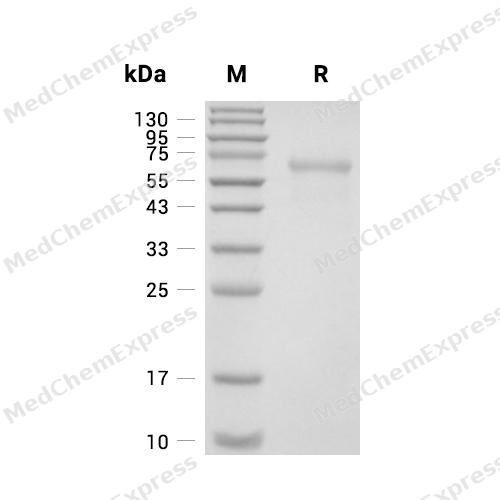
Purity - SDS-PAGE

Assay Procedure
Materials
Assay buffer: 25 mM Tris, 2 μM ZnCl2, 0.005% (w/v) Brij-35, pH 9.0
ADAM10 Protein, Human (HEK293, His) (HY-P702498)
Substrate: Mca-KPLGL-Dpa-AR-NH?, dissolved in DMSO to 20 mM
Standard: MCA-Pro-Leu-OH
Procedure
1. Dilute MCA-Pro-Leu-OH in assay buffer to final concentrations of 0, 9.76, 19, 39, 78, 156, 312.5, 625, 1250, 2500, 5000 pmoL. Add 100 μL of each concentration to the wells. Read the fluorescence in endpoint mode with excitation and emission wavelengths of 320 nm and 405 nm (top read).
2. First, dilute Human ADAM10 to 200 μg/mL in sterile water. Then, dilute it to 1 ng/μL in assay buffer.
3. Dilute the substrate to 20 μM in assay buffer.
4. Add 50 μL of 1 ng/μL Human ADAM10 and 50 μL of 20 μM substrate to the wells. For the blank wells, add 50 μL of assay buffer and 50 μL of 20 μM substrate.
5. Seal the plate and incubate at 37°C for 30 minutes.
6. Read the fluorescence in endpoint mode with excitation and emission wavelengths of 320 nm and 405 nm.
7. Calculate specific activity:
Specific Activity (pmol/min/μg) = | Adjusted Fluorescence* (RFU) x Conversion Factor ** (pmol/RFU) |
| Incubation time (min) x amount of enzyme (μg) |
*Adjusted for Control
**Derived using calibration standard
Per Well:
Human ADAM10: 0.05 μg
Substrate: 10 μM


Technical Parameters
-
Species Human
-
Source HEK293
-
Tag C-10*His
-
Accession
O14672-1 (T214-E672)
-
Gene ID102
-
Molecular Construction
-
N-term
-
ADAM10 (T214-E672)
Accession # O14672 -
10*His
-
C-term
-
-
Protein Length
Partial Extracellular Domain
-
Synonyms
ADAM10; A Disintegrin And Metalloproteinase Domain 10; ADAM Metallopeptidase Domain 10; A Disintegrin And Metalloprotease Domain 10; MADM; Alternative Protein ADAM10; Disintegrin And Metalloproteinase Domain-Containing Protein 10; CD156c Antigen; Kuzbanian Protein Homolog; ADAM 10; HsT18717; AD10; CD156C; AD18; Kuz; RAK; Mammalian Disintegrin-Metalloprotease; KUZ; CDw156
-
AA Sequence
TTSAEKNTCQLYIQTDHLFFKYYGTREAVIAQISSHVKAIDTIYQTTDFSGIRNISFMVKRIRINTTADEKDPTNPFRFPNIGVEKFLELNSEQNHDDYCLAYVFTDRDFDDGVLGLAWVGAPSGSSGGICEKSKLYSDGKKKSLNTGIITVQNYGSHVPPKVSHITFAHEVGHNFGSPHDSGTECTPGESKNLGQKENGNYIMYARATSGDKLNNNKFSLCSIRNISQVLEKKRNNCFVESGQPICGNGMVEQGEECDCGYSDQCKDECCFDANQPEGRKCKLKPGKQCSPSQGPCCTAQCAFKSKSEKCRDDSDCAREGICNGFTALCPASDPKPNFTDCNRHTQVCINGQCAGSICEKYGLEECTCASSDGKDDKELCHVCCMKKMDPSTCASTGSVQWSRHFSGRTITLQPGSPCNDFRGYCDVFMRCRLVDADGPLARLKKAIFSPELYENIAE
-
Molecular Weight
Approximately 60-71 kDa, based on SDS-PAGE under reducing conditions.
-
Glycosylation
Yes
-
Purity
≥ 95%, as determined by reducing SDS-PAGE.


Product Properties
Solution
Supplied as a 0.22 μm filtered solution in 20 mM MES, 300 mM NaCl, pH 5.5, 10 mM ZnCl2, 0.1% Brij-35, 10% Glycerol.
<1 EU/μg, determined by LAL method.
Stored at -80°C for 1 year from date of receipt. It is stable at -20°C for 3 months after opening. It is recommended to freeze aliquots at -80°C for extended storage. Avoid repeated freeze-thaw cycles.
Shipping with dry ice.


Documentation
-
Data Sheet (239 KB)
-
SDS (254 KB)
- English - EN (254 KB)
- Français - FR (254 KB)
- Deutsch - DE (254 KB)
- Norwegian - NO (254 KB)
- Español - ES (254 KB)
- Swedish - SV (254 KB)
- Italian - IT (254 KB)
- Korean - KR (254 KB)
- Portuguese - PT (254 KB)
-
Handling Instructions (2659 KB)

Calculators
Concentration (start) × Volume (start) = Concentration (final) × Volume (final)


 Powered by Bioz

