



AGO2/Argonaute-2 Protein, Mouse (sf9, His, solution)

Based on 1 Customer Validation
The AGO2/Argonaute-2 protein is critical for RNA-mediated silencing complex (RISC)-mediated gene silencing. In "minimal RISC," AGO2 binds to short guide RNAs, such as microRNAs (miRNAs) or short interfering RNAs (siRNAs), to guide RISC for silencing with complementary mRNAs. AGO2/Argonaute-2 Protein, Mouse (sf9, His, solution) is the recombinant mouse-derived AGO2/Argonaute-2 protein, expressed by Sf9 insect cells , with N-His labeled tag.
- Species: Mouse
- Source: Sf9 insect cells
-
Storage:Stored at -80°C for 1 year from date of receipt. It is stable at -20°C for 3 months after opening. It is recommended to freeze aliquots at -80°C for extended storage. Avoid repeated freeze-thaw cycles.


To place orders, for customer services and technical support, please contact: MedChemExpress USA
Tel: 609-228-6898 E-mail: [email protected] [email protected]


-
 Biological Activity
-
Technical Parameters
-
Product Properties
- Documentation
- Help & FAQs




Biological Activity
Description
The AGO2/Argonaute-2 protein is critical for RNA-mediated silencing complex (RISC)-mediated gene silencing. In "minimal RISC," AGO2 binds to short guide RNAs, such as microRNAs (miRNAs) or short interfering RNAs (siRNAs), to guide RISC for silencing with complementary mRNAs. AGO2/Argonaute-2 Protein, Mouse (sf9, His, solution) is the recombinant mouse-derived AGO2/Argonaute-2 protein, expressed by Sf9 insect cells , with N-His labeled tag.
Background
AGO2, a pivotal player in RNA-mediated gene silencing (RNAi) orchestrated by the RNA-induced silencing complex (RISC), is indispensable for diverse regulatory processes. The 'minimal RISC' configuration involves AGO2 tethered to a short guide RNA, such as microRNA (miRNA) or short interfering RNA (siRNA), directing RISC to target mRNAs for silencing. The silencing mechanism hinges on the complementarity between the guide RNA and its target mRNA. Perfect complementarity prompts AGO2-mediated endonucleolytic cleavage, whereas partial complementarity inhibits translation independently of endonuclease activity. AGO2 can impede translation initiation by binding to the 7-methylguanosine cap, hindering eIF4-E recruitment, or through interaction with EIF6, preventing the association of ribosomal subunits. This translational repression leads to mRNA accumulation in cytoplasmic processing bodies (P-bodies), potentially culminating in mRNA degradation. Notably, AGO2 exhibits versatility by both repressing and promoting translation under distinct growth conditions. Furthermore, AGO2 is integral to transcriptional gene silencing (TGS), where short RNAs, such as antigene RNAs, guide the repression of complementary promoter regions. In the context of microbial infection, AGO2 associates with viral miRNA-like small RNA, such as CoV2-miR-O7a during Sars-CoV-2 infection, potentially repressing specific mRNAs, such as BATF2, to evade the interferon response.
MCE Validation Data
-
Purity - SDS-PAGE
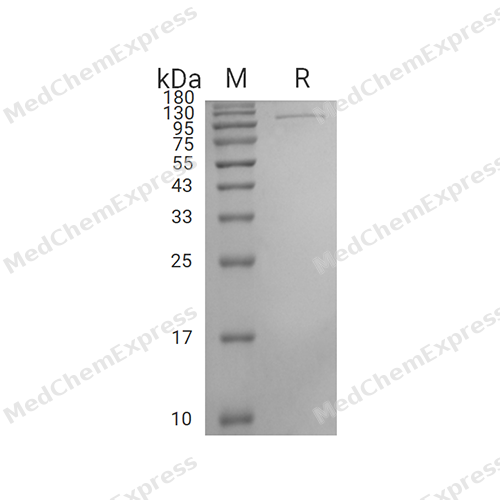
Purity - SDS-PAGE


Technical Parameters
-
Species Mouse
-
Source Sf9 insect cells
-
Tag N-His
-
Accession
Q8CJG0 (M1-A860)
-
Gene ID239528
-
Molecular Construction
-
N-term
-
His
-
AGO2 (M1-A860)
Accession # Q8CJG0 -
C-term
-
-
Protein Length
Full Length
-
Synonyms
AGO2; HAGO2; Prev. EIF2C2; Eukaryotic Translation Initiation Factor 2C 2; Prev. CASC7; Long Intergenic Non-Protein Coding RNA 980; LINC00980; Argonaute 2, RISC Catalytic Component; Q10; Argonaute 2; Cancer Susceptibility Candidate 7 (Non-Protein Coding);
-
AA Sequence
MYSGAGPVLASPAPTTSPIPGYAFKPPPRPDFGTTGRTIKLQANFFEMDIPKIDIYHYELDIKPEKCPRRVNREIVEHMVQHFKTQIFGDRKPVFDGRKNLYTAMPLPIGRDKVELEVTLPGEGKDRIFKVSIKWVSCVSLQALHDALSGRLPSVPFETIQALDVVMRHLPSMRYTPVGRSFFTASEGCSNPLGGGREVWFGFHQSVRPSLWKMMLNIDVSATAFYKAQPVIEFVCEVLDFKSIEEQQKPLTDSQRVKFTKEIKGLKVEITHCGQMKRKYRVCNVTRRPASHQTFPLQQESGQTVECTVAQYFKDRHKLVLRYPHLPCLQVGQEQKHTYLPLEVCNIVAGQRCIKKLTDNQTSTMIRATARSAPDRQEEISKLMRSASFNTDPYVREFGIMVKDEMTDVTGRVLQPPSILYGGRNKAIATPVQGVWDMRNKQFHTGIEIKVWAIACFAPQRQCTEVHLKSFTEQLRKISRDAGMPIQGQPCFCKYAQGADSVEPMFRHLKNTYAGLQLVVVILPGKTPVYAEVKRVGDTVLGMATQCVQMKNVQRTTPQTLSNLCLKINVKLGGVNNILLPQGRPPVFQQPVIFLGADVTHPPAGDGKKPSIAAVVGSMDAHPNRYCATVRVQQHRQEIIQDLAAMVRELLIQFYKSTRFKPTRIIFYRDGVSEGQFQQVLHHELLAIREACIKLEKDYQPGITFIVVQKRHHTRLFCTDKNERVGKSGNIPAGTTVDTKITHPTEFDFYLCSHAGIQGTSRPSHYHVLWDDNRFSSDELQILTYQLCHTYVRCTRSVSIPAPAYYAHLVAFRARYHLVDKEHDSAEGSHTSGQSNGRDHQALAKAVQVHQDTLRTMYFA
-
Predicted Molecular Mass
99 kDa
-
Molecular Weight
Approximately 105 kDa, based on SDS-PAGE under reducing conditions.
-
Purity
≥ 90%, as determined by reducing SDS-PAGE.


Product Properties
Solution
Supplied as a 0.22 μm filtered solution of 20 mM Tris, 500 mM NaCl, pH 7.4, 10% glycerol.
Note: For SPR assay, please replace the buffer. Primary amine components (e.g., Tris, imidazole) can affect protein-coupled chips.
<1 EU/μg, determined by LAL method.
Stored at -80°C for 1 year from date of receipt. It is stable at -20°C for 3 months after opening. It is recommended to freeze aliquots at -80°C for extended storage. Avoid repeated freeze-thaw cycles.
Shipping with dry ice.


Documentation
-
Data Sheet (241 KB)
-
SDS (252 KB)
- English - EN (252 KB)
- Français - FR (252 KB)
- Deutsch - DE (252 KB)
- Norwegian - NO (252 KB)
- Español - ES (252 KB)
- Swedish - SV (252 KB)
- Italian - IT (252 KB)
- Korean - KR (252 KB)
- Portuguese - PT (252 KB)
-
Handling Instructions (2659 KB)

Calculators
Concentration (start) × Volume (start) = Concentration (final) × Volume (final)


 Powered by Bioz

