



Agrin Protein, Rat (HEK293, His)
Based on 1 Customer Validation
Agrin, especially the neuron-specific (z+) isoform, plays a crucial role in neuromuscular junction (NMJ) formation and postsynaptic differentiation. It activates the AGRN-LRP4 receptor complex, leading to NMJ formation through phosphorylation of MUSK. Agrin Protein, Rat (HEK293, His) is the recombinant rat-derived Agrin protein, expressed by HEK293 , with N-6*His labeled tag and P1788-S1798 del.
- Species: Rat
- Source: HEK293
-
Storage:Stored at -20°C for 2 years from date of receipt. After reconstitution, it is stable at 4°C for 1 week or -20°C for longer (with carrier protein). It is recommended to freeze aliquots at -20°C or -80°C for extended storage.


To place orders, for customer services and technical support, please contact: MedChemExpress USA
Tel: 609-228-6898 E-mail: [email protected] [email protected]


-
 Biological Activity
-
Technical Parameters
-
Product Properties
- Documentation
- Help & FAQs




Biological Activity
Description
Agrin, especially the neuron-specific (z+) isoform, plays a crucial role in neuromuscular junction (NMJ) formation and postsynaptic differentiation. It activates the AGRN-LRP4 receptor complex, leading to NMJ formation through phosphorylation of MUSK. Agrin Protein, Rat (HEK293, His) is the recombinant rat-derived Agrin protein, expressed by HEK293 , with N-6*His labeled tag and P1788-S1798 del.
Background
Agrin protein is a heparan sulfate basal lamina glycoprotein that has a crucial role in the formation and maintenance of the neuromuscular junction (NMJ), as well as in directing key events in postsynaptic differentiation. Specifically, the neuron-specific (z+) isoform of Agrin is a component of the AGRN-LRP4 receptor complex, which activates and phosphorylates MUSK, thereby inducing NMJ formation. This process involves the regulation of various processes, including the transcription of specific genes and the clustering of AChR in the postsynaptic membrane, with calcium ions playing a critical role in AChR clustering. The neuronal function of Agrin is tightly regulated by alternative splicing, glycan binding, and proteolytic processing. In addition to its role in NMJ formation, Agrin also modulates calcium ion homeostasis in neurons by increasing cytoplasmic calcium ion levels. In the central nervous system (CNS), Agrin functions by inhibiting the alpha(3)-subtype of Na+/K+-ATPase and inducing depolarization at CNS synapses. The transmembrane isoform of Agrin, known as TM-agrin, is predominantly expressed in brain neurons and promotes dendritic filopodia and synapse formation in mature hippocampal neurons, primarily through the action of attached glycosaminoglycan chains and Rho-family GTPases. Multiple isoforms of Agrin, including isoform 1, isoform 4, isoform 5, and isoform 6, contain neuron-specific C-terminal insertions and are potent activators of AChR clustering. Isoform 5, known as agrin (z+8), which contains an 8-AA insertion, forms a receptor complex with the neuronal AGRN, muscle-specific kinase MUSK, and LRP4. The splicing factors NOVA1 and NOVA2 regulate the splicing of Agrin and the production of the 'z' isoforms.
Verified Bioactivity
Measured by the ability of the immobilized protein to support the adhesion of U‑87 MG human glioblastoma/astrocytoma cells. The ED50 for this effect is 0.3128 μg/mL, corresponding to a specific activity is 3.197×10³ units/mg.
MCE Validation Data
-
Purity - SDS-PAGE
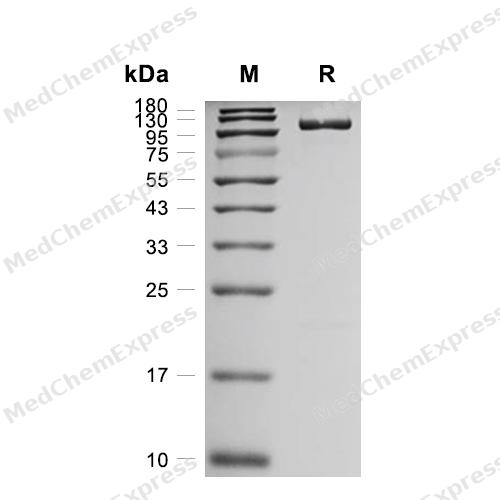
Purity - SDS-PAGE
-
Bioactivity - Cell-Based Assay
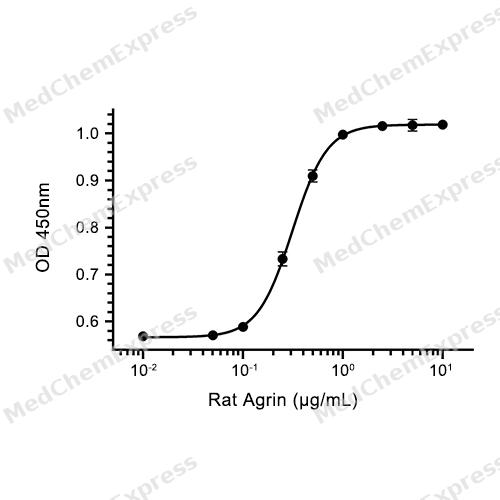
Bioactivity - Cell-Based Assay


Technical Parameters
-
Species Rat
-
Source HEK293
-
Tag N-6*His
-
Accession
P25304-1 (A1153-P1959, ΔP1788-S1798)
-
Gene ID25592
-
Protein Length
Partial Extracellular Domain
-
Synonyms
AGRN; AGRN Protein; Prev. AGRIN; CMS8; Agrin Proteoglycan; Agrin; CMSPPD
-
AA Sequence
AATGTTAAMATARATTVSRLPASSVTPRVYPSHTSRPVGRTTAPPTTRRPPTTATNMDRPRTPGHQQPSKSCDSQPCLHGGTCQDQDSGKGFTCSCTAGRGGSVCEKVQPPSMPAFKGHSFLAFPTLRAYHTLRLALEFRALETEGLLLYNGNARGKDFLALALLDGRVQFRFDTGSGPAVLTSLVPVEPGRWHRLELSRHWRQGTLSVDGETPVVGESPSGTDGLNLDTNLYVGGIPEEQVAMVLDRTSVGVGLKGCIRMLDINNQQLELSDWQRAAVQSSGVGECGDHPCLPNPCHGGALCQALEAGMFLCQCPPGRFGPTCADEKSPCQPNPCHGAAPCRVLSSGGAKCECPLGRSGTFCQTVLETAGSRPFLADFNGFSYLELKGLHTFERDLGEKMALEMVFLARGPSGLLLYNGQKTDGKGDFVSLALHNRHLEFCYDLGKGAAVIRSKEPIALGTWVRVFLERNGRKGALQVGDGPRVLGESPKSRKVPHTMLNLKEPLYIGGAPDFSKLARGAAVSSGFSGVIQLVSLRGHQLLTQEHVLRAVDVSPFADHPCTQALGNPCLNGGSCVPREATYECLCPGGFSGLHCEKGLVEKSVGDLETLAFDGRTYIEYLNAVIESELTNEIPAEKALQSNHFELSLRTEATQGLVLWIGKAAERADYMALAIVDGHLQLSYDLGSQPVVLRSTVKVNTNRWLRIRAHREHREGSLQVGNEAPVTGSSPLGATQLDTDGALWLGGLQKLPVGQALPKAYGTGFVGCLRDVVVGHRQLHLLEDAVTKPELRPCPTP
-
Molecular Weight
Approximately 100 kDa, based on SDS-PAGE under reducing conditions.
-
Glycosylation
Yes
-
Purity
≥ 95%, as determined by reducing SDS-PAGE.


Product Properties
Lyophilized powder.
Lyophilized from a 0.22 μm filtered solution of PBS , pH 6.8.
<0.1 EU/μg, determined by LAL method.
It is not recommended to reconstitute to a concentration less than 100 μg/mL in PBS. For long term storage it is recommended to add a carrier protein (0.1% BSA, 5% HSA, 10% FBS or 5% Trehalose).
Stored at -20°C for 2 years from date of receipt. After reconstitution, it is stable at 4°C for 1 week or -20°C for longer (with carrier protein). It is recommended to freeze aliquots at -20°C or -80°C for extended storage.
Room temperature in continental US; may vary elsewhere.


Documentation
-
Data Sheet (241 KB)
-
SDS (251 KB)
- English - EN (251 KB)
- Français - FR (251 KB)
- Deutsch - DE (251 KB)
- Norwegian - NO (251 KB)
- Español - ES (251 KB)
- Swedish - SV (251 KB)
- Italian - IT (251 KB)
- Korean - KR (251 KB)
- Portuguese - PT (251 KB)
-
Handling Instructions (2659 KB)

Calculators
Concentration (start) × Volume (start) = Concentration (final) × Volume (final)


 Powered by Bioz

