



ALCAM/CD166 Protein, Cynomolgus (HEK293, His)

Based on 1 Customer Validation
ALCAM/CD166 Protein is a glycoprotein involved in homotypic and heterotypic cell adhesion. ALCAM/CD166 has emerged as a modulator of cancer progression, mainly by controlling cell proliferation, adhesion, migration and invasion. ALCAM/CD166 Protein, Cynomolgus (HEK293, His) is the recombinant cynomolgus-derived ALCAM/CD166 protein, expressed by HEK293 , with C-His labeled tag.
- Species: Cynomolgus
- Source: HEK293
-
Storage:Stored at -20°C for 2 years from date of receipt. After reconstitution, it is stable at 4°C for 1 week or -20°C for longer (with carrier protein). It is recommended to freeze aliquots at -20°C or -80°C for extended storage.


To place orders, for customer services and technical support, please contact: MedChemExpress USA
Tel: 609-228-6898 E-mail: [email protected] [email protected]


-
 Biological Activity
-
Technical Parameters
-
Product Properties
- Documentation
- References
- Help & FAQs




Biological Activity
Description
ALCAM/CD166 Protein is a glycoprotein involved in homotypic and heterotypic cell adhesion. ALCAM/CD166 has emerged as a modulator of cancer progression, mainly by controlling cell proliferation, adhesion, migration and invasion[1]. ALCAM/CD166 Protein, Cynomolgus (HEK293, His) is the recombinant cynomolgus-derived ALCAM/CD166 protein, expressed by HEK293 , with C-His labeled tag.
Background
Activated Leukocyte Cell Adhesion Molecule (ALCAM) or cluster of differentiation 166 (CD166) is a cell surface glycoprotein structurally related to the immunoglobulin superfamily molecules, initially identified on activated leukocytes. ALCAM is also found in epithelial cells, vascular endothelial cells, neurons, myeloid progenitors, hematopoietic stem cells, mesenchymal stem cells, bone marrow stromal cells, tumor cells and cancer stem cells. ALCAM can be proteolytically cleaved at the cell surface by metalloproteases, which generate shedding of its ectodomain. In normal physiology, ALCAM has been shown to modulate cell-cell interactions with lymphocytes as well as epithelial and endothelial cells. Besides cell adhesion, other ALCAM functions have been described such as angiogenesis, transmigration of monocytes, leukocyte intravasation across blood brain barrier, T cell activation, hematopoiesis, neurite extension, osteogenesis, and embryonic implantation in the uterus[1].
Verified Bioactivity
Measured by its binding ability in a functional ELISA. When Recombinant Cynomolgus Monkey ALCAM/CD166 is immobilized at 1 µg/mL (100 µL/well) can bind Biotinylated Recombinant Human CD6. The ED50 for this effect is 102.3 ng/mL.
MCE Validation Data
-
Purity - SDS-PAGE
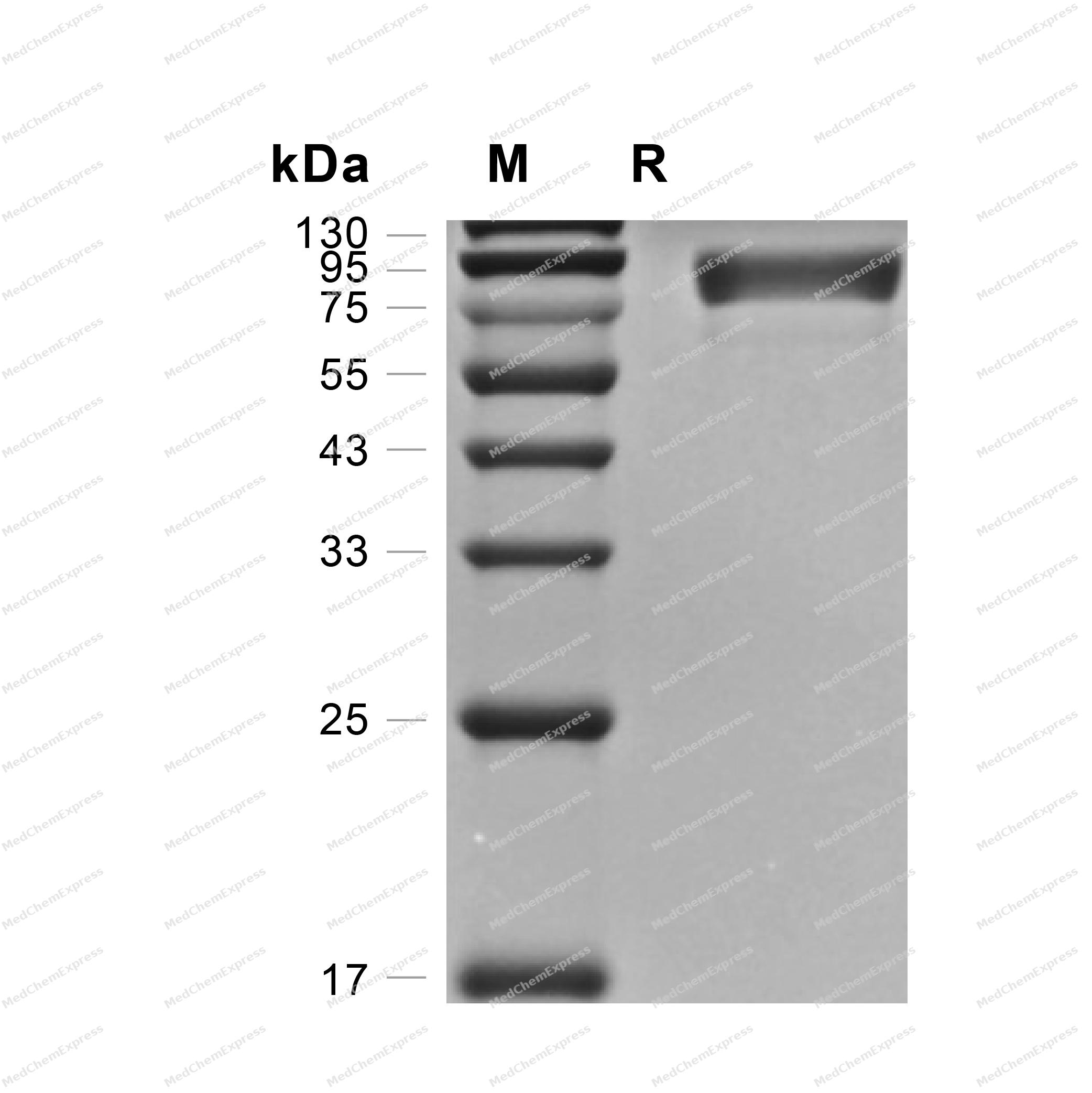
Purity - SDS-PAGE
-
Bioactivity - ELISA
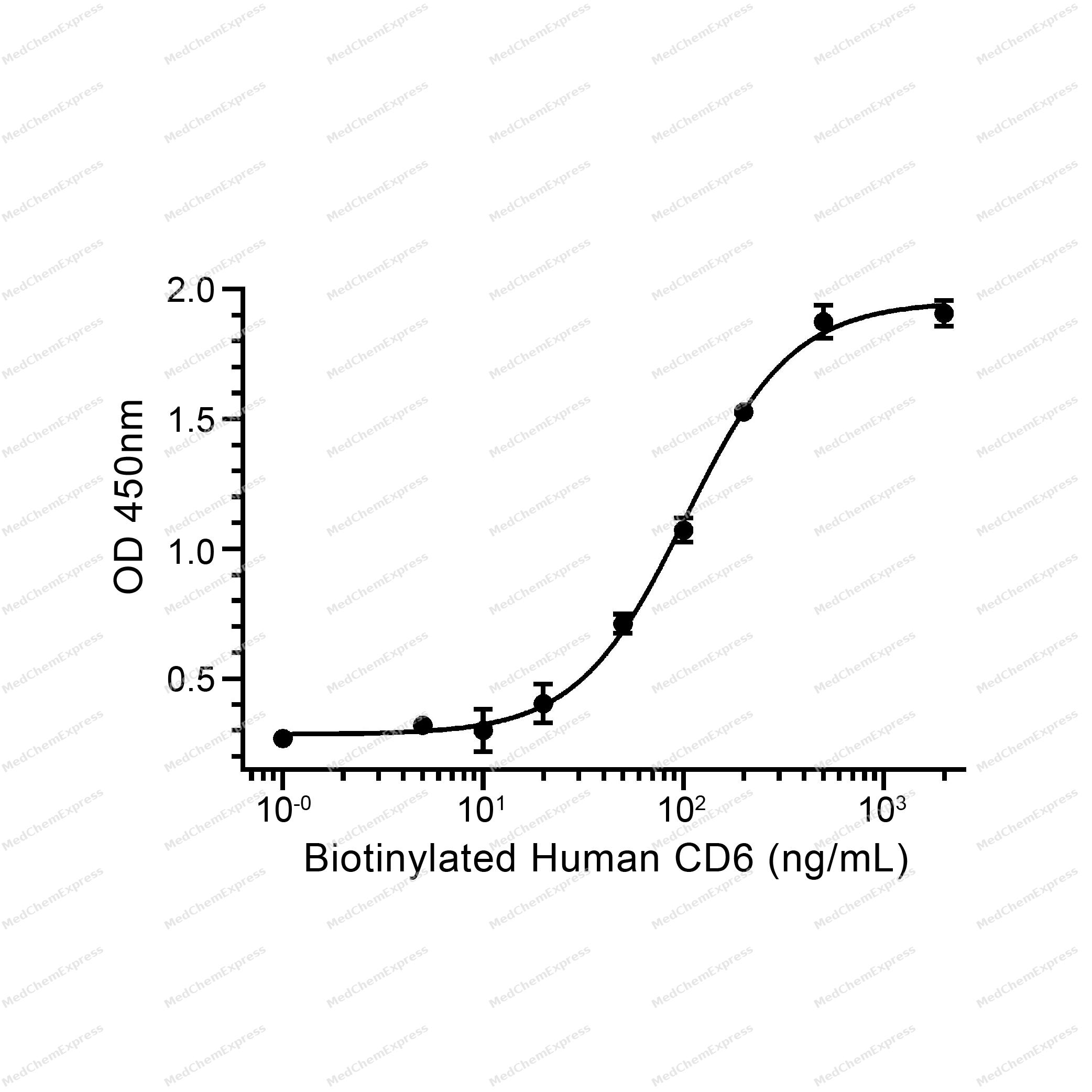
Bioactivity - ELISA


Technical Parameters
-
Species Cynomolgus
-
Source HEK293
-
Tag C-His
-
Accession
G7NZQ8 (W28-A526)
-
Gene ID/
-
Molecular Construction
-
N-term
-
ALCAM (W28-A526)
Accession # G7NZQ8 -
His
-
C-term
-
-
Protein Length
Partial
-
Synonyms
ALCAM; CD166 Antigen; Activated Leukocyte Cell Adhesion Molecule; CD166; MEMD; Activated Leucocyte Cell Adhesion Molecule
-
AA Sequence
WYTVNSAYGDTIIMPCRLDVPQNLMFGKWKYEKPDGSPVFIAFRSSTKKSVQYDDVPEYKDRLSLSENYTLSISNARISDEKRFVCMLVTEDNVFEAPTVVKVFKQPSKPEIVSKALFLETEQLKKLGDCISEDSYPDGNITWYRNGKVLHPLEGAVVIIFKKEMDPVTQLYTMTSTLEYKTTKADIQMPFTCSVTYYGPSGQKTVHSEQAVFDIYYPTEQVTIQVLPPKTAIKEGDNVTLKCLGNGNPPPEEFLFYLPGQPEGIRSSNTYTLTDVRRNATGDYKCSLIDKKSMIASTAITVHYLDLSLNPSGEVTRQIGDALPVSCTISASRNATVVWMKDNIRLRSSPSFSSLHYQDAGNYVCETALQEVEGLKKRESLTLIVEGKPQIKMTKKTDPSGLSKTIICHVEGFPKPAIQWTITGSGSVINQTEESPYINGRYYSKIIISPEENVTLTCTAENQLERTVNSLNVSAISIPEHDEADEISDENREKVNDQA
-
Molecular Weight
Approximately 65-68 kDa, based on SDS-PAGE under reducing conditions.
-
Purity
≥ 95%, as determined by reducing SDS-PAGE.


Product Properties
Lyophilized powder.
Lyophilized from a 0.22 μm filtered solution of PBS, pH 7.4.
<1 EU/μg, determined by LAL method.
It is not recommended to reconstitute to a concentration less than 100 μg/mL in ddH2O. For long term storage it is recommended to add a carrier protein (0.1% BSA, 5% HSA, 10% FBS or 5% Trehalose).
Stored at -20°C for 2 years from date of receipt. After reconstitution, it is stable at 4°C for 1 week or -20°C for longer (with carrier protein). It is recommended to freeze aliquots at -20°C or -80°C for extended storage.
Room temperature in continental US; may vary elsewhere.


Documentation
-
Data Sheet (264 KB)
-
SDS (251 KB)
- English - EN (251 KB)
- Français - FR (251 KB)
- Deutsch - DE (251 KB)
- Norwegian - NO (251 KB)
- Español - ES (251 KB)
- Swedish - SV (251 KB)
- Italian - IT (251 KB)
- Korean - KR (251 KB)
- Portuguese - PT (251 KB)
-
Handling Instructions (2659 KB)


References

Calculators
Concentration (start) × Volume (start) = Concentration (final) × Volume (final)


 Powered by Bioz

