



alpha Actinin 4/ACTN4 Protein, Human (HEK293, C-His)

Based on 1 Customer Validation
Alpha-actinin 4 is a member of the spectrin gene superfamily and binds to actin in a variety of cell types. It localizes to microfilament bundles, adherens junctions, and Z-disks, promoting actin binding to membranes. alpha Actinin 4 (ACTN4) Protein,Human (HEK293,C-His) is the recombinant human-derived alpha Actinin 4, expressed by HEK293 , with C-10*His labeled tag.
- Species: Human
- Source: HEK293
-
Storage:Stored at -20°C for 2 years from date of receipt. After reconstitution, it is stable at 4°C for 1 week or -20°C for longer (with carrier protein). It is recommended to freeze aliquots at -20°C or -80°C for extended storage.


To place orders, for customer services and technical support, please contact: MedChemExpress USA
Tel: 609-228-6898 E-mail: [email protected] [email protected]


-
 Biological Activity
-
Technical Parameters
-
Product Properties
- Documentation
- Help & FAQs




Biological Activity
Description
Alpha-actinin 4 is a member of the spectrin gene superfamily and binds to actin in a variety of cell types. It localizes to microfilament bundles, adherens junctions, and Z-disks, promoting actin binding to membranes. alpha Actinin 4 (ACTN4) Protein,Human (HEK293,C-His) is the recombinant human-derived alpha Actinin 4, expressed by HEK293 , with C-10*His labeled tag.
Background
Alpha Actinin 4, a member of the spectrin gene superfamily, plays a multifaceted role as an actin-binding protein in various cell types. The nonmuscle isoform is distributed along microfilament bundles and adherens-type junctions, facilitating actin-membrane binding in nonmuscle cells. Conversely, skeletal, cardiac, and smooth muscle isoforms are localized to the Z-disc and analogous dense bodies, anchoring myofibrillar actin filaments. In the cytoplasm, this gene encodes a nonmuscle alpha actinin isoform, believed to be involved in metastatic processes. Notably, mutations in this gene have been linked to focal and segmental glomerulosclerosis, highlighting its significance in both cellular architecture and disease pathology. With ubiquitous expression observed in tissues such as placenta (RPKM 105.3), kidney (RPKM 104.8), and 25 other tissues, Alpha Actinin 4 emerges as a critical player in cellular dynamics and disease-associated mechanisms.
MCE Validation Data
-
Purity - SDS-PAGE
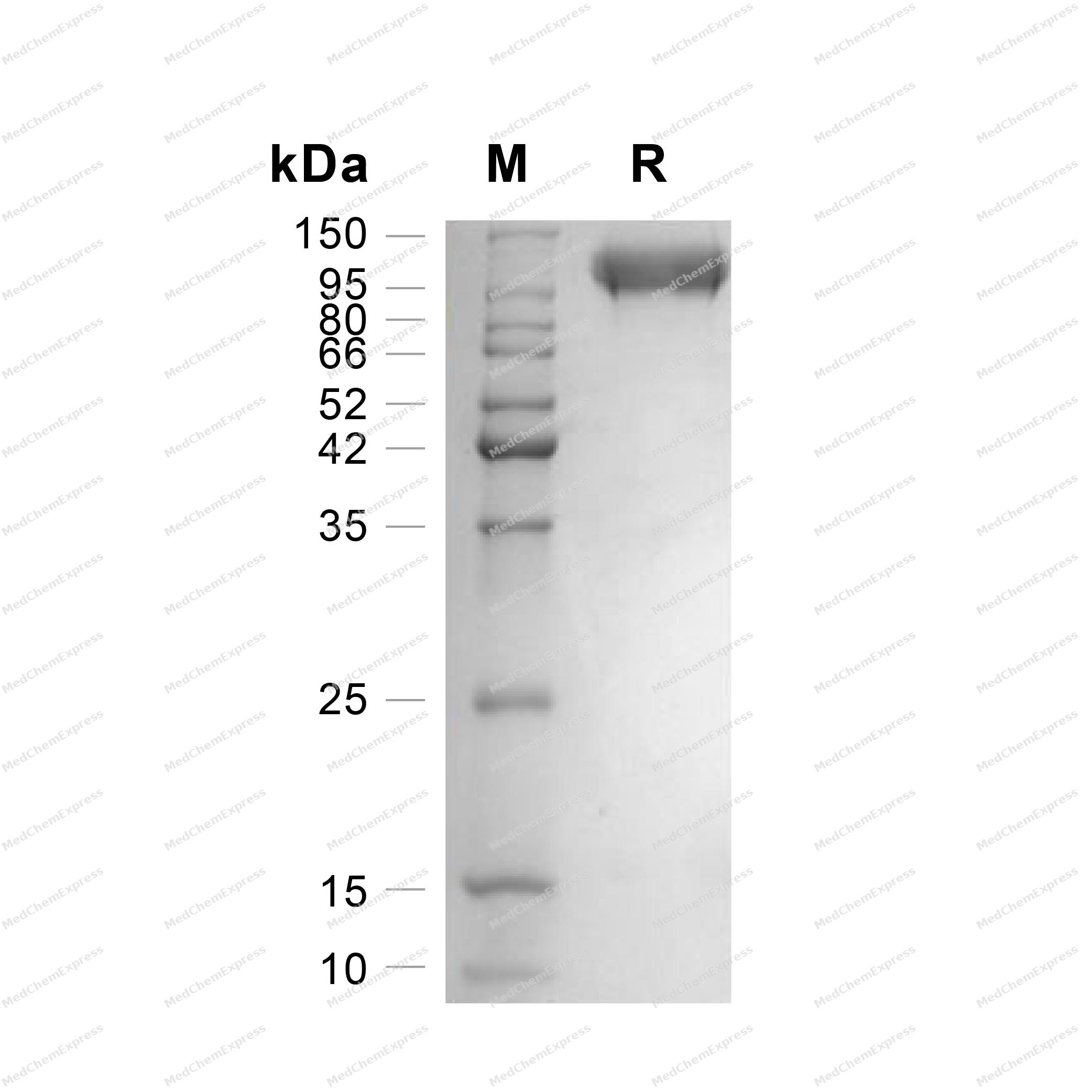
Purity - SDS-PAGE


Technical Parameters
-
Species Human
-
Source HEK293
-
Tag C-10*His
-
Accession
NP_004915 (M1-L911)
-
Gene ID81
-
Molecular Construction
-
N-term
-
ACTN4 (M1-L911)
Accession # NP_004915 -
10*His
-
C-term
-
-
Protein Length
Full Length
-
Synonyms
ACTN4; Actinin Alpha 4 Isoform 3; Prev. FSGS1; Actinin Alpha 4 Isoform 2; Focal Segmental Glomerulosclerosis 1; Actinin Alpha 4 Isoform 1; Non-Muscle Alpha-Actinin 4; ACTN4 Protein; Alpha-Actinin-4; ACTININ-4; Actinin, Alpha 4, Isoform CRA_a; FSGS; Actini
-
AA Sequence
MVDYHAANQSYQYGPSSAGNGAGGGGSMGDYMAQEDDWDRDLLLDPAWEKQQRKTFTAWCNSHLRKAGTQIENIDEDFRDGLKLMLLLEVISGERLPKPERGKMRVHKINNVNKALDFIASKGVKLVSIGAEEIVDGNAKMTLGMIWTIILRFAIQDISVEETSAKEGLLLWCQRKTAPYKNVNVQNFHISWKDGLAFNALIHRHRPELIEYDKLRKDDPVTNLNNAFEVAEKYLDIPKMLDAEDIVNTARPDEKAIMTYVSSFYHAFSGAQKAETAANRICKVLAVNQENEHLMEDYEKLASDLLEWIRRTIPWLEDRVPQKTIQEMQQKLEDFRDYRRVHKPPKVQEKCQLEINFNTLQTKLRLSNRPAFMPSEGKMVSDINNGWQHLEQAEKGYEEWLLNEIRRLERLDHLAEKFRQKASIHEAWTDGKEAMLKHRDYETATLSDIKALIRKHEAFESDLAAHQDRVEQIAAIAQELNELDYYDSHNVNTRCQKICDQWDALGSLTHSRREALEKTEKQLEAIDQLHLEYAKRAAPFNNWMESAMEDLQDMFIVHTIEEIEGLISAHDQFKSTLPDADREREAILAIHKEAQRIAESNHIKLSGSNPYTTVTPQIINSKWEKVQQLVPKRDHALLEEQSKQQSNEHLRRQFASQANVVGPWIQTKMEEIGRISIEMNGTLEDQLSHLKQYERSIVDYKPNLDLLEQQHQLIQEALIFDNKHTNYTMEHIRVGWEQLLTTIARTINEVENQILTRDAKGISQEQMQEFRASFNHFDKDHGGALGPEEFKACLISLGYDVENDRQGEAEFNRIMSLVDPNHSGLVTFQAFIDFMSRETTDTDTADQVIASFKVLAGDKNFITAEELRRELPPDQAEYCIARMAPYQGPDAVPGALDYKSFSTALYGESDL
-
Predicted Molecular Mass
106.2 kDa
-
Molecular Weight
Approximately 106-120 kDa, based on SDS-PAGE under reducing conditions.
-
Purity
≥ 95%, as determined by reducing SDS-PAGE.


Product Properties
Lyophilized powder.
Lyophilized from a 0.22 μm filtered solution of 20 mM PB, 150 mM NaCl, pH 7.4.
<1 EU/μg, determined by LAL method.
It is not recommended to reconstitute to a concentration less than 100 μg/mL in ddH2O. For long term storage it is recommended to add a carrier protein (0.1% BSA, 5% HSA, 10% FBS or 5% Trehalose).
Stored at -20°C for 2 years from date of receipt. After reconstitution, it is stable at 4°C for 1 week or -20°C for longer (with carrier protein). It is recommended to freeze aliquots at -20°C or -80°C for extended storage.
Room temperature in continental US; may vary elsewhere.


Documentation
-
Data Sheet (241 KB)
-
SDS (251 KB)
- English - EN (251 KB)
- Français - FR (251 KB)
- Deutsch - DE (251 KB)
- Norwegian - NO (251 KB)
- Español - ES (251 KB)
- Swedish - SV (251 KB)
- Italian - IT (251 KB)
- Korean - KR (251 KB)
- Portuguese - PT (251 KB)
-
Handling Instructions (2659 KB)

Calculators
Concentration (start) × Volume (start) = Concentration (final) × Volume (final)


 Powered by Bioz

