



AQP4 Protein, Human (His)

Based on 1 Customer Validation
The AQP4 protein forms water-specific channels and is involved in brain water balance and solute transport. AQP4 Protein, Human (His) is the recombinant human-derived AQP4, expressed by E. coli, with N-6*His labeled tag. The total length of AQP4 Protein, Human (His) is 71 a.a..
- Species: Human
- Source: E. coli
-
Storage:Stored at -20°C for 2 years from date of receipt. After reconstitution, it is stable at 4°C for 1 week or -20°C for longer (with carrier protein). It is recommended to freeze aliquots at -20°C or -80°C for extended storage.


To place orders, for customer services and technical support, please contact: MedChemExpress USA
Tel: 609-228-6898 E-mail: [email protected] [email protected]


-
 Biological Activity
-
Technical Parameters
-
Product Properties
- Documentation
- Help & FAQs




Biological Activity
Description
The AQP4 protein forms water-specific channels and is involved in brain water balance and solute transport. AQP4 Protein, Human (His) is the recombinant human-derived AQP4, expressed by E. coli, with N-6*His labeled tag. The total length of AQP4 Protein, Human (His) is 71 a.a..
Background
AQP4, a water-specific channel, is instrumental in maintaining brain water homeostasis and facilitating glymphatic solute transport. It plays a crucial role in regulating the exchange of water across the blood-brain interface, influencing cerebrospinal fluid influx into the brain cortex and parenchyma through paravascular spaces surrounding penetrating arteries. Additionally, AQP4 is essential for the proper drainage of interstitial fluid along paravenous pathways, contributing to the normal clearance of solutes, including soluble beta-amyloid peptides derived from APP, from the brain interstitial fluid. While redundant in urinary water homeostasis and concentrating ability, AQP4 forms homotetramers, with the tetramers capable of organizing into oligomeric arrays of varying sizes in membranes. This oligomerization can facilitate cell-cell adhesion through interactions between AQP4 arrays in adjacent cells. AQP4 is also part of a complex involving MLC1, TRPV4, HEPACAM, and ATP1B1, highlighting its role within a larger molecular network.
MCE Validation Data
-
Purity - SDS-PAGE
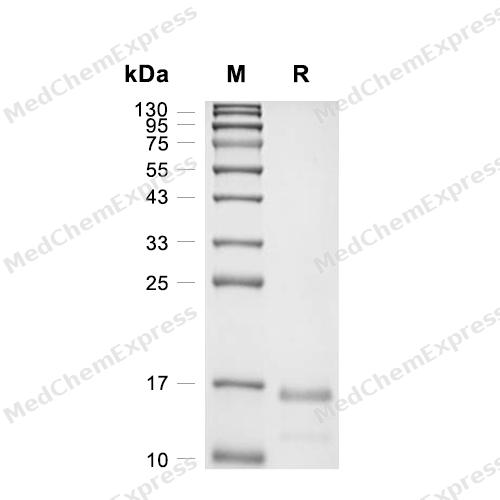
Purity - SDS-PAGE


Technical Parameters
-
Species Human
-
Source E. coli
-
Tag N-6*His
-
Accession
P55087-1 (C253-V323)
-
Gene ID361
-
Protein Length
Cytoplasmic Domain
-
Synonyms
AQP4; HAQP4; Aquaporin 4; WCH4; MIWC; Aquaporin Type4 Transcript Variant C; Mercurial-Insensitive Water Channel; Alternative Protein AQP4; Aquaporin-4; Aquaporin Type4; AQP-4; MLC4
-
AA Sequence
CPDVEFKRRFKEAFSKAAQQTKGSYMEVEDNRSQVETDDLILKPGVVHVIDVDRGEEKKGKDQSGEVLSSV
-
Predicted Molecular Mass
8 kDa
-
Molecular Weight
Approximately 16 kDa, based on SDS-PAGE under reducing conditions.
-
Purity
≥ 90%, as determined by reducing SDS-PAGE.


Product Properties
Lyophilized powder.
Lyophilized from a 0.22 μm filtered solution of 0.1% TFA, 20% Acetonitrile, pH 4.15.
<1 EU/μg, determined by LAL method.
It is not recommended to reconstitute to a concentration less than 100 μg/mL in ddH2O. For long term storage it is recommended to add a carrier protein (0.1% BSA, 5% HSA, 10% FBS or 5% Trehalose).
Stored at -20°C for 2 years from date of receipt. After reconstitution, it is stable at 4°C for 1 week or -20°C for longer (with carrier protein). It is recommended to freeze aliquots at -20°C or -80°C for extended storage.
Room temperature in continental US; may vary elsewhere.


Documentation
-
Data Sheet (235 KB)
-
SDS (252 KB)
- English - EN (252 KB)
- Français - FR (252 KB)
- Deutsch - DE (252 KB)
- Norwegian - NO (252 KB)
- Español - ES (252 KB)
- Swedish - SV (252 KB)
- Italian - IT (252 KB)
- Korean - KR (252 KB)
- Portuguese - PT (252 KB)
-
Handling Instructions (2659 KB)

Calculators
Concentration (start) × Volume (start) = Concentration (final) × Volume (final)


 Powered by Bioz

