



ATP1B1 Protein, Human (HEK293, His)

Based on 1 Customer Validation
The ATP1B1 protein is the non-catalytic component of ATP hydrolase and promotes Na(+)/K(+) ion exchange across the plasma membrane. Its regulatory role involves the assembly of α/β heterodimers to control sodium pump levels. ATP1B1 Protein, Human (HEK293, His) is the recombinant human-derived ATP1B1 protein, expressed by HEK293 , with N-His labeled tag.
- Species: Human
- Source: HEK293
-
Storage:Stored at -20°C for 2 years from date of receipt. After reconstitution, it is stable at 4°C for 1 week or -20°C for longer (with carrier protein). It is recommended to freeze aliquots at -20°C or -80°C for extended storage.


To place orders, for customer services and technical support, please contact: MedChemExpress USA
Tel: 609-228-6898 E-mail: [email protected] [email protected]


-
 Biological Activity
-
Technical Parameters
-
Product Properties
- Documentation
- Help & FAQs




Biological Activity
Description
The ATP1B1 protein is the non-catalytic component of ATP hydrolase and promotes Na(+)/K(+) ion exchange across the plasma membrane. Its regulatory role involves the assembly of α/β heterodimers to control sodium pump levels. ATP1B1 Protein, Human (HEK293, His) is the recombinant human-derived ATP1B1 protein, expressed by HEK293 , with N-His labeled tag.
Background
The ATP1B1 protein serves as the non-catalytic component of the active enzyme that catalyzes the hydrolysis of ATP, facilitating the exchange of Na(+) and K(+) ions across the plasma membrane. Its regulatory role is manifested through the assembly of alpha/beta heterodimers, controlling the number of sodium pumps transported to the plasma membrane. Beyond its involvement in ion transport, ATP1B1 plays a vital role in innate immunity by amplifying virus-triggered induction of interferons (IFNs) and interferon-stimulated genes (ISGs). This immune-modulatory function involves the enhancement of TRAF3 and TRAF6 ubiquitination, as well as TAK1 and TBK1 phosphorylation. Additionally, ATP1B1 is implicated in cell adhesion and the establishment of epithelial cell polarity, underscoring its multifaceted contributions to cellular processes beyond ion homeostasis.
Verified Bioactivity
The enzyme activity of this recombinant protein is testing in progress, we cannot offer a guarantee yet.
MCE Validation Data
-
Purity - SDS-PAGE
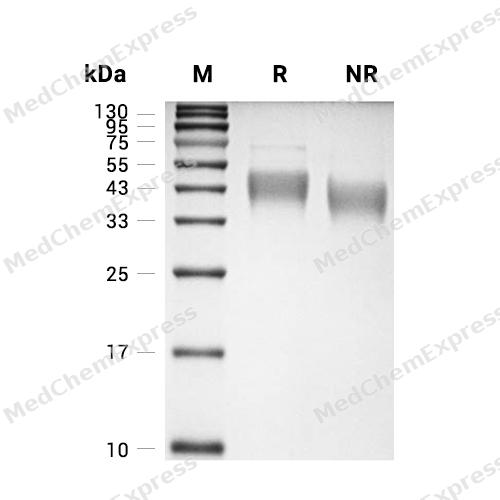
Purity - SDS-PAGE


Technical Parameters
-
Species Human
-
Source HEK293
-
Tag N-6*His
-
Accession
P05026-1 (E63-S303)
-
Molecular Construction
-
N-term
-
His
-
ATP1B1 (E63-S303)
Accession # P05026 -
C-term
-
-
Protein Length
Extracellular Domain
-
Synonyms
ATP1B1; Sodium/Potassium-Transporting ATPase Beta-1 Chain; Prev. ATP1B; Sodium/Potassium-Dependent ATPase Beta-1 Subunit; Sodium/Potassium-Transporting ATPase Subunit Beta-1; Beta 1-Subunit Of Na(+),K(+)-ATPase; Sodium-Potassium ATPase Subunit Beta 1 (Non
-
AA Sequence
EFKPTYQDRVAPPGLTQIPQIQKTEISFRPNDPKSYEAYVLNIVRFLEKYKDSAQRDDMIFEDCGDVPSEPKERGDFNHERGERKVCRFKLEWLGNCSGLNDETYGYKEGKPCIIIKLNRVLGFKPKPPKNESLETYPVMKYNPNVLPVQCTGKRDEDKDKVGNVEYFGLGNSPGFPLQYYPYYGKLLQPKYLQPLLAVQFTNLTMDTEIRIECKAYGENIGYSEKDRFQGRFDVKIEVKS
-
Molecular Weight
Approximately 40-47 kDa, based on SDS-PAGE under reducing conditions, due to the glycosylation.
-
Glycosylation
Yes
-
Purity
≥ 95%, as determined by reducing SDS-PAGE.


Product Properties
Lyophilized powder.
Lyophilized from a 0.22 μm filtered solution of PBS, pH 7.4.
<1 EU/μg, determined by LAL method.
It is not recommended to reconstitute to a concentration less than 100 μg/mL in ddH2O. For long term storage it is recommended to add a carrier protein (0.1% BSA, 5% HSA, 10% FBS or 5% Trehalose).
Stored at -20°C for 2 years from date of receipt. After reconstitution, it is stable at 4°C for 1 week or -20°C for longer (with carrier protein). It is recommended to freeze aliquots at -20°C or -80°C for extended storage.
Room temperature in continental US; may vary elsewhere.


Documentation
-
Data Sheet (237 KB)
-
SDS (251 KB)
- English - EN (251 KB)
- Français - FR (251 KB)
- Deutsch - DE (251 KB)
- Norwegian - NO (251 KB)
- Español - ES (251 KB)
- Swedish - SV (251 KB)
- Italian - IT (251 KB)
- Korean - KR (251 KB)
- Portuguese - PT (251 KB)
-
Handling Instructions (2659 KB)

Calculators
Concentration (start) × Volume (start) = Concentration (final) × Volume (final)


 Powered by Bioz

