



Beta-galactosidase/GLB1 Protein, Human (HEK293, His)
Based on 1 publication(s) in Google Scholar
The beta-galactosidase/GLB1 protein cleaves beta-linked terminal galactose residues in gangliosides and glycoproteins, contributing to elastogenesis and connective tissue development. Beta-galactosidase/GLB1 Protein, Human (HEK293, His) is the recombinant human-derived Beta-galactosidase/GLB1 protein, expressed by HEK293 , with C-6*His labeled tag.
- Species: Human
- Source: HEK293
-
Storage:Stored at -80°C for 1 year from date of receipt. It is stable at -20°C for 3 months after opening. It is recommended to freeze aliquots at -80°C for extended storage. Avoid repeated freeze-thaw cycles.


To place orders, for customer services and technical support, please contact: MedChemExpress USA
Tel: 609-228-6898 E-mail: [email protected] [email protected]


-
 Biological Activity
-
Technical Parameters
-
Product Properties
- Documentation
- Help & FAQs




Biological Activity
Description
The beta-galactosidase/GLB1 protein cleaves beta-linked terminal galactose residues in gangliosides and glycoproteins, contributing to elastogenesis and connective tissue development. Beta-galactosidase/GLB1 Protein, Human (HEK293, His) is the recombinant human-derived Beta-galactosidase/GLB1 protein, expressed by HEK293 , with C-6*His labeled tag.
Background
The Beta-galactosidase (GLB1) protein functions as an enzyme that cleaves beta-linked terminal galactosyl residues from various substrates, including gangliosides, glycoproteins, and glycosaminoglycans. Despite lacking direct beta-galactosidase catalytic activity, GLB1 plays essential functional roles in elastogenesis, contributing to the formation of extracellular elastic fibers and the development of connective tissue. Intriguingly, GLB1 is identified as the elastin-binding protein (EBP), a crucial component of the non-integrin cell surface receptor found on fibroblasts, smooth muscle cells, chondroblasts, leukocytes, and certain cancer cell types. In elastin-producing cells, GLB1 associates with tropoelastin intracellularly, serving as a recycling molecular chaperone that facilitates the secretion of tropoelastin and supports its assembly into elastic fibers. This multifaceted functionality positions GLB1 as a key player in both enzymatic processes and structural roles related to tissue development and maintenance.
Verified Bioactivity
Measured by its ability to cleave a fluorogenic substrate, 4-Methylumbelliferyl-beta-D-galactopyranoside. The specific activity is 1151.98 pmol/min/μg, as measured under the described conditions.
MCE Validation Data
-
Purity - SDS-PAGE
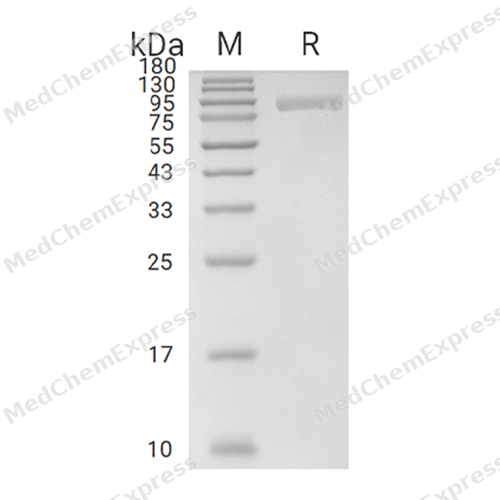
Purity - SDS-PAGE


Publications (1)
-
Journal Impact Factor
-
Most Recent
-
Phytother Res
Celastrol Targets Hsc70-Bim Interaction as a Novel Senolytic to Extend Lifespan and Mitigate Organ Fibrosis. [Abstract]2026 Mar;40(3):1472-1494. PMID: 41582000


Technical Parameters
-
Species Human
-
Source HEK293
-
Tag C-6*His
-
Accession
P16278-1 (L24-V677)
-
Molecular Construction
-
N-term
-
Beta-gal (L24-V677)
Accession # P16278-1 -
6*His
-
C-term
-
-
Protein Length
Full Length of Isoform-1
-
Synonyms
GLB1; Beta-Galactosidase; Prev. ELNR1; Elastin Receptor 1 (67kD); EBP; Galactosidase, Beta 1; Elastin Receptor 1, 67kDa; Elastin Receptor 1; Elastin Binding Protein; MPS4B; Acid Beta-Galactosidase; Galactosidase Beta 1; Lactase
-
AA Sequence
LRNATQRMFEIDYSRDSFLKDGQPFRYISGSIHYSRVPRFYWKDRLLKMKMAGLNAIQTYVPWNFHEPWPGQYQFSEDHDVEYFLRLAHELGLLVILRPGPYICAEWEMGGLPAWLLEKESILLRSSDPDYLAAVDKWLGVLLPKMKPLLYQNGGPVITVQVENEYGSYFACDFDYLRFLQKRFRHHLGDDVVLFTTDGAHKTFLKCGALQGLYTTVDFGTGSNITDAFLSQRKCEPKGPLINSEFYTGWLDHWGQPHSTIKTEAVASSLYDILARGASVNLYMFIGGTNFAYWNGANSPYAAQPTSYDYDAPLSEAGDLTEKYFALRNIIQKFEKVPEGPIPPSTPKFAYGKVTLEKLKTVGAALDILCPSGPIKSLYPLTFIQVKQHYGFVLYRTTLPQDCSNPAPLSSPLNGVHDRAYVAVDGIPQGVLERNNVITLNITGKAGATLDLLVENMGRVNYGAYINDFKGLVSNLTLSSNILTDWTIFPLDTEDAVRSHLGGWGHRDSGHHDEAWAHNSSNYTLPAFYMGNFSIPSGIPDLPQDTFIQFPGWTKGQVWINGFNLGRYWPARGPQLTLFVPQHILMTSAPNTITVLELEWAPCSSDDPELCAVTFVDRPVIGSSVTYDHPSKPVEKRLMPPPPQKNKDSWLDHV
-
Molecular Weight
Approximately 80-95 kDa, based on SDS-PAGE under reducing conditions, due to the glycosylation.
-
Glycosylation
Yes
-
Purity
≥ 95%, as determined by reducing SDS-PAGE.


Product Properties
Solution
Supplied as a 0.22 μm filtered solution of 20 mM Tris-HCl, 150 mM NaCl, pH 8.0.
Note: For SPR assay, please replace the buffer. Primary amine components (e.g., Tris, imidazole) can affect protein-coupled chips.
<1 EU/μg, determined by LAL method.
Stored at -80°C for 1 year from date of receipt. It is stable at -20°C for 3 months after opening. It is recommended to freeze aliquots at -80°C for extended storage. Avoid repeated freeze-thaw cycles.
Shipping with dry ice.


Documentation
-
Data Sheet (239 KB)
-
SDS (252 KB)
- English - EN (252 KB)
- Français - FR (252 KB)
- Deutsch - DE (252 KB)
- Norwegian - NO (252 KB)
- Español - ES (252 KB)
- Swedish - SV (252 KB)
- Italian - IT (252 KB)
- Korean - KR (252 KB)
- Portuguese - PT (252 KB)
-
Handling Instructions (2659 KB)

Calculators
Concentration (start) × Volume (start) = Concentration (final) × Volume (final)


 Powered by Bioz

