



Alpha 1-Microglobulin Protein, Rat (HEK293, His)

Based on 1 Customer Validation
Alpha 1-microglobulin (called bikunin) plays multiple roles: maintaining extracellular matrix and cell membrane structure, acting as an antioxidant at the blood-placenta interface, maintaining mitochondrial redox homeostasis, and protecting renal tubular cells from heme induction of oxidative damage.It acts as a serine protease inhibitor and contributes to extracellular space remodeling, cell adhesion and cumulus expansion during ovulation.Alpha 1-Microglobulin Protein, Rat (HEK293, His) is the recombinant rat-derived Alpha 1-Microglobulin protein, expressed by HEK293 , with C-His labeled tag.
- Species: Rat
- Source: HEK293
-
Storage:Stored at -20°C for 2 years from date of receipt. After reconstitution, it is stable at 4°C for 1 week or -20°C for longer (with carrier protein). It is recommended to freeze aliquots at -20°C or -80°C for extended storage.


To place orders, for customer services and technical support, please contact: MedChemExpress USA
Tel: 609-228-6898 E-mail: [email protected] [email protected]


-
 Biological Activity
-
Technical Parameters
-
Product Properties
- Documentation
- Help & FAQs




Biological Activity
Description
Alpha 1-microglobulin (called bikunin) plays multiple roles: maintaining extracellular matrix and cell membrane structure, acting as an antioxidant at the blood-placenta interface, maintaining mitochondrial redox homeostasis, and protecting renal tubular cells from heme induction of oxidative damage.It acts as a serine protease inhibitor and contributes to extracellular space remodeling, cell adhesion and cumulus expansion during ovulation.Alpha 1-Microglobulin Protein, Rat (HEK293, His) is the recombinant rat-derived Alpha 1-Microglobulin protein, expressed by HEK293 , with C-His labeled tag.
Background
Bikunin is involved in maintaining the structure and function of the extracellular matrix and cell membranes. It acts as an antioxidant by reducing oxidized collagen fibers and preventing oxidative damage at the blood-placenta interface. It also helps maintain mitochondrial redox homeostasis by scavenging free radicals and preserving ATP synthesis. Bikunin protects renal tubule epithelial cells from heme-induced oxidative damage to mitochondria. It has a chaperone role in facilitating the correct folding of bikunin itself in the endoplasmic reticulum. Bikunin is a serine protease inhibitor and plays a role in extracellular space remodeling and cell adhesion. It inhibits various proteases involved in inflammation and cytotoxic responses. Bikunin is also involved in the transfer of heavy chains from the I-alpha-I complex to hyaluronan, allowing for the remodeling of extracellular matrix proteoglycan structures. Additionally, it plays a role in cumulus oophorus expansion during ovulation and inhibits calcium oxalate crystallization.
MCE Validation Data
-
Purity - SDS-PAGE
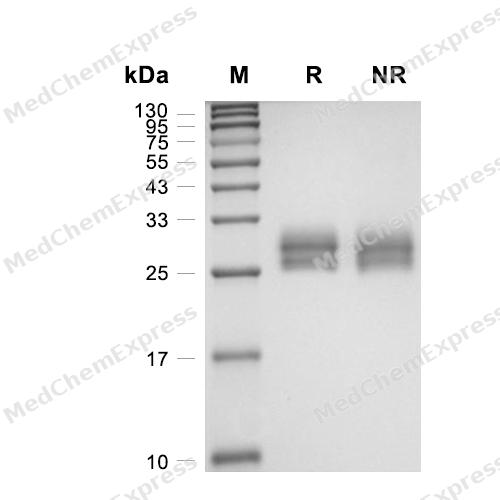
Purity - SDS-PAGE


Technical Parameters
-
Species Rat
-
Source HEK293
-
Tag C-6*His
-
Accession
Q64240 (D20-A202)
-
Molecular Construction
-
N-term
-
AMBP (M1-A202)
Accession # Q64240 -
His
-
C-term
-
-
Protein Length
Full Length of Alpha-1-microglobulin Chain
-
Synonyms
AMBP; HI30; Prev. ITIL; Complex-Forming Glycoprotein Heterogeneous In Charge; Prev. ITI; Inter-Alpha-Trypsin Inhibitor Light Chain; HCP; Growth-Inhibiting Protein 19; Protein AMBP; Uronic-Acid-Rich Protein; Protein HC; Trypstatin; IATIL; Uristatin; ITILC;
-
AA Sequence
DNVPTLPDIQVQENFNEARIYGKWFNLAVGSTCPWLRRIKNKMSVSTLVLQEGATEAEISVTSTQWRKGVCEEISGVYQKTDIDGKFLYHKSKWNATLESYVVHTNYDEYAIFLTKKFSHRHGPTITAKLYGREPQLRDSLLQEFREVALSVGIPENSIVFMADRGECVPGDREVESTSFARA
-
Molecular Weight
Approximately 25-30 kDa, based on SDS-PAGE under reducing conditions, due to the glycosylation.
-
Glycosylation
Yes
-
Purity
≥ 95%, as determined by reducing SDS-PAGE.


Product Properties
Lyophilized powder.
Lyophilized from a 0.2 μm filtered solution of PBS, pH 7.4.
<1 EU/μg, determined by LAL method.
It is not recommended to reconstitute to a concentration less than 100 μg/mL in ddH2O. For long term storage it is recommended to add a carrier protein (0.1% BSA, 5% HSA, 10% FBS or 5% Trehalose).
Stored at -20°C for 2 years from date of receipt. After reconstitution, it is stable at 4°C for 1 week or -20°C for longer (with carrier protein). It is recommended to freeze aliquots at -20°C or -80°C for extended storage.
Room temperature in continental US; may vary elsewhere.


Documentation
-
Data Sheet (236 KB)
-
SDS (251 KB)
- English - EN (251 KB)
- Français - FR (251 KB)
- Deutsch - DE (251 KB)
- Norwegian - NO (251 KB)
- Español - ES (251 KB)
- Swedish - SV (251 KB)
- Italian - IT (251 KB)
- Korean - KR (251 KB)
- Portuguese - PT (251 KB)
-
Handling Instructions (2659 KB)

Calculators
Concentration (start) × Volume (start) = Concentration (final) × Volume (final)


 Powered by Bioz

