



Carbonic Anhydrase 8 Protein, Mouse (His)

Based on 1 Customer Validation
Despite its name, the carbonic anhydrase VIII (CA8) protein lacks carbonic anhydrase catalytic activity. This distinguishes CA8 from its typical functions related to carbonic anhydrase, an enzyme known for its ability to catalyze the reversible hydration of carbon dioxide. Carbonic Anhydrase 8 Protein, Mouse (His) is the recombinant mouse-derived Carbonic Anhydrase VIII/CA8 protein, expressed by E. coli , with C-His labeled tag.
- Species: Mouse
- Source: E. coli
-
Storage:Stored at -20°C for 2 years from date of receipt. After reconstitution, it is stable at 4°C for 1 week or -20°C for longer (with carrier protein). It is recommended to freeze aliquots at -20°C or -80°C for extended storage.


To place orders, for customer services and technical support, please contact: MedChemExpress USA
Tel: 609-228-6898 E-mail: [email protected] [email protected]


-
 Biological Activity
-
Technical Parameters
-
Product Properties
- Documentation
- Help & FAQs




Biological Activity
Description
Despite its name, the carbonic anhydrase VIII (CA8) protein lacks carbonic anhydrase catalytic activity. This distinguishes CA8 from its typical functions related to carbonic anhydrase, an enzyme known for its ability to catalyze the reversible hydration of carbon dioxide. Carbonic Anhydrase 8 Protein, Mouse (His) is the recombinant mouse-derived Carbonic Anhydrase VIII/CA8 protein, expressed by E. coli , with C-His labeled tag.
Background
Carbonic Anhydrase VIII (CA8) protein, in accordance with available information, lacks carbonic anhydrase catalytic activity, distinguishing it from other members of the carbonic anhydrase enzyme family. Notably, CA8 is expressed exclusively in Purkinje cells, emphasizing its cell-specific distribution within the central nervous system. The absence of catalytic activity in CA8 suggests that its role may extend beyond the classical enzymatic functions associated with carbonic anhydrases. The unique expression pattern in Purkinje cells indicates a specialized role for CA8 in these neurons, warranting further investigation into its specific molecular and physiological functions within this distinct cellular context. Elucidating the role of CA8 in Purkinje cells may provide valuable insights into its contributions to neuronal processes and potential implications for neurological functions. (
Verified Bioactivity
Measured by its ability to hydrolyze 4-nitrophenyl acetate to 4-nitrophenol per minute. The specific activity is 792.065 pmol/min/ug.
MCE Validation Data
-
Purity - SDS-PAGE
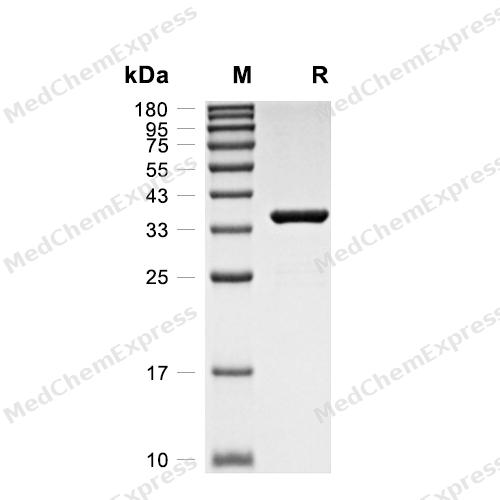
Purity - SDS-PAGE


Technical Parameters
-
Species Mouse
-
Source E. coli
-
Tag C-6*His
-
Accession
P28651 (M1-Q291)
-
Molecular Construction
-
N-term
-
CA8 (M1-Q291)
Accession # P28651 -
His
-
C-term
-
-
Protein Length
Full Length
-
Synonyms
CA8; Carbonic Anhydrase-Related Protein; Prev. CALS; Carbonic Anhydrase-Like Sequence; CA-VIII; Carbonate Dehydratase; CARP; CA-Related Protein; Carbonic Anhydrase VIII; CAMRQ3; CA-RP; SCAR34; Carbonic Anhydrase 8 (Inactive); Carbonic Anhydrase 8
-
AA Sequence
MADLSFIEDAVAFPEKEEDEEEEEEEGVEWGYEEGVEWGLVFPDANGEYQSPINLNSREARYDPSLLDVRLSPNYVVCRDCEVTNDGHTIQVILKSKSVLSGGPLPQGQEFELYEVRFHWGRENQRGSEHTVNFKAFPMELHLIHWNSTLFGSIDEAVGKPHGIAIIALFVQIGKEHVGLKAVTEILQDIQYKGKSKTIPCFNPNTLLPDPLLRDYWVYEGSLTIPPCSEGVTWILFRYPLTISQMQIEEFRRLRTHVKGAELVEGCDGILGDNFRPTQPLSDRVIRAAFQ
-
Molecular Weight
Approximately 37 kDa, based on SDS-PAGE under reducing conditions.
-
Purity
≥ 95%, as determined by reducing SDS-PAGE.


Product Properties
Lyophilized powder.
Lyophilized from a 0.22 μm filtered solution of 50 mM Tris-HCl, 300 mM NaCl, pH 7.4.
Note: For SPR assay, please replace the buffer. Primary amine components (e.g., Tris, imidazole) can affect protein-coupled chips.
<1 EU/μg, determined by LAL method.
It is not recommended to reconstitute to a concentration less than 100 μg/mL in ddH2O. For long term storage it is recommended to add a carrier protein (0.1% BSA, 5% HSA, 10% FBS or 5% Trehalose).
Stored at -20°C for 2 years from date of receipt. After reconstitution, it is stable at 4°C for 1 week or -20°C for longer (with carrier protein). It is recommended to freeze aliquots at -20°C or -80°C for extended storage.
Room temperature in continental US; may vary elsewhere.


Documentation
-
Data Sheet (237 KB)
-
SDS (251 KB)
- English - EN (251 KB)
- Français - FR (251 KB)
- Deutsch - DE (251 KB)
- Norwegian - NO (251 KB)
- Español - ES (251 KB)
- Swedish - SV (251 KB)
- Italian - IT (251 KB)
- Korean - KR (251 KB)
- Portuguese - PT (251 KB)
-
Handling Instructions (2659 KB)

Calculators
Concentration (start) × Volume (start) = Concentration (final) × Volume (final)


 Powered by Bioz

