



Cathepsin C/DPPI Protein, Human (HEK293, C-His)

Based on 1 Customer Validation
Cathepsin C/DPPI Protein, a thiol protease, exhibits dipeptidylpeptidase activity with broad substrate specificity, excluding proline at the P1 position and arginine at the P2 position. Operating as both exopeptidase and endopeptidase, it displays catalytic versatility. Crucially, Cathepsin C/DPPI activates serine proteases like elastase, cathepsin G, and granzymes A and B. Cathepsin C/DPPI Protein, Human (HEK293, C-His) is the recombinant human-derived Cathepsin C/DPPI protein, expressed by HEK293, with C-10*His labeled tag.
- Species: Human
- Source: HEK293
-
Storage:Stored at -80°C for 1 year from date of receipt. It is stable at -20°C for 3 months after opening. It is recommended to freeze aliquots at -80°C for extended storage. Avoid repeated freeze-thaw cycles.


To place orders, for customer services and technical support, please contact: MedChemExpress USA
Tel: 609-228-6898 E-mail: [email protected] [email protected]


-
 Biological Activity
-
Technical Parameters
-
Product Properties
- Documentation
- Help & FAQs




Biological Activity
Description
Cathepsin C/DPPI Protein, a thiol protease, exhibits dipeptidylpeptidase activity with broad substrate specificity, excluding proline at the P1 position and arginine at the P2 position. Operating as both exopeptidase and endopeptidase, it displays catalytic versatility. Crucially, Cathepsin C/DPPI activates serine proteases like elastase, cathepsin G, and granzymes A and B. Cathepsin C/DPPI Protein, Human (HEK293, C-His) is the recombinant human-derived Cathepsin C/DPPI protein, expressed by HEK293, with C-10*His labeled tag.
Background
Cathepsin C/DPPI Protein functions as a thiol protease, displaying dipeptidylpeptidase activity with a broad substrate specificity encompassing both polar and hydrophobic amino acids. Notably, proline is restricted from the P1 position, and arginine cannot occupy the P2 position of the substrate. This enzyme operates as both an exopeptidase and an endopeptidase, showcasing versatility in its catalytic functions. Of significance, Cathepsin C/DPPI plays a crucial role in the activation of serine proteases, including elastase, cathepsin G, and granzymes A and B.
Verified Bioactivity
Measured by its ability to cleave the fluorogenic peptide substrate 10 μM Gly-Arg-AMC (HY-P4342) that incubate at room temperature in kinetic Mode for 5 minutes. The specific activity is > 200 pmol/min/µg. (Activation description: The proenzyme needs to be activated by Human Cathepsin L1 (HY-P7754A) for an activated form.)
MCE Validation Data
-
Purity - SDS-PAGE
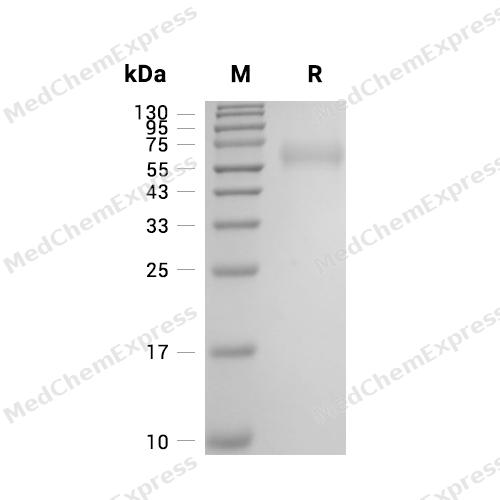
Purity - SDS-PAGE


Technical Parameters
-
Species Human
-
Source HEK293
-
Tag C-10*His
-
Accession
P53634-1/NP_001805.3 (D25-L463)
-
Gene ID1075
-
Molecular Construction
-
N-term
-
Cathepsin C/DPPI (D25-L463)
Accession # P53634-1/NP_001805.3 -
10*His
-
C-term
-
-
Protein Length
Full Length of Isoform-1
-
Synonyms
CTSC; Dipeptidyl Peptidase I; Prev. PALS; CPPI; Prev. PLS; DPPI; Dipeptidyl Peptidase 1; Dipeptidyl Peptidase 1 Isoform A Preproprotein; Dipeptidyl Transferase; PDON1; Cathepsin J; HMS; DPP1; JPD; Dipeptidyl-Peptidase I; JP; Cathepsin C; DPP-I
-
AA Sequence
DTPANCTYLDLLGTWVFQVGSSGSQRDVNCSVMGPQEKKVVVYLQKLDTAYDDLGNSGHFTIIYNQGFEIVLNDYKWFAFFKYKEEGSKVTTYCNETMTGWVHDVLGRNWACFTGKKVGTASENVYVNIAHLKNSQEKYSNRLYKYDHNFVKAINAIQKSWTATTYMEYETLTLGDMIRRSGGHSRKIPRPKPAPLTAEIQQKILHLPTSWDWRNVHGINFVSPVRNQASCGSCYSFASMGMLEARIRILTNNSQTPILSPQEVVSCSQYAQGCEGGFPYLIAGKYAQDFGLVEEACFPYTGTDSPCKMKEDCFRYYSSEYHYVGGFYGGCNEALMKLELVHHGPMAVAFEVYDDFLHYKKGIYHHTGLRDPFNPFELTNHAVLLVGYGTDSASGMDYWIVKNSWGTGWGENGYFRIRRGTDECAIESIAVAATPIPKL
-
Predicted Molecular Mass
51 kDa
-
Molecular Weight
Approximately 55-70 kDa, based on SDS-PAGE under reducing conditions, due to the glycosylation.
-
Glycosylation
Yes
-
Purity
≥ 95%, as determined by reducing SDS-PAGE.


Product Properties
Solution
Supplied as a 0.22 μm filtered solution in 20 mM MES, 150 mM NaCl, pH 5.5.
<1 EU/μg, determined by LAL method.
Stored at -80°C for 1 year from date of receipt. It is stable at -20°C for 3 months after opening. It is recommended to freeze aliquots at -80°C for extended storage. Avoid repeated freeze-thaw cycles.
Shipping with dry ice.


Documentation
-
Data Sheet (238 KB)
-
SDS (252 KB)
- English - EN (252 KB)
- Français - FR (252 KB)
- Deutsch - DE (252 KB)
- Norwegian - NO (252 KB)
- Español - ES (252 KB)
- Swedish - SV (252 KB)
- Italian - IT (252 KB)
- Korean - KR (252 KB)
- Portuguese - PT (252 KB)
-
Handling Instructions (2659 KB)

Calculators
Concentration (start) × Volume (start) = Concentration (final) × Volume (final)


 Powered by Bioz

