



CCL9/10/MIP-1 gamma Protein, Mouse
Based on 1 publication(s) in Google Scholar
CCL9 Protein, Mouse, is often produced in macrophages, osteoclasts, and functions as a cell survival factor.
- Species: Mouse
- Source: E. coli
-
Storage:Stored at -20°C for 2 years from date of receipt. After reconstitution, it is stable at 4°C for 1 week or -20°C for longer (with carrier protein). It is recommended to freeze aliquots at -20°C or -80°C for extended storage.


To place orders, for customer services and technical support, please contact: MedChemExpress USA
Tel: 609-228-6898 E-mail: [email protected] [email protected]


-
 Biological Activity
-
Technical Parameters
-
Product Properties
- Documentation
- References
- Help & FAQs




Biological Activity
Description
CCL9 Protein, Mouse, is often produced in macrophages, osteoclasts, and functions as a cell survival factor.
Background
CCL9, a chemokine also known as macrophage inflammatory protein-1 gamma (MIP-1γ), is often produced in macrophages, osteoclasts, and functions as a cell survival factor. Among CC chemokine family members, the mouse CCL9 shares 45, 24, and 20% aa sequence identity with mouse CCL6 (C10), CCL3 (MIP-1α), and CCL4 (MIP-1β), respectively. CCL9/CCR1 signaling is important for the recruitment of myeloid progenitors to intestinal tumors, leading to enhanced invasion. CCL9 is highly induced in immature myeloid cells in the premetastatic lung of tumor-bearing mice or in co-culture with tumor cells, and it plays a critical role in tumor cell survival at the metastatic site[1][2].
Verified Bioactivity
1.The biological activity determined by a chemotaxis bioassay using human neutrophils is in a concentration range of 0.1-10 ng/mL.
2.Measured by its ability to chemoattract THP-1 human acute monocytic leukemia cells. The ED50 for this effect is ≤0.34 μg/mL, corresponding to a specific activity is ≥2.94×10³ U/mg.
MCE Validation Data
-
Purity - SDS-PAGE
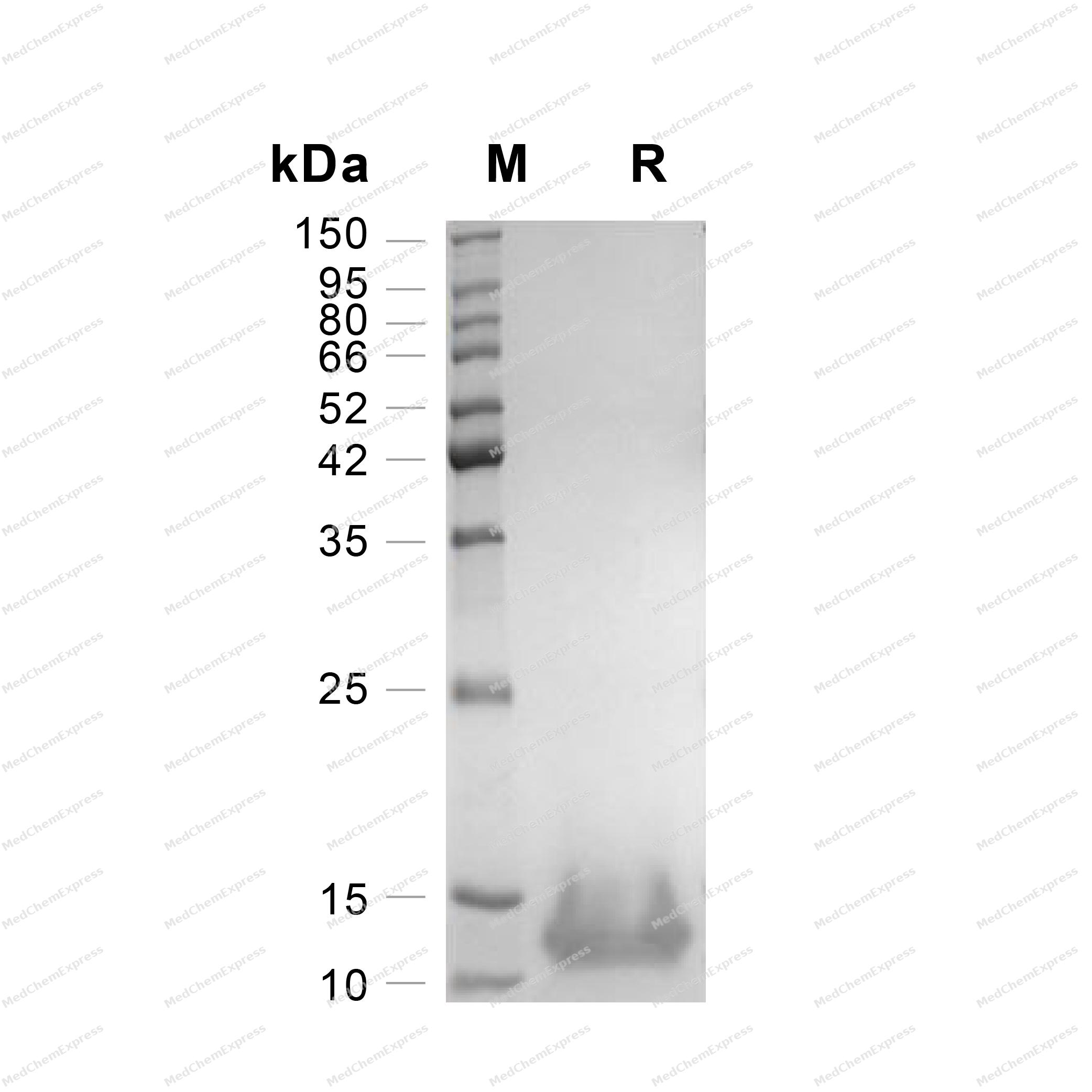
Purity - SDS-PAGE
-
Bioactivity - Cell-Based Assay
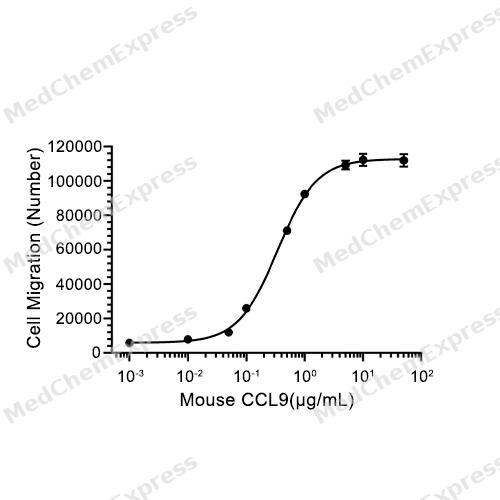
Bioactivity - Cell-Based Assay


Publications (1)
-
Journal Impact Factor
-
Most Recent
-
Biochem Pharmacol
Complement C3/C3a-CCL9 feedback loop orchestrates inflammatory crosstalk to accelerate aortic dissection. [Abstract]2025 Oct 13:117421. PMID: 41093012


Technical Parameters
-
Species Mouse
-
Source E. coli
-
Tag Tag Free
-
Accession
P51670 (Q22-Q122)
-
Molecular Construction
-
N-term
-
CCL9 (Q22-Q122)
Accession # P51670 -
C-term
-
-
Protein Length
Full Length of Mature Protein
-
Synonyms
Scya9; Scya10; Mrp2; Ccl9; Small-inducible cytokine A9; MRP-2; Macrophage inflammatory protein-related protein 2; MIP-1-gamma; Macrophage inflammatory protein 1-gamma; CCF18; C-C motif chemokine 9
-
AA Sequence
QITHATETKEVQSSLKAQQGLEIEMFHMGFQDSSDCCLSYNSRIQCSRFIGYFPTSGGCTRPGIIFISKRGFQVCANPSDRRVQRCIERLEQNSQPRTYKQ
-
Predicted Molecular Mass
11.6 kDa
-
Molecular Weight
Approximately 15 kDa, based on SDS-PAGE under reducing conditions.
-
Purity
≥ 95%, as determined by reducing SDS-PAGE.


Product Properties
Lyophilized powder.
1.Lyophilized from a 0.22 μm filtered solution of 20 mM His-HCl, 8% sucrose, 0.05% Tween 80, pH 5.5.
2.Lyophilized from a 0.22 μm filtered solution of 20 mM PB, 150 mM NaCl, pH 7.4.
3.Lyophilized from a 0.22 μm filtered solution of PBS, pH 7.4.
Please refer to the lot-specific COA for specific buffer information.
<1 EU/μg, determined by LAL method.
It is not recommended to reconstitute to a concentration less than 100 μg/mL in ddH2O. For long term storage it is recommended to add a carrier protein (0.1% BSA, 5% HSA, 10% FBS or 5% Trehalose).
Stored at -20°C for 2 years from date of receipt. After reconstitution, it is stable at 4°C for 1 week or -20°C for longer (with carrier protein). It is recommended to freeze aliquots at -20°C or -80°C for extended storage.
Room temperature in continental US; may vary elsewhere.


Documentation
-
Data Sheet (263 KB)
-
SDS (252 KB)
- English - EN (252 KB)
- Français - FR (252 KB)
- Deutsch - DE (252 KB)
- Norwegian - NO (252 KB)
- Español - ES (252 KB)
- Swedish - SV (252 KB)
- Italian - IT (252 KB)
- Korean - KR (252 KB)
- Portuguese - PT (252 KB)
-
Handling Instructions (2659 KB)


References
[1]. Hangyi H Yan, et al. CCL9 Induced by TGFβ Signaling in Myeloid Cells Enhances Tumor Cell Survival in the Premetastatic Organ. Cancer Res. 2015 Dec 15;75(24):5283-98. [Content Brief]
[2]. Xinyan Zhao, et al. CCL9 is secreted by the follicle-associated epithelium and recruits dome region Peyer's patch CD11b+ dendritic cells. J Immunol. 2003 Sep 15;171(6):2797-803. [Content Brief]
[3]. Baohua Li, et al. CCL9/CCR1 induces myeloid?derived suppressor cell recruitment to the spleen in a murine H22 orthotopic hepatoma model. Oncol Rep. 2019 Jan;41(1):608-618. [Content Brief]

Calculators
Concentration (start) × Volume (start) = Concentration (final) × Volume (final)


 Powered by Bioz

