



CD157 Protein, Rat (HEK293, His)

Based on 1 Customer Validation
CD157 protein catalyzes the synthesis of cADPR from NAD(+) and hydrolyzes cADPR to ADPR. cADPR acts as a second messenger, releasing calcium from intracellular stores. CD157 protein may also contribute to pre-B cell growth. CD157 Protein, Rat (HEK293, His) is the recombinant rat-derived CD157 protein, expressed by HEK293 , with C-His labeled tag.
- Species: Rat
- Source: HEK293
-
Storage:Stored at -20°C for 2 years from date of receipt. After reconstitution, it is stable at 4°C for 1 week or -20°C for longer (with carrier protein). It is recommended to freeze aliquots at -20°C or -80°C for extended storage.


To place orders, for customer services and technical support, please contact: MedChemExpress USA
Tel: 609-228-6898 E-mail: [email protected] [email protected]


-
 Biological Activity
-
Technical Parameters
-
Product Properties
- Documentation
- Help & FAQs




Biological Activity
Description
CD157 protein catalyzes the synthesis of cADPR from NAD(+) and hydrolyzes cADPR to ADPR. cADPR acts as a second messenger, releasing calcium from intracellular stores. CD157 protein may also contribute to pre-B cell growth. CD157 Protein, Rat (HEK293, His) is the recombinant rat-derived CD157 protein, expressed by HEK293 , with C-His labeled tag.
Background
CD157 protein acts as an enzyme that catalyzes the synthesis of cyclic ADP-beta-D-ribose (cADPR) from NAD(+) and also hydrolyzes cADPR to ADP-D-ribose (ADPR). Cyclic ADPR functions as a natural second messenger, triggering the release of calcium from intracellular stores and thereby controlling the mobilization of intracellular calcium. Additionally, CD157 protein may play a role in the growth of pre-B cells.
Verified Bioactivity
Measured by its binding ability in a functional ELISA. When Fibronectin is immobilized at 10 µg/mL (100 µL/well) can bind Biotinylated Rat CD157 Protein. The ED50 for this effect is 4.274 μg/mL.
MCE Validation Data
-
Purity - SDS-PAGE
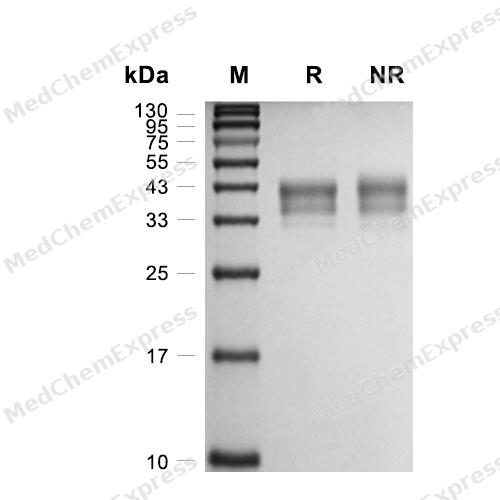
Purity - SDS-PAGE
-
Bioactivity - ELISA
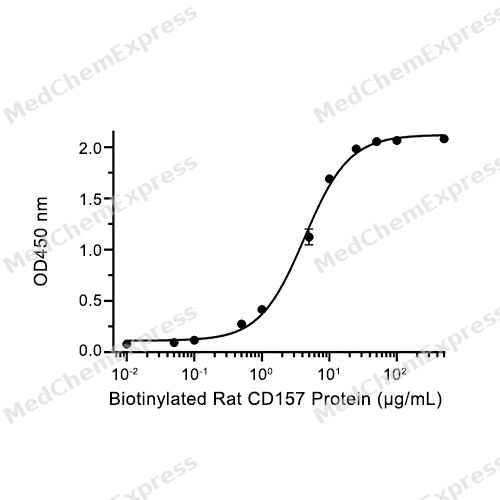
Bioactivity - ELISA

Assay Procedure
Materials
Biotin
Pre-chilled sterile water
Wash buffer: 1X PBST
Blocking buffer: 1% BSA in 1X PBST
TMB substrate solution: Mix substrate solution A and B at a 1:1 ratio immediately before use
Stop solution: 2 M H2SO4
CD157 Protein, Rat (HEK293, His) (HY-P76205)
Fibronectin Protein
Procedure
Biotinylation
1. Dissolution of Biotin Reagent: Remove Biotin from -10 to -30°C and immediately dissolve 1 tube of Biotin in 180 μL of cold purified water. Gently pipette to mix and obtain a 10 mM Biotin solution.
2. Calculate the volume of EZ-LinkTM Sulfo-NHS-LC-LC-Biotin, No-WeighTM Format to be added.
3. Incubation: Incubate at room temperature in the dark for 45 minutes.
4. Quantification of Biotinylated Rat CD157 Protein: Use the BCA assay to quantify the protein concentration.
ELISA Detection
1. Coating: Dilute Fibronectin Protein to 10 μg/mL in 1X PBST, add 100 μL/well, and incubate overnight at 2-8°C.
2. Washing: Wash the plate with wash buffer (260 μL/well) , once, and pat dry.
3. Blocking: Add 100 μL/well of blocking buffer, incubate at 25°C with shaking at 450 rpm for 4 hours.
4. Dilution of Biotinylated Rat CD157: Prepare dilutions at concentrations of 50, 12.5, 6.25, 3.125, 1.5625, 0.78125, 0.390625, 0.1953125, 0.097656, 0.0488, 0.0244, 0.0122, 0 μg/mL.
5. Add Biotinylated Rat CD157: Add 100 μL/well, incubate at 25°C with shaking at 450 rpm for 2 hours.
6. Washing: Wash the plate with wash buffer (260 μL/well) , five times, with each wash lasting 1 minute, then pat dry.
7. Add secondary antibody: Add 100 μL/well, incubate at 25°C with shaking at 450 rpm for 1 hour.
8. Washing: Wash the plate with wash buffer (260 μL/well) , three times, with each wash lasting 1 minute, then pat dry.
9. Add TMB Substrate Solution: Add 100 μL/well, incubate at room temperature in the dark for 15 minutes.
10. Stop Reaction: Add 100 μL of 2 M H2SO4 per well.
11. Read Plate: Measure absorbance at 450 nm.
12. Using GraphPad Prism software, plot a curve with the OD value as the vertical axis and the Biotinylated Rat CD157 protein concentration as the horizontal axis, and calculate the ED50 value.


Technical Parameters
-
Species Rat
-
Source HEK293
-
Tag C-6*His
-
Accession
Q63072 (R34-E293)
-
Molecular Construction
-
N-term
-
CD157 (R34-E293)
Accession # Q63072 -
His
-
C-term
-
-
Protein Length
Full Length of ADP-ribosyl cyclase/cyclic ADP-ribose hydrolase 2 Chain
-
Synonyms
BST1; NAD(+) Nucleosidase; Bone Marrow Stromal Cell Antigen 1; ADP-Ribosyl Cyclase/Cyclic ADP-Ribose Hydrolase; ADP-Ribosyl Cyclase 2; Bone Marrow Stromal Antigen 1; CADPR2; Cyclic ADP-Ribose Hydrolase; CD157; CADPr Hydrolase 2; BST-1; CADPR Hydrolase 2;
-
AA Sequence
RWSGEGTTPHLQSIFLGRCAEYTTLLSLEPGNKNCTAIWEAFKVVLDKDPCSVLPSDYDLFINLSRHAIPRDKSLFWENNHLLVMSYAENTRRLMPLCDVLYGKVGDFLSWCRQENASGLDYQSCPTAEDCENNAVDAYWKSASMQYSRDSSGVINVMLNGSEPKGAYPTKGFFADFEIPYLQKDKITRIEIWVMHEVGGPHVESCGEGSVKILEDRLEALGFQHSCINDYPPVKFLMCVDHSTHPDCAMNSASASMWRE
-
Molecular Weight
Approximately 38-42 kDa, based on SDS-PAGE under reducing conditions, due to the glycosylation.
-
Glycosylation
Yes
-
Purity
≥ 95%, as determined by reducing SDS-PAGE.


Product Properties
Lyophilized powder.
Lyophilized from a 0.22 μm filtered solution of PBS, pH 7.4.
<1 EU/μg, determined by LAL method.
It is not recommended to reconstitute to a concentration less than 100 μg/mL in ddH2O. For long term storage it is recommended to add a carrier protein (0.1% BSA, 5% HSA, 10% FBS or 5% Trehalose).
Stored at -20°C for 2 years from date of receipt. After reconstitution, it is stable at 4°C for 1 week or -20°C for longer (with carrier protein). It is recommended to freeze aliquots at -20°C or -80°C for extended storage.
Room temperature in continental US; may vary elsewhere.


Documentation
-
Data Sheet (237 KB)
-
SDS (251 KB)
- English - EN (251 KB)
- Français - FR (251 KB)
- Deutsch - DE (251 KB)
- Norwegian - NO (251 KB)
- Español - ES (251 KB)
- Swedish - SV (251 KB)
- Italian - IT (251 KB)
- Korean - KR (251 KB)
- Portuguese - PT (251 KB)
-
Handling Instructions (2659 KB)

Calculators
Concentration (start) × Volume (start) = Concentration (final) × Volume (final)


 Powered by Bioz

