



CD19 Protein, Mouse (Biotinylated, HEK293, His)

Based on 1 Customer Validation
The CD19 protein acts as a coreceptor for B cell antigen receptors, lowering the signaling threshold and initiating B cell responses to antigens. It activates a cascade leading to PI3K activation and Ca(2+) mobilization. CD19 Protein, Mouse (Biotinylated, HEK293, His) is the recombinant mouse-derived CD19 protein, expressed by HEK293 , with C-His labeled tag.
- Species: Mouse
- Source: HEK293
-
Storage:Stored at -80°C for 1 year from date of receipt. It is stable at -20°C for 3 months after opening. It is recommended to freeze aliquots at -80°C for extended storage. Avoid repeated freeze-thaw cycles.


To place orders, for customer services and technical support, please contact: MedChemExpress USA
Tel: 609-228-6898 E-mail: [email protected] [email protected]


-
 Biological Activity
-
Technical Parameters
-
Product Properties
- Documentation
- Help & FAQs




Biological Activity
Description
The CD19 protein acts as a coreceptor for B cell antigen receptors, lowering the signaling threshold and initiating B cell responses to antigens. It activates a cascade leading to PI3K activation and Ca(2+) mobilization. CD19 Protein, Mouse (Biotinylated, HEK293, His) is the recombinant mouse-derived CD19 protein, expressed by HEK293 , with C-His labeled tag.
Background
CD19 protein functions as a coreceptor for the B-cell antigen receptor complex (BCR) on B-lymphocytes, effectively reducing the threshold for downstream signaling pathways and initiating B-cell responses to antigens. It activates signaling cascades leading to phosphatidylinositol 3-kinase activation and mobilization of intracellular Ca(2+) stores. While not essential for early B cell differentiation in the bone marrow, CD19 is crucial for the normal differentiation of B-1 cells and plays a vital role in B cell differentiation and proliferation in response to antigen challenges. Furthermore, CD19 is required for maintaining normal levels of serum immunoglobulins and the production of high-affinity antibodies upon antigen exposure. CD19 interacts with CR2/CD21 and forms a complex with CD81, CR2/CD21, CD81, and IFITM1/CD225 in the membrane of mature B-cells. It also interacts directly with CD81, essential for trafficking and compartmentalization of the CD19 receptor on the cell surface when phosphorylated on specific tyrosine residues. Additionally, CD19 interacts with PLCG2 when phosphorylated on Tyr-402 and with LYN, and it forms an interaction with the regulatory p85 subunit of phosphatidylinositol 3-kinase (PI3K) when tyrosine phosphorylated.
Verified Bioactivity
Immobilized human CD81 (HY-P72706) at 2 μg/mL (100 μL/well) can bind Biotinylated Mouse CD19 Protein. The ED50 for this effect is 21.1 μg/mL.
MCE Validation Data
-
Bioactivity - ELISA
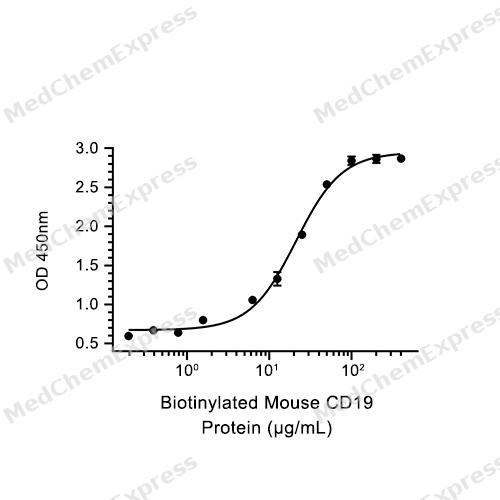
Bioactivity - ELISA


Technical Parameters
-
Species Mouse
-
Source HEK293
-
Tag C-His
-
Accession
P25918 (G17-G287)
-
Molecular Construction
-
N-term
-
CD19 (G17-G287)
Accession # P25918 -
His
-
C-term
-
-
Protein Length
Extracellular Domain (with Propeptide)
-
Conjugation
Biotin
-
Conjugate Method
The biotin is covalently conjugated to the primary amine groups of the protein using chemical labeling methods.
-
Synonyms
CD19; CDNA FLJ60916, Highly Similar To B-Lymphocyte Antigen CD19; CD19 Molecule; CDNA FLJ54955, Highly Similar To B-Lymphocyte Antigen CD19; B-Lymphocyte Surface Antigen B4; CD19 Antigen, Isoform CRA_f; T-Cell Surface Antigen Leu-12; CD19 Antigen, Isoform
-
AA Sequence
GGRPQKSLLVEVEEGGNVVLPCLPDSSPVSSEKLAWYRGNQSTPFLELSPGSPGLGLHVGSLGILLVIVNVSDHMGGFYLCQKRPPFKDIWQPAWTVNVEDSGEMFRWNASDVRDLDCDLRNRSSGSHRSTSGSQLYVWAKDHPKVWGTKPVCAPRGSSLNQSLINQDLTVAPGSTLWLSCGVPPVPVAKGSISWTHVHPRRPNVSLLSLSLGGEHPVREMWVWGSLLLLPQATALDEGTYYCLRGNLTIERHVKVIARSAVWLWLLRTGG
-
Predicted Molecular Mass
31 kDa
-
Glycosylation
Yes
-
Purity
≥ 90%, as determined by reducing SDS-PAGE.


Product Properties
Solution
Supplied as a 0.22 μm filtered solution of PBS, pH 7.4.
<1 EU/μg, determined by LAL method.
Stored at -80°C for 1 year from date of receipt. It is stable at -20°C for 3 months after opening. It is recommended to freeze aliquots at -80°C for extended storage. Avoid repeated freeze-thaw cycles.
Shipping with dry ice.


Documentation
-
Data Sheet (237 KB)
-
SDS (251 KB)
- English - EN (251 KB)
- Français - FR (251 KB)
- Deutsch - DE (251 KB)
- Norwegian - NO (251 KB)
- Español - ES (251 KB)
- Swedish - SV (251 KB)
- Italian - IT (251 KB)
- Korean - KR (251 KB)
- Portuguese - PT (251 KB)
-
Handling Instructions (2659 KB)

Calculators
Concentration (start) × Volume (start) = Concentration (final) × Volume (final)


 Powered by Bioz

