



CD5L Protein, Mouse (HEK293, His)
Based on 2 publication(s) in Google Scholar
The CD5L protein is primarily expressed by macrophages and regulates inflammatory responses in infection or atherosclerosis. CD5L is incorporated into adipocytes via CD36-mediated endocytosis, thereby inhibiting lipid droplet size and affecting lipolysis. CD5L Protein, Mouse (HEK293, His) is the recombinant mouse-derived CD5L protein, expressed by HEK293 , with C-6*His labeled tag.
- Species: Mouse
- Source: HEK293
-
Storage:Stored at -20°C for 2 years from date of receipt. After reconstitution, it is stable at 4°C for 1 week or -20°C for longer (with carrier protein). It is recommended to freeze aliquots at -20°C or -80°C for extended storage.


To place orders, for customer services and technical support, please contact: MedChemExpress USA
Tel: 609-228-6898 E-mail: [email protected] [email protected]


-
 Biological Activity
-
Technical Parameters
-
Product Properties
- Documentation
- Help & FAQs




Biological Activity
Description
The CD5L protein is primarily expressed by macrophages and regulates inflammatory responses in infection or atherosclerosis. CD5L is incorporated into adipocytes via CD36-mediated endocytosis, thereby inhibiting lipid droplet size and affecting lipolysis. CD5L Protein, Mouse (HEK293, His) is the recombinant mouse-derived CD5L protein, expressed by HEK293 , with C-6*His labeled tag.
Background
CD5L Protein serves as a pivotal regulator of lipid synthesis, predominantly expressed by macrophages in lymphoid and inflamed tissues, orchestrating inflammatory responses in conditions such as infection or atherosclerosis. Its impact extends to adipocytes, where it inhibits lipid droplet size and influences lipolysis following incorporation into mature adipocytes through CD36-mediated endocytosis. By associating with cytosolic FASN, CD5L suppresses fatty acid synthase activity, resulting in the breakdown of triacylglycerols into glycerol and free fatty acids. In the context of obesity, CD5L-induced lipolysis contributes to inflammation and insulin resistance by recruiting inflammatory macrophages into adipose tissues. Additionally, CD5L exerts regulatory control over metabolic pathways in T-helper Th17 cells, influencing the expression of pro-inflammatory genes by modulating lipid content and limiting the synthesis of cholesterol ligands for RORC, the master transcription factor of Th17-cell differentiation. Notably present in non-pathogenic Th17 cells, CD5L alters polyunsaturated fatty acyl content, affecting metabolic proteins and consequently limiting RORC activity. Moreover, CD5L plays a role in obesity-associated autoimmunity by associating with IgM, interfering with Fcalpha/mu receptor binding, and enhancing the development of long-lived plasma cells producing high-affinity IgG autoantibodies. Beyond its metabolic functions, CD5L acts as an apoptosis inhibitor in macrophages, promoting their survival against the apoptotic effects of oxidized lipids in atherosclerosis. Furthermore, it contributes to the early response to microbial infection, serving as a pattern recognition receptor and promoting autophagy. CD5L's multifaceted roles underscore its significance in diverse physiological processes and its potential implications in various pathological conditions.
Verified Bioactivity
Measured by its ability to inhibit apoptosis on the J774A.1 mouse reticulum cell sarcoma macrophage cells. The ED50 for this effect is 1.798-1.828 µg/mL, corresponding to a specific activity is 547.046-556.174 units/mg in the presence of Fas Ligand/His and 5 µg/mL Anti-His Antibody.
MCE Validation Data
-
Purity - SDS-PAGE
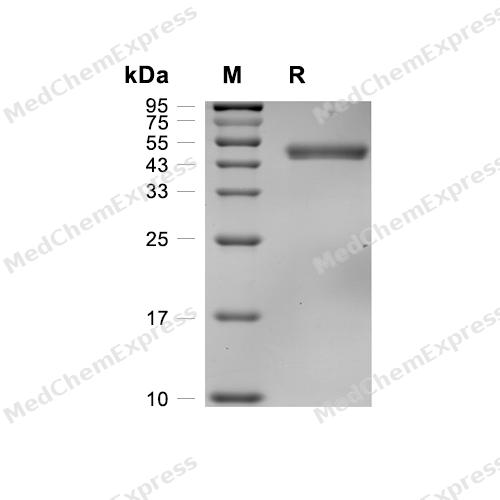
Purity - SDS-PAGE
-
Bioactivity - Cell-Based Assay
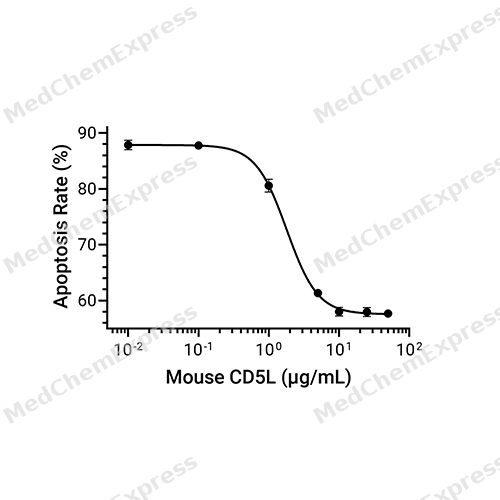
Bioactivity - Cell-Based Assay


Publications (2)


Technical Parameters
-
Species Mouse
-
Source HEK293
-
Tag C-6*His
-
Accession
Q9QWK4 (E22-V352)
-
Molecular Construction
-
N-term
-
CD5L (E22-V352)
Accession # Q9QWK4 -
6*His
-
C-term
-
-
Protein Length
Full Length of Mature Protein
-
Synonyms
CD5L; CT-2; Prev. API6; Apoptosis Inhibitor Of Macrophage; Spalpha; CD5 Molecule-Like; CD5 Antigen-Like (Scavenger Receptor Cysteine Rich Family); SP-ALPHA; Apoptosis Inhibitor Expressed By Macrophages; SP-Alpha; IgM-Associated Peptide; PRO229; Apoptosis
-
AA Sequence
ESPTKVQLVGGAHRCEGRVEVEHNGQWGTVCDDGWDRRDVAVVCRELNCGAVIQTPRGASYQPPASEQRVLIQGVDCNGTEDTLAQCELNYDVFDCSHEEDAGAQCENPDSDLLFIPEDVRLVDGPGHCQGRVEVLHQSQWSTVCKAGWNLQVSKVVCRQLGCGRALLTYGSCNKNTQGKGPIWMGKMSCSGQEANLRSCLLSRLENNCTHGEDTWMECEDPFELKLVGGDTPCSGRLEVLHKGSWGSVCDDNWGEKEDQVVCKQLGCGKSLHPSPKTRKIYGPGAGRIWLDDVNCSGKEQSLEFCRHRLWGYHDCTHKEDVEVICTDFDV
-
Molecular Weight
Approximately 52-60 kDa, based on SDS-PAGE under reducing conditions, due to the glycosylation.
-
Glycosylation
Yes
-
Purity
≥ 95%, as determined by reducing SDS-PAGE.


Product Properties
Lyophilized powder
Lyophilized from a 0.2 μm filtered solution of PBS, pH 7.4.
<1 EU/μg, determined by LAL method.
It is not recommended to reconstitute to a concentration less than 100 μg/mL in ddH2O. For long term storage it is recommended to add a carrier protein (0.1% BSA, 5% HSA, 10% FBS or 5% Trehalose).
Stored at -20°C for 2 years from date of receipt. After reconstitution, it is stable at 4°C for 1 week or -20°C for longer (with carrier protein). It is recommended to freeze aliquots at -20°C or -80°C for extended storage.
Room temperature in continental US; may vary elsewhere.


Documentation
-
Data Sheet (239 KB)
-
SDS (254 KB)
- English - EN (254 KB)
- Français - FR (254 KB)
- Deutsch - DE (254 KB)
- Norwegian - NO (254 KB)
- Español - ES (254 KB)
- Swedish - SV (254 KB)
- Italian - IT (254 KB)
- Korean - KR (254 KB)
- Portuguese - PT (254 KB)
-
Handling Instructions (2659 KB)

Calculators
Concentration (start) × Volume (start) = Concentration (final) × Volume (final)


 Powered by Bioz

