



CD79B Protein, Rat (HEK293, His)

Based on 1 Customer Validation
CD79B Protein, also known as B29 or Igβ, is an essential component of the B cell receptor along with immunoglobulin and mb1 (Igα, CD79a) and is absolutely required for B cell development. Rat CD79B protein comprises 228 amino acids, and its amino acid sequence is 85 and 69% identical with the mouse and human counterparts, respectively. The B-cell antigen receptor (BCR) signaling component Igβ (CD79B) and the co-receptor CD19 act as an alternative B-cell signaling module that promotes the survival of B lymphoma and normal B cells via integrated ITAM/PI3K signaling. The loss of CD79B causes a block in N-glycan maturation and accumulation of immature proteins. CD79B Protein, Rat (HEK293, His) is the recombinant rat-derived CD79B protein, expressed by HEK293 , with C-His labeled tag.
- Species: Rat
- Source: HEK293
-
Storage:Stored at -20°C for 2 years from date of receipt. After reconstitution, it is stable at 4°C for 1 week or -20°C for longer (with carrier protein). It is recommended to freeze aliquots at -20°C or -80°C for extended storage.


To place orders, for customer services and technical support, please contact: MedChemExpress USA
Tel: 609-228-6898 E-mail: [email protected] [email protected]


-
 Biological Activity
-
Technical Parameters
-
Product Properties
- Documentation
- References
- Help & FAQs




Biological Activity
Description
CD79B Protein, also known as B29 or Igβ, is an essential component of the B cell receptor along with immunoglobulin and mb1 (Igα, CD79a) and is absolutely required for B cell development. Rat CD79B protein comprises 228 amino acids, and its amino acid sequence is 85 and 69% identical with the mouse and human counterparts, respectively. The B-cell antigen receptor (BCR) signaling component Igβ (CD79B) and the co-receptor CD19 act as an alternative B-cell signaling module that promotes the survival of B lymphoma and normal B cells via integrated ITAM/PI3K signaling. The loss of CD79B causes a block in N-glycan maturation and accumulation of immature proteins[1][2][3]. CD79B Protein, Rat (HEK293, His) is the recombinant rat-derived CD79B protein, expressed by HEK293 , with C-His labeled tag.
Background
The human, murine, and rat B29 (Ig beta, CD79b) genes are highly conserved in sequence and organization and exhibit strict B cell-specific expression. In the human and rat genomes, the B29 gene is located between the skeletal muscle-specific Na-channel alpha subunit (SCN4A) gene and the pituitary-specific growth hormone (GH-N) gene. Rat B29/Ig-β gene was 3.1 kb in length with six exons and was separated by 3.3 and 9.3 kb from Na-channel and GH genes, respectively[1][2].
The B-cell receptor (BCR) consists of surface-bound immunoglobulin (Ig) and a heterodimeric signaling unit comprised of CD79A and CD79B. Upon cognate antigen recognition, the receptor initiates important signals for B-cell development and function[3].
Verified Bioactivity
Immobilized Human CD79B at 2 μg/mL (100 μL/well) can bind Anti-CD79B Antibody. The ED50 for this effect is 0.7885 μg/mL.
MCE Validation Data
-
Purity - SDS-PAGE
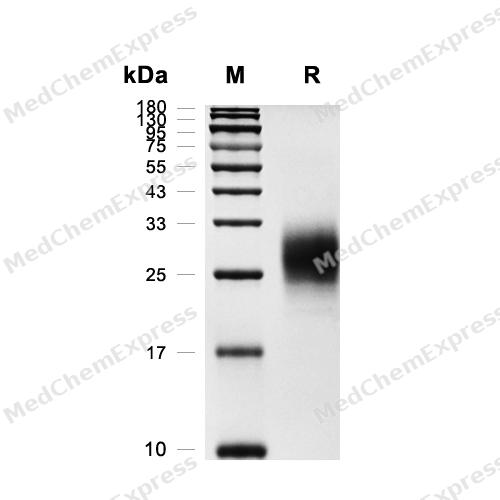
Purity - SDS-PAGE
-
Bioactivity - ELISA
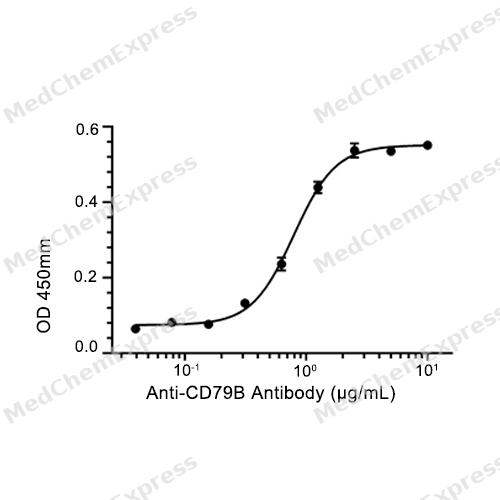
Bioactivity - ELISA


Technical Parameters
-
Species Rat
-
Source HEK293
-
Tag C-6*His
-
Accession
O70153 (V26-D158)
-
Molecular Construction
-
N-term
-
CD79B (V26-D158)
Accession # O70153 -
His
-
C-term
-
-
Protein Length
Partial
-
Synonyms
CD79B; CD79b Molecule, Immunoglobulin-Associated Beta; Prev. IGB; B-Cell-Specific Glycoprotein B29; Ig-Beta; B-Cell Antigen Receptor Complex-Associated Protein Beta Chain Isoform 3; B29; CD79b Antigen; B-Cell Antigen Receptor Complex-Associated Protein Be
-
AA Sequence
VPAMTKSDQPPIFQGSPCSKIWQHPRFAAKKRSSMVKFHCHTDYSGVMTWFRQKGNQRPQELFPEDGHISQTRNGSVYTLTLQNIQYEDNGIYFCQQKCNSTEPDVTDGCGTELLVLGFSTLDQLKRRNTLKD
-
Molecular Weight
Approximately 28 kDa, based on SDS-PAGE under reducing conditions, due to the glycosylation.
-
Glycosylation
Yes
-
Purity
≥ 95%, as determined by reducing SDS-PAGE.


Product Properties
Lyophilized powder.
Lyophilized from a 0.22 μm filtered solution of PBS, pH 7.4.
<1 EU/μg, determined by LAL method.
It is not recommended to reconstitute to a concentration less than 100 μg/mL in ddH2O. For long term storage it is recommended to add a carrier protein (0.1% BSA, 5% HSA, 10% FBS or 5% Trehalose).
Stored at -20°C for 2 years from date of receipt. After reconstitution, it is stable at 4°C for 1 week or -20°C for longer (with carrier protein). It is recommended to freeze aliquots at -20°C or -80°C for extended storage.
Room temperature in continental US; may vary elsewhere.


Documentation
-
Data Sheet (263 KB)
-
SDS (252 KB)
- English - EN (252 KB)
- Français - FR (252 KB)
- Deutsch - DE (252 KB)
- Norwegian - NO (252 KB)
- Español - ES (252 KB)
- Swedish - SV (252 KB)
- Italian - IT (252 KB)
- Korean - KR (252 KB)
- Portuguese - PT (252 KB)
-
Handling Instructions (2659 KB)


References
[1]. Lisa Patrone, et al. A conserved sequence upstream of the B29 (Ig beta, CD79b) gene interacts with YY1. Mol Biol Rep. 2004 Mar;31(1):1-11. [Content Brief]
[2]. S Nakazato, et al. Physical linkage of the B29/Ig-beta (CD79B) gene to the skeletal muscle, sodium-channel, and growth hormone genes in rat and human. Genomics. 1998 Mar 15;48(3):363-8. [Content Brief]
[3]. Kanutte Huse, et al. Mechanism of CD79A and CD79B Support for IgM+ B Cell Fitness through B Cell Receptor Surface Expression. J Immunol. 2022 Nov 15;209(10):2042-2053. [Content Brief]

Calculators
Concentration (start) × Volume (start) = Concentration (final) × Volume (final)


 Powered by Bioz

