



CD99 Protein, Rat (HEK293, Fc)

Based on 1 Customer Validation
CD99 protein is a member of the CD99 family and plays a key role in several important cellular processes such as immune response, cell adhesion and migration. It exerts a major influence on lymphocyte trafficking and is involved in the regulation of immune cell interactions. CD99 Protein, Rat (HEK293, Fc) is the recombinant rat-derived CD99 protein, expressed by HEK293 , with C-hFc labeled tag.
- Species: Rat
- Source: HEK293
-
Storage:Stored at -20°C for 2 years from date of receipt. After reconstitution, it is stable at 4°C for 1 week or -20°C for longer (with carrier protein). It is recommended to freeze aliquots at -20°C or -80°C for extended storage.


To place orders, for customer services and technical support, please contact: MedChemExpress USA
Tel: 609-228-6898 E-mail: [email protected] [email protected]


-
 Biological Activity
-
Technical Parameters
-
Product Properties
- Documentation
- Help & FAQs




Biological Activity
Description
CD99 protein is a member of the CD99 family and plays a key role in several important cellular processes such as immune response, cell adhesion and migration. It exerts a major influence on lymphocyte trafficking and is involved in the regulation of immune cell interactions. CD99 Protein, Rat (HEK293, Fc) is the recombinant rat-derived CD99 protein, expressed by HEK293 , with C-hFc labeled tag.
Background
CD99 Protein, a member of the CD99 family, is a key player in several important cellular processes, including immune responses, cell adhesion, and migration. It exerts significant influence on lymphocyte trafficking and is involved in the regulation of immune cell interactions. CD99 Protein is known to be expressed on various immune cells, where it contributes to the formation of immunological synapses and facilitates the communication between different immune cells. Additionally, CD99 Protein is implicated in cell adhesion and migration processes, playing a crucial role in the transmigration of leukocytes across endothelial cell barriers. Through its multifaceted functions, CD99 Protein is essential for the proper functioning of the immune system and the coordination of immune responses.
Verified Bioactivity
Measured by its ability to chemoattract U87 cells. The ED50 for this effect is 21.43 ng/mL, corresponding to a specific activity is 4.67×10⁴ U/mg.
MCE Validation Data
-
Purity - SDS-PAGE
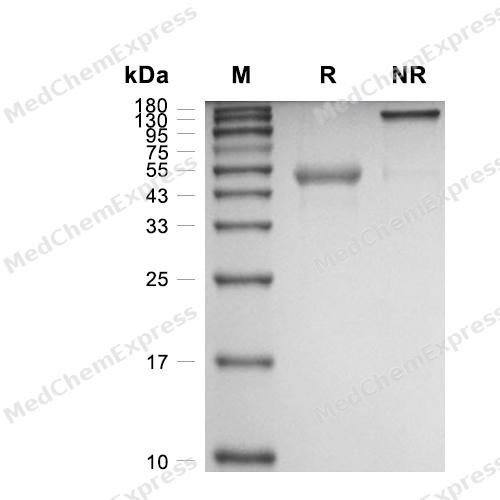
Purity - SDS-PAGE
-
Bioactivity - Cell-Based Assay
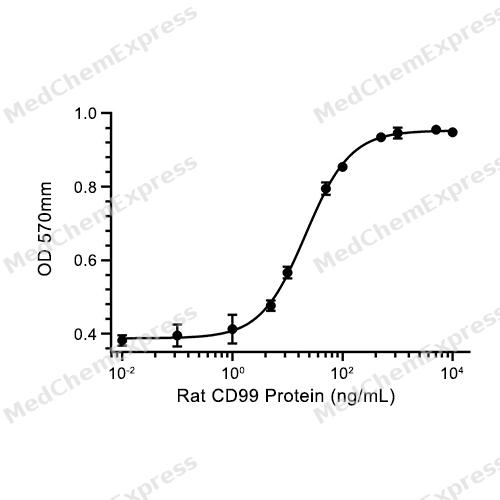
Bioactivity - Cell-Based Assay


Technical Parameters
-
Species Rat
-
Source HEK293
-
Tag C-hFc
-
Accession
B4F7A5 (D25-G127)
-
Molecular Construction
-
N-term
-
CD99 (D25-G127)
Accession # B4F7A5 -
hFc
-
C-term
-
-
Protein Length
Full Length of Disordered Region
-
Synonyms
CD99; MIC2 (Monoclonal Antibody 12E7); Prev. MIC2X; Cell Surface Antigen 12E7; Prev. MIC2Y; Cell Surface Antigen O13; Prev. MIC2; Surface Antigen MIC2; CD99 Antigen; CD99 Molecule; Antigen Identified By Monoclonal Antibodies 12E7, F21 And O13; Protein MIC
-
AA Sequence
DGDFRLDDALEDTDKKPTPKPPTPKKPSSGDFDLEEALTGGADEDPRRPGSRPKPDPKPPGPPRDSGGISDRDLEDVAGHGGRGGGAGDRGTDGAESEGQPQG
-
Molecular Weight
Approximately 47 kDa, based on SDS-PAGE under reducing conditions.
-
Purity
≥ 95%, as determined by reducing SDS-PAGE.


Product Properties
Lyophilized powder.
Lyophilized from a 0.22 μm filtered solution of PBS, pH 7.4.
<1 EU/μg, determined by LAL method.
It is not recommended to reconstitute to a concentration less than 100 μg/mL in ddH2O. For long term storage it is recommended to add a carrier protein (0.1% BSA, 5% HSA, 10% FBS or 5% Trehalose).
Stored at -20°C for 2 years from date of receipt. After reconstitution, it is stable at 4°C for 1 week or -20°C for longer (with carrier protein). It is recommended to freeze aliquots at -20°C or -80°C for extended storage.
Room temperature in continental US; may vary elsewhere.


Documentation
-
Data Sheet (235 KB)
-
SDS (251 KB)
- English - EN (251 KB)
- Français - FR (251 KB)
- Deutsch - DE (251 KB)
- Norwegian - NO (251 KB)
- Español - ES (251 KB)
- Swedish - SV (251 KB)
- Italian - IT (251 KB)
- Korean - KR (251 KB)
- Portuguese - PT (251 KB)
-
Handling Instructions (2659 KB)

Calculators
Concentration (start) × Volume (start) = Concentration (final) × Volume (final)


 Powered by Bioz

