



Cortactin Protein, Human (HEK293, His)

Based on 1 Customer Validation
Cortactin (CTTN) Protein, Human (HEK293, His) is the recombinant human-derived Cortactin (CTTN), expressed by HEK293 , with C-10*His labeled tag.
- Species: Human
- Source: HEK293
-
Storage:Stored at -20°C for 2 years from date of receipt. After reconstitution, it is stable at 4°C for 1 week or -20°C for longer (with carrier protein). It is recommended to freeze aliquots at -20°C or -80°C for extended storage.


To place orders, for customer services and technical support, please contact: MedChemExpress USA
Tel: 609-228-6898 E-mail: [email protected] [email protected]


-
 Biological Activity
-
Technical Parameters
-
Product Properties
- Documentation
- Help & FAQs




Biological Activity
Description
Cortactin (CTTN) Protein, Human (HEK293, His) is the recombinant human-derived Cortactin (CTTN), expressed by HEK293 , with C-10*His labeled tag.
Background
Cortactin is a protein involved in the organization of the actin cytoskeleton and regulation of cell shape, playing a role in lamellipodia formation and cell migration. Through its interaction with CTTNBP2, it contributes to the regulation of neuronal spine density (By similarity). Additionally, Cortactin functions in focal adhesion assembly and turnover (By similarity). In complex with ABL1 and MYLK, it regulates cortical actin-based cytoskeletal rearrangement critical for sphingosine 1-phosphate (S1P)-mediated endothelial cell barrier enhancement. The protein also participates in intracellular protein transport, endocytosis, and modulates the levels of potassium channels at the cell membrane. It is involved in receptor-mediated endocytosis via clathrin-coated pits (By similarity) and stabilizes KCNH1 channels at the cell membrane. Cortactin plays a role in cancer cell invasiveness and metastasis formation.
MCE Validation Data
-
Purity - SDS-PAGE
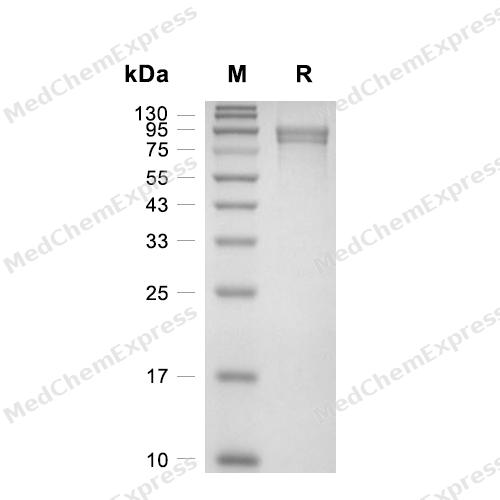
Purity - SDS-PAGE


Technical Parameters
-
Species Human
-
Source HEK293
-
Tag C-10*His
-
Accession
Q14247-3/NP_612632.1 (M1-Q513)
-
Gene ID2017
-
Protein Length
Partial
-
Synonyms
CTTN; Ems1 Sequence (Mammary Tumor And Squamous Cell Carcinoma-Associated (P80/85 Src Substrate); Prev. EMS1; Amplaxin; Src Substrate Cortactin; Epididymis Secretory Sperm Binding Protein; Cortactin; Oncogene EMS1
-
AA Sequence
MWKASAGHAVSIAQDDAGADDWETDPDFVNDVSEKEQRWGAKTVQGSGHQEHINIHKLRENVFQEHQTLKEKELETGPKASHGYGGKFGVEQDRMDKSAVGHEYQSKLSKHCSQVDSVRGFGGKFGVQMDRVDQSAVGFEYQGKTEKHASQKDYSSGFGGKYGVQADRVDKSAVGFDYQGKTEKHESQRDYSKGFGGKYGIDKDKVDKSAVGFEYQGKTEKHESQKDYVKGFGGKFGVQTDRQDKCALGWDHQEKLQLHESQKDYSKGFGGKYGVQKDRMDKNASTFEDVTQVSSAYQKTVPVEAVTSKTSNIRANFENLAKEKEQEDRRKAEAERAQRMAKERQEQEEARRKLEEQARAKTQTPPVSPAPQPTEERLPSSPVYEDAASFKAELSYRGPVSGTEPEPVYSMEAADYREASSQQGLAYATEAVYESAEAPGHYPAEDSTYDEYENDLGITAVALYDYQAAGDDEISFDPDDIITNIEMIDDGWWRGVCKGRYGLFPANYVELRQ
-
Predicted Molecular Mass
57.5 kDa
-
Molecular Weight
Approximately 80-95 kDa, based on SDS-PAGE under reducing conditions.
-
Purity
≥ 95%, as determined by reducing SDS-PAGE.


Product Properties
Lyophilized powder.
Lyophilized from a 0.22 μm filtered solution of PBS, pH 7.4.
<1 EU/μg, determined by LAL method.
It is not recommended to reconstitute to a concentration less than 100 μg/mL in ddH2O. For long term storage it is recommended to add a carrier protein (0.1% BSA, 5% HSA, 10% FBS or 5% Trehalose).
Stored at -20°C for 2 years from date of receipt. After reconstitution, it is stable at 4°C for 1 week or -20°C for longer (with carrier protein). It is recommended to freeze aliquots at -20°C or -80°C for extended storage.
Room temperature in continental US; may vary elsewhere.


Documentation
-
Data Sheet (238 KB)
-
SDS (251 KB)
- English - EN (251 KB)
- Français - FR (251 KB)
- Deutsch - DE (251 KB)
- Norwegian - NO (251 KB)
- Español - ES (251 KB)
- Swedish - SV (251 KB)
- Italian - IT (251 KB)
- Korean - KR (251 KB)
- Portuguese - PT (251 KB)
-
Handling Instructions (2659 KB)

Calculators
Concentration (start) × Volume (start) = Concentration (final) × Volume (final)


 Powered by Bioz

