



CPLX3 Protein, Human (HEK293, His)

Based on 1 Customer Validation
CPLX3 protein is a complex protein that regulates synaptic vesicle fusion through the SNARE protein complex. CPLX3 Protein, Human (HEK293, His) is the recombinant human-derived CPLX3 protein, expressed by HEK293 , with N-His labeled tag.
- Species: Human
- Source: HEK293
-
Storage:Stored at -20°C for 2 years from date of receipt. After reconstitution, it is stable at 4°C for 1 week or -20°C for longer (with carrier protein). It is recommended to freeze aliquots at -20°C or -80°C for extended storage.


To place orders, for customer services and technical support, please contact: MedChemExpress USA
Tel: 609-228-6898 E-mail: [email protected] [email protected]


-
 Biological Activity
-
Technical Parameters
-
Product Properties
- Documentation
- Help & FAQs




Biological Activity
Description
CPLX3 protein is a complex protein that regulates synaptic vesicle fusion through the SNARE protein complex. CPLX3 Protein, Human (HEK293, His) is the recombinant human-derived CPLX3 protein, expressed by HEK293 , with N-His labeled tag.
Background
CPLX3, a complexin protein, intricately modulates the SNARE protein complex, thereby playing a pivotal role in the regulation of synaptic vesicle fusion. Its significance extends to the maintenance of synaptic ultrastructure in the adult retina, highlighting its involvement in fundamental neuronal processes. Functionally, CPLX3 exerts a positive influence on synaptic transmission by modulating the availability of synaptic vesicles and facilitating neurotransmitter exocytosis, particularly at photoreceptor ribbon synapses in the retina. Additionally, CPLX3 contributes to the suppression of tonic photoreceptor activity and baseline 'noise' through the inhibition of Ca(2+) vesicle tonic release, while promoting evoked synchronous and asynchronous Ca(2+) vesicle release. The molecular basis of its regulatory role lies in its interaction with the SNARE core complex, specifically binding to SNAP25, VAMP2, and STX1A, underscoring its multifaceted involvement in the intricate machinery of neuronal communication.
MCE Validation Data
-
Purity - SDS-PAGE
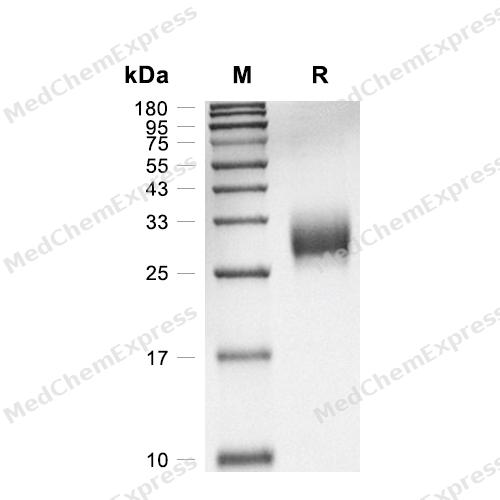
Purity - SDS-PAGE


Technical Parameters
-
Species Human
-
Source HEK293
-
Tag N-6*His
-
Accession
Q8WVH0 (M1-K154)
-
Molecular Construction
-
N-term
-
His
-
CPLX3 (M1-K154)
Accession # Q8WVH0 -
C-term
-
-
Protein Length
Full Length of Complexin-3 Chain
-
Synonyms
CPLX3; Complexin-3; Complexin 3; Nbla11589; CPX-III; CPX III; Epididymis Secretory Sperm Binding Protein; CPXIII; Complexin III
-
AA Sequence
MAFMVKTMVGGQLKNLTGSLGGGEDKGDGDKSAAEAQGMSREEYEEYQKQLVEEKMERDAQFTQRKAERATLRSHFRDKYRLPKNETDESQIQMAGGDVELPRELAKMIEEDTEEEEEKASVLGQLASLPGLNLGSLKDKAQATLGDLKQSAEK
-
Molecular Weight
Approximately 29-32 kDa, based on SDS-PAGE under reducing conditions.
-
Purity
≥ 95%, as determined by reducing SDS-PAGE.


Product Properties
Lyophilized powder.
Lyophilized from a 0.22 μm filtered solution of PBS, pH 7.4.
<1 EU/μg, determined by LAL method.
It is not recommended to reconstitute to a concentration less than 100 μg/mL in ddH2O. For long term storage it is recommended to add a carrier protein (0.1% BSA, 5% HSA, 10% FBS or 5% Trehalose).
Stored at -20°C for 2 years from date of receipt. After reconstitution, it is stable at 4°C for 1 week or -20°C for longer (with carrier protein). It is recommended to freeze aliquots at -20°C or -80°C for extended storage.
Room temperature in continental US; may vary elsewhere.


Documentation
-
Data Sheet (236 KB)
-
SDS (251 KB)
- English - EN (251 KB)
- Français - FR (251 KB)
- Deutsch - DE (251 KB)
- Norwegian - NO (251 KB)
- Español - ES (251 KB)
- Swedish - SV (251 KB)
- Italian - IT (251 KB)
- Korean - KR (251 KB)
- Portuguese - PT (251 KB)
-
Handling Instructions (2659 KB)

Calculators
Concentration (start) × Volume (start) = Concentration (final) × Volume (final)


 Powered by Bioz

