



CYP3A4 Protein, Human (His)
Based on 1 publication(s) in Google Scholar
The CYP3A4 protein, encoded by the CYP3A4 gene, is a key enzyme in drug metabolism and the synthesis of cholesterol, steroids, and lipids. It localizes to the endoplasmic reticulum and is induced by glucocorticoids and certain drugs. CYP3A4 Protein, Human (His) is the recombinant human-derived CYP3A4 protein, expressed by E. coli , with N-10*His labeled tag.
- Species: Human
- Source: E. coli
-
Storage:Stored at -20°C for 2 years from date of receipt. After reconstitution, it is stable at 4°C for 1 week or -20°C for longer (with carrier protein). It is recommended to freeze aliquots at -20°C or -80°C for extended storage.


To place orders, for customer services and technical support, please contact: MedChemExpress USA
Tel: 609-228-6898 E-mail: [email protected] [email protected]


-
 Biological Activity
-
Technical Parameters
-
Product Properties
- Documentation
- Help & FAQs




Biological Activity
Description
The CYP3A4 protein, encoded by the CYP3A4 gene, is a key enzyme in drug metabolism and the synthesis of cholesterol, steroids, and lipids. It localizes to the endoplasmic reticulum and is induced by glucocorticoids and certain drugs. CYP3A4 Protein, Human (His) is the recombinant human-derived CYP3A4 protein, expressed by E. coli , with N-10*His labeled tag.
Background
The CYP3A4 gene encodes a member of the cytochrome P450 superfamily of enzymes, which are monooxygenases playing a crucial role in drug metabolism and the synthesis of cholesterol, steroids, and lipids. This enzyme localizes to the endoplasmic reticulum, and its expression is induced by glucocorticoids and certain pharmacological agents. CYP3A4 is a key player in the metabolism of about half of the drugs in current use, encompassing substances like acetaminophen, codeine, cyclosporin A, diazepam, erythromycin, and chloroquine. Additionally, the enzyme participates in the metabolism of steroids and carcinogens. The gene is situated in a cluster of cytochrome P450 genes on chromosome 7q21.1. Formerly, another CYP3A gene, CYP3A3, was believed to exist, but it is now considered to be a transcript variant of CYP3A4. Multiple alternatively spliced transcript variants have been identified, encoding different isoforms of the enzyme. With biased expression observed in the liver (RPKM 476.5), small intestine (RPKM 282.8), and one other tissue, CYP3A4 is a pivotal factor in drug metabolism and overall xenobiotic processing.
Verified Bioactivity
Immobilized Human CYP3A4 at 2 μg/mL (100 μL/well) can bind CYP3A4 antibody. The ED50 for this effect is 5-20 ng/mL.
MCE Validation Data
-
Purity - SDS-PAGE
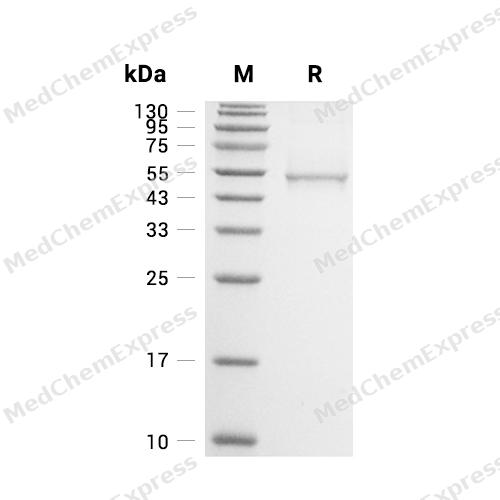
Purity - SDS-PAGE
-
Bioactivity - ELISA
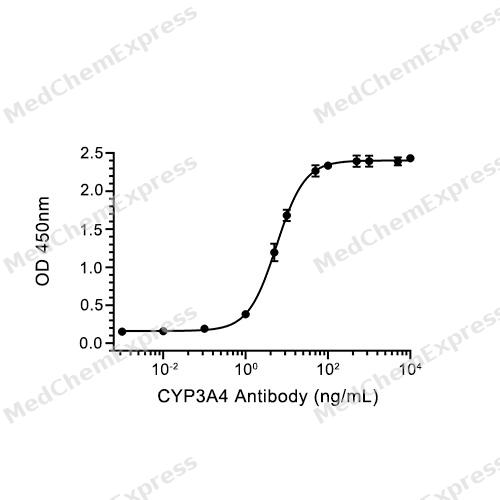
Bioactivity - ELISA


Publications (1)
-
Journal Impact Factor
-
Most Recent


Technical Parameters
-
Species Human
-
Source E. coli
-
Tag N-10*His
-
Accession
NP_059488.2 (A2-A503)
-
Molecular Construction
-
N-term
-
10*His
-
CYP3A4 (A2-A503)
Accession # NP_059488.2 -
C-term
-
-
Protein Length
Full Length
-
Synonyms
CYP3A4; CYPIIIA3; Prev. CYP3A3; Cytochrome P450, Subfamily IIIA (Niphedipine Oxidase), Polypeptide 3; Cytochrome P450, Subfamily IIIA (Niphedipine Oxidase), Polypeptide 4; Taurochenodeoxycholate 6-Alpha-Hydroxylase; Cytochrome P450, Family 3, Subfamily A,
-
AA Sequence
ALIPDLAMETWLLLAVSLVLLYLYGTHSHGLFKKLGIPGPTPLPFLGNILSYHKGFCMFDMECHKKYGKVWGFYDGQQPVLAITDPDMIKTVLVKECYSVFTNRRPFGPVGFMKSAISIAEDEEWKRLRSLLSPTFTSGKLKEMVPIIAQYGDVLVRNLRREAETGKPVTLKDVFGAYSMDVITSTSFGVNIDSLNNPQDPFVENTKKLLRFDFLDPFFLSITVFPFLIPILEVLNICVFPREVTNFLRKSVKRMKESRLEDTQKHRVDFLQLMIDSQNSKETESHKALSDLELVAQSIIFIFAGYETTSSVLSFIMYELATHPDVQQKLQEEIDAVLPNKAPPTYDTVLQMEYLDMVVNETLRLFPIAMRLERVCKKDVEINGMFIPKGVVVMIPSYALHRDPKYWTEPEKFLPERFSKKNKDNIDPYIYTPFGSGPRNCIGMRFALMNMKLALIRVLQNFSFKPCKETQIPLKLSLGGLLQPEKPVVLKVESRDGTVSGA
-
Predicted Molecular Mass
58.6 kDa
-
Molecular Weight
Approximately 54 kDa, based on SDS-PAGE under reducing conditions.
-
Purity
≥ 90%, as determined by reducing SDS-PAGE.


Product Properties
Lyophilized powder.
1.Lyophilized from a 0.22 μm filtered solution of PBS, pH 7.4, 0.1% SKL.
2.Lyophilized from a 0.22 μm filtered solution of PBS, pH 7.4, 8% trehalose.
Please refer to the lot-specific COA for specific buffer information.
<1 EU/μg, determined by LAL method.
It is not recommended to reconstitute to a concentration less than 100 μg/mL in ddH2O. For long term storage it is recommended to add a carrier protein (0.1% BSA, 5% HSA, 10% FBS or 5% Trehalose).
Stored at -20°C for 2 years from date of receipt. After reconstitution, it is stable at 4°C for 1 week or -20°C for longer (with carrier protein). It is recommended to freeze aliquots at -20°C or -80°C for extended storage.
Room temperature in continental US; may vary elsewhere.


Documentation
-
Data Sheet (238 KB)
-
SDS (252 KB)
- English - EN (252 KB)
- Français - FR (252 KB)
- Deutsch - DE (252 KB)
- Norwegian - NO (252 KB)
- Español - ES (252 KB)
- Swedish - SV (252 KB)
- Italian - IT (252 KB)
- Korean - KR (252 KB)
- Portuguese - PT (252 KB)
-
Handling Instructions (2659 KB)

Calculators
Concentration (start) × Volume (start) = Concentration (final) × Volume (final)


 Powered by Bioz

