



DDOST Protein, Human

Based on 1 Customer Validation
DDOST is a key subunit of the oligosaccharyltransferase (OST) complex, which catalyzes the initial glycan transfer during protein N-glycosylation. This co-translational process begins with the transfer of defined glycans to asparagine residues in the nascent polypeptide chain. DDOST Protein, Human is the recombinant human-derived DDOST protein, expressed by E. coli , with tag free.
- Species: Human
- Source: E. coli
-
Storage:Stored at -20°C for 2 years from date of receipt. After reconstitution, it is stable at 4°C for 1 week or -20°C for longer (with carrier protein). It is recommended to freeze aliquots at -20°C or -80°C for extended storage.


To place orders, for customer services and technical support, please contact: MedChemExpress USA
Tel: 609-228-6898 E-mail: [email protected] [email protected]


-
 Biological Activity
-
Technical Parameters
-
Product Properties
- Documentation
- Help & FAQs




Biological Activity
Description
DDOST is a key subunit of the oligosaccharyltransferase (OST) complex, which catalyzes the initial glycan transfer during protein N-glycosylation. This co-translational process begins with the transfer of defined glycans to asparagine residues in the nascent polypeptide chain. DDOST Protein, Human is the recombinant human-derived DDOST protein, expressed by E. coli , with tag free.
Background
DDOST, a subunit of the oligosaccharyl transferase (OST) complex, plays a pivotal role in catalyzing the initial transfer of a defined glycan (Glc(3)Man(9)GlcNAc(2) in eukaryotes) from the lipid carrier dolichol-pyrophosphate to an asparagine residue within an Asn-X-Ser/Thr consensus motif in nascent polypeptide chains. This marks the crucial commencement of protein N-glycosylation, a cotranslational process. The OST complex, where DDOST is a vital component, associates with the Sec61 complex at the translocon complex, facilitating protein translocation across the endoplasmic reticulum (ER). The maximal enzyme activity of the OST complex requires the presence of all subunits. Additionally, DDOST is indispensable for the assembly of both SST3A- and SS3B-containing OST complexes. In essence, DDOST's involvement in protein modification, particularly protein glycosylation, underscores its essential role in initiating the intricate process of N-glycosylation, contributing to the structural and functional diversity of glycoproteins.
Verified Bioactivity
The enzyme activity of this recombinant protein is testing in progress, we cannot offer a guarantee yet.
MCE Validation Data
-
Purity - SDS-PAGE
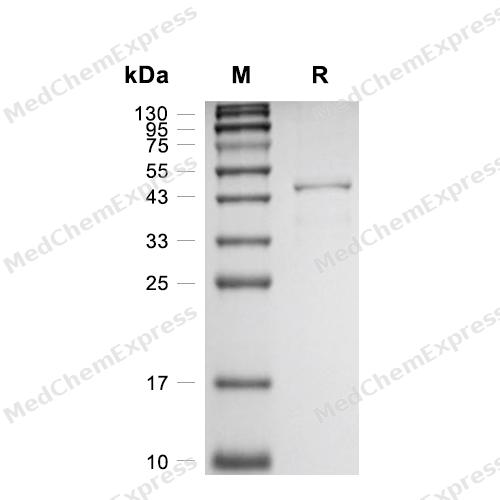
Purity - SDS-PAGE


Technical Parameters
-
Species Human
-
Source E. coli
-
Tag Tag Free
-
Accession
P39656-1 (S43-P427)
-
Molecular Construction
-
N-term
-
DDOST (S43-P427)
Accession # P39656 -
C-term
-
-
Protein Length
Lumenal Domain
-
Synonyms
DDOST; Dolichyl-Diphosphooligosaccharide--Protein Glycosyltransferase Subunit (Non-Catalytic); Dolichyl-Diphosphooligosaccharide--Protein Glycosyltransferase Non-Catalytic Subunit; Dolichyl-Diphosphooligosaccharide-Protein Glycosyltransferase; OST48; Doli
-
AA Sequence
SGPRTLVLLDNLNVRETHSLFFRSLKDRGFELTFKTADDPSLSLIKYGEFLYDNLIIFSPSVEDFGGNINVETISAFIDGGGSVLVAASSDIGDPLRELGSECGIEFDEEKTAVIDHHNYDISDLGQHTLIVADTENLLKAPTIVGKSSLNPILFRGVGMVADPDNPLVLDILTGSSTSYSFFPDKPITQYPHAVGKNTLLIAGLQARNNARVIFSGSLDFFSDSFFNSAVQKAAPGSQRYSQTGNYELAVALSRWVFKEEGVLRVGPVSHHRVGETAPPNAYTVTDLVEYSIVIQQLSNGKWVPFDGDDIQLEFVRIDPFVRTFLKKKGGKYSVQFKLPDVYGVFQFKVDYNRLGYTHLYSSTQVSVRPLQHTQYERFIPSAYP
-
Molecular Weight
Approximately 46 kDa, based on SDS-PAGE under reducing conditions.
-
Purity
≥ 95%, as determined by reducing SDS-PAGE.


Product Properties
Lyophilized powder.
Lyophilized from a 0.22 μm filtered solution of 50 mM Tris-HCl, 150 mM NaCl, pH 8.0, 8% trehalose, 0.02% Tween 80.
Note: For SPR assay, please replace the buffer. Primary amine components (e.g., Tris, imidazole) can affect protein-coupled chips.
<1 EU/μg, determined by LAL method.
It is not recommended to reconstitute to a concentration less than 100 μg/mL in ddH2O.
Stored at -20°C for 2 years from date of receipt. After reconstitution, it is stable at 4°C for 1 week or -20°C for longer (with carrier protein). It is recommended to freeze aliquots at -20°C or -80°C for extended storage.
Room temperature in continental US; may vary elsewhere.


Documentation
-
Data Sheet (237 KB)
-
SDS (251 KB)
- English - EN (251 KB)
- Français - FR (251 KB)
- Deutsch - DE (251 KB)
- Norwegian - NO (251 KB)
- Español - ES (251 KB)
- Swedish - SV (251 KB)
- Italian - IT (251 KB)
- Korean - KR (251 KB)
- Portuguese - PT (251 KB)
-
Handling Instructions (2659 KB)

Calculators
Concentration (start) × Volume (start) = Concentration (final) × Volume (final)


 Powered by Bioz

