



Dipeptidyl peptidase 3/DPP3 Protein, Human (His)

Based on 1 Customer Validation
According to research reports, dipeptidyl peptidase 3 (DPP3) protein, as an enzymatic entity, is able to cleave and degrade various bioactive peptides, including substrates such as angiotensin, leucine-enkephalin, and methionine-enkephalin. According to the results of multiple studies, in addition to its role in processing these bioactive peptides, DPP3 also has the ability to cleave Arg-Arg-β-naphthylamide in vitro. Dipeptidyl peptidase 3/DPP3 Protein, Human (His) is the recombinant human-derived Dipeptidyl peptidase 3/DPP3 protein, expressed by E. coli , with N-6*His labeled tag.
- Species: Human
- Source: E. coli
-
Storage:Stored at -80°C for 1 year from date of receipt. It is stable at -20°C for 3 months after opening. It is recommended to freeze aliquots at -80°C for extended storage. Avoid repeated freeze-thaw cycles.


To place orders, for customer services and technical support, please contact: MedChemExpress USA
Tel: 609-228-6898 E-mail: [email protected] [email protected]


-
 Biological Activity
-
Technical Parameters
-
Product Properties
- Documentation
- Help & FAQs




Biological Activity
Description
According to research reports, dipeptidyl peptidase 3 (DPP3) protein, as an enzymatic entity, is able to cleave and degrade various bioactive peptides, including substrates such as angiotensin, leucine-enkephalin, and methionine-enkephalin. According to the results of multiple studies, in addition to its role in processing these bioactive peptides, DPP3 also has the ability to cleave Arg-Arg-β-naphthylamide in vitro. Dipeptidyl peptidase 3/DPP3 Protein, Human (His) is the recombinant human-derived Dipeptidyl peptidase 3/DPP3 protein, expressed by E. coli , with N-6*His labeled tag.
Background
Dipeptidyl peptidase 3 (DPP3) is a protein with significant roles in peptide metabolism, cleaving and degrading various bioactive peptides, including angiotensin, Leu-enkephalin, and Met-enkephalin. This enzymatic activity suggests its involvement in the regulation of key physiological processes, particularly those related to blood pressure and pain modulation. Additionally, DPP3 has been shown to cleave Arg-Arg-beta-naphthylamide in vitro, further expanding its substrate specificity. The diverse range of peptides targeted by DPP3 underscores its importance in modulating the levels of signaling molecules and highlights its potential implications in various physiological and pathological contexts (
Verified Bioactivity
1.Measured by its ability to cleave the fluorogenic peptide substrate, Arg-Arg-7-amido-4-methylcoumarin (RR-AMC, HY-P4340) that incubate at room temperature in kinetic mode for 5 minutes. The specific activity is 2417.68 pmol/min/μg.
2.Loaded Procizumab (HY-P991050) on ProA biosensor, can bind Dipeptidyl peptidase 3/DPP3 Protein, Human (His) with an affinity constant of 7.400E-09 M as determined in BLI assay.
MCE Validation Data
-
Purity - SDS-PAGE
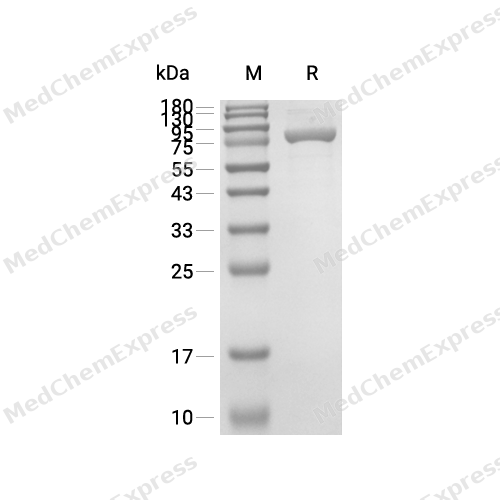
Purity - SDS-PAGE
-
Bioactivity - BLI
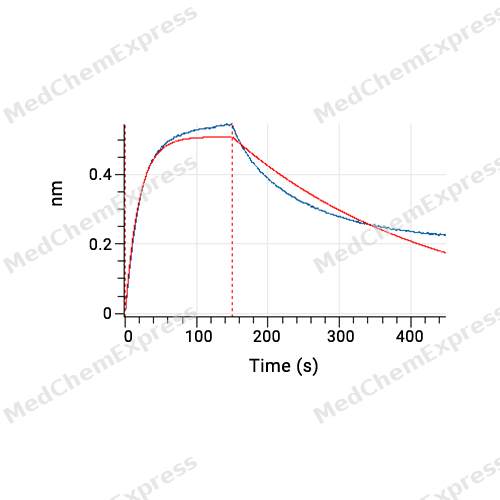
Bioactivity - BLI


Technical Parameters
-
Species Human
-
Source E. coli
-
Tag N-6*His
-
Accession
Q9NY33 (M1-A737)
-
Molecular Construction
-
N-term
-
6*His
-
DPP3 (M1-A737)
Accession # Q9NY33 -
C-term
-
-
Protein Length
Full Length
-
Synonyms
DPP3; DPP III; Dipeptidyl Peptidase 3; Dipeptidylpeptidase III; Dipeptidyl Aminopeptidase III; Dipeptidyl-Peptidase 3; Dipeptidyl Peptidase III; Dipeptidylpeptidase 3; Enkephalinase B; DPPIII; Dipeptidyl Arylamidase III
-
AA Sequence
MADTQYILPNDIGVSSLDCREAFRLLSPTERLYAYHLSRAAWYGGLAVLLQTSPEAPYIYALLSRLFRAQDPDQLRQHALAEGLTEEEYQAFLVYAAGVYSNMGNYKSFGDTKFVPNLPKEKLERVILGSEAAQQHPEEVRGLWQTCGELMFSLEPRLRHLGLGKEGITTYFSGNCTMEDAKLAQDFLDSQNLSAYNTRLFKEVDGEGKPYYEVRLASVLGSEPSLDSEVTSKLKSYEFRGSPFQVTRGDYAPILQKVVEQLEKAKAYAANSHQGQMLAQYIESFTQGSIEAHKRGSRFWIQDKGPIVESYIGFIESYRDPFGSRGEFEGFVAVVNKAMSAKFERLVASAEQLLKELPWPPTFEKDKFLTPDFTSLDVLTFAGSGIPAGINIPNYDDLRQTEGFKNVSLGNVLAVAYATQREKLTFLEEDDKDLYILWKGPSFDVQVGLHELLGHGSGKLFVQDEKGAFNFDQETVINPETGEQIQSWYRSGETWDSKFSTIASSYEECRAESVGLYLCLHPQVLEIFGFEGADAEDVIYVNWLNMVRAGLLALEFYTPEAFNWRQAHMQARFVILRVLLEAGEGLVTITPTTGSDGRPDARVRLDRSKIRSVGKPALERFLRRLQVLKSTGDVAGGRALYEGYATVTDAPPECFLTLRDTVLLRKESRKLIVQPNTRLEGSDVQLLEYEASAAGLIRSFSERFPEDGPELEEILTQLATADARFWKGPSEAPSGQA
-
Predicted Molecular Mass
84.8 kDa
-
Molecular Weight
Approximately 70-90 kDa, based on SDS-PAGE under reducing conditions.
-
Purity
≥ 90%, as determined by reducing SDS-PAGE.


Product Properties
Solution
Supplied as a 0.22 μm filtered solution of 25 mM Tris-HCl, 10 mM NaCl, 2 mM DTT, 0.05% Tween 80, 20% Glycerol, pH 8.0.
Note: For SPR assay, please replace the buffer. Primary amine components (e.g., Tris, imidazole) can affect protein-coupled chips.
<1 EU/μg, determined by LAL method.
Stored at -80°C for 1 year from date of receipt. It is stable at -20°C for 3 months after opening. It is recommended to freeze aliquots at -80°C for extended storage. Avoid repeated freeze-thaw cycles.
Shipping with dry ice.


Documentation
-
Data Sheet (240 KB)
-
SDS (252 KB)
- English - EN (252 KB)
- Français - FR (252 KB)
- Deutsch - DE (252 KB)
- Norwegian - NO (252 KB)
- Español - ES (252 KB)
- Swedish - SV (252 KB)
- Italian - IT (252 KB)
- Korean - KR (252 KB)
- Portuguese - PT (252 KB)
-
Handling Instructions (2659 KB)

Calculators
Concentration (start) × Volume (start) = Concentration (final) × Volume (final)


 Powered by Bioz

