



DKK-1 Protein, Rat (HEK293, His)
Based on 1 publication(s) in Google Scholar
DKK-1 Protein, with co-receptor and lipoprotein receptor binding activities, crucially regulates ossification and neuron death positively. Primarily located in the extracellular space, DKK-1 is implicated in anodontia, showing biased expression in kidney (RPKM 4.7), brain (RPKM 0.6), and two other tissues. Its role in the WNT signaling pathway and impact on visual epilepsy highlight its significance in developmental and neurological contexts. DKK-1 Protein, Rat (HEK293, His) is the recombinant rat-derived DKK-1 protein, expressed by HEK293 , with C-6*His labeled tag.
- Species: Rat
- Source: HEK293
-
Storage:Stored at -20°C for 2 years from date of receipt. After reconstitution, it is stable at 4°C for 1 week or -20°C for longer (with carrier protein). It is recommended to freeze aliquots at -20°C or -80°C for extended storage.


To place orders, for customer services and technical support, please contact: MedChemExpress USA
Tel: 609-228-6898 E-mail: [email protected] [email protected]


-
 Biological Activity
-
Technical Parameters
-
Product Properties
- Documentation
- Help & FAQs




Biological Activity
Description
DKK-1 Protein, with co-receptor and lipoprotein receptor binding activities, crucially regulates ossification and neuron death positively. Primarily located in the extracellular space, DKK-1 is implicated in anodontia, showing biased expression in kidney (RPKM 4.7), brain (RPKM 0.6), and two other tissues. Its role in the WNT signaling pathway and impact on visual epilepsy highlight its significance in developmental and neurological contexts. DKK-1 Protein, Rat (HEK293, His) is the recombinant rat-derived DKK-1 protein, expressed by HEK293 , with C-6*His labeled tag.
Background
DKK-1 Protein is predicted to play a crucial role in co-receptor binding, low-density lipoprotein particle receptor binding, and receptor antagonist activity. It is involved in the negative regulation of ossification and the positive regulation of neuron death, and its primary localization is in the extracellular space. This protein is implicated in anodontia, and its biased expression pattern is evident, with notable levels observed in the kidney (RPKM 4.7), brain (RPKM 0.6), and two other tissues. DKK-1's involvement in the WNT signaling pathway and its impact on visual epilepsy make it a significant factor in both developmental and neurological contexts.
Verified Bioactivity
Measured by its ability to inhibit Wnt3a-induced alkaline phosphatase production by C3H10T1/2 cells. The ED50 for this effect is approximately 0.1097 μg/ml in the presence of 10 ng/mL of mouse Wnt3a, corresponding to a specific activity is 9115.7703 units/mg.
MCE Validation Data
-
Purity - SDS-PAGE
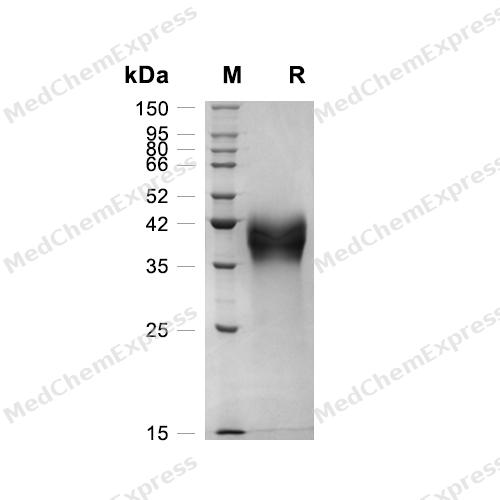
Purity - SDS-PAGE
-
Bioactivity - Cell-Based Assay
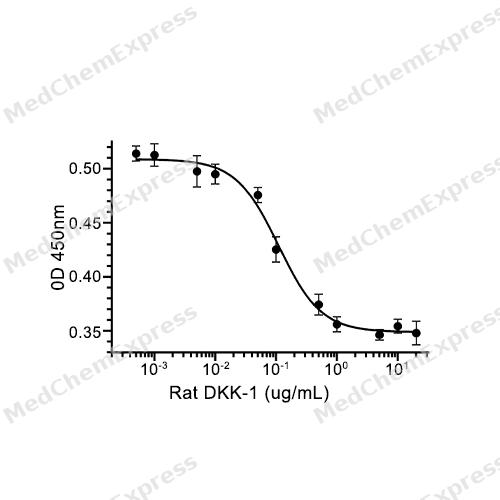
Bioactivity - Cell-Based Assay


Publications (1)
-
Journal Impact Factor
-
Most Recent
-
Int Immunopharmacol
Decoding the DKK1/CKAP4 signaling Axis: A novel mechanism driving Neointimal hyperplasia in arteriovenous fistulas. [Abstract]2026 May 15:177:116520. PMID: 41865456


Technical Parameters
-
Species Rat
-
Source HEK293
-
Tag C-6*His
-
Accession
A6I0Z0/NP_001099820.1 (T32-H270)
-
Molecular Construction
-
N-term
-
DKK-1 (T32-H270)
Accession # A6I0Z0/NP_001099820.1 -
6*His
-
C-term
-
-
Protein Length
Full Length of Mature Protein
-
Synonyms
DKK1; Dickkopf 1 Homolog (Xenopus Laevis); Dickkopf Wnt Signaling Pathway Inhibitor 1; Dickkopf 1 Homolog; SK; Dickkopf-1 Like; DKK-1; Dickkopf-1; Dickkopf-Related Protein 1; HDkk-1; Dickkopf-Like Protein 1; Dkk-1; Dickkopf (Xenopus Laevis) Homolog 1
-
AA Sequence
TLNSVLINSNAIKNLPPPLGGAGGQPGSAVSVAPGVLYEGGNKYQTLDNYQPYPCAEDEECGTDEYCSSPSRGAAGVGGVQICLACRKRRKRCMRHAMCCPGNYCKNGICMPSDHSHLPRGEIEEGIIENLGNDHGAGDGYPRRTTLTSKIYHTKGQEGSVCLRSSDCATGLCCARHFWSKICKPVLKEGQVCTKHRRKGSHGLEIFQRCYCGEGLACRIQKDHHQTSNSSRLHTCQRH
-
Molecular Weight
Approximately 38.58 kDa
-
Purity
≥ 95%, as determined by reducing SDS-PAGE.


Product Properties
Lyophilized powder.
Lyophilized from a 0.2 μm filtered solution of 20 mM PB, 150 mM NaCl, pH 7.4.
<1 EU/μg, determined by LAL method.
It is not recommended to reconstitute to a concentration less than 100 μg/mL in ddH2O. For long term storage it is recommended to add a carrier protein (0.1% BSA, 5% HSA, 10% FBS or 5% Trehalose).
Stored at -20°C for 2 years from date of receipt. After reconstitution, it is stable at 4°C for 1 week or -20°C for longer (with carrier protein). It is recommended to freeze aliquots at -20°C or -80°C for extended storage.
Room temperature in continental US; may vary elsewhere.


Documentation
-
Data Sheet (237 KB)
-
SDS (251 KB)
- English - EN (251 KB)
- Français - FR (251 KB)
- Deutsch - DE (251 KB)
- Norwegian - NO (251 KB)
- Español - ES (251 KB)
- Swedish - SV (251 KB)
- Italian - IT (251 KB)
- Korean - KR (251 KB)
- Portuguese - PT (251 KB)
-
Handling Instructions (2659 KB)

Calculators
Concentration (start) × Volume (start) = Concentration (final) × Volume (final)


 Powered by Bioz

