



EphB1 Protein, Rhesus Macaque (HEK293, His)

Based on 1 Customer Validation
EphB1, a tyrosine kinase receptor, was promiscuously bound to the transmembrane ligand ephrin-B family on adjacent cells, initiating contact-dependent bidirectional signaling. EphB1 activates the MAPK/ERK and JNK signaling cascades that regulate cell migration and adhesion, respectively. EphB1 promotes differentiation and maturation of dendritic cells in non-small cell lung cancer. EphB1 Protein, Rhesus Macaque (HEK293, His) is the recombinant Rhesus Macaque-derived EphB1 protein, expressed by HEK293 , with C-His labeled tag.
- Species: Rhesus Macaque
- Source: HEK293
-
Storage:Stored at -20°C for 2 years from date of receipt. After reconstitution, it is stable at 4°C for 1 week or -20°C for longer (with carrier protein). It is recommended to freeze aliquots at -20°C or -80°C for extended storage.


To place orders, for customer services and technical support, please contact: MedChemExpress USA
Tel: 609-228-6898 E-mail: [email protected] [email protected]


-
 Biological Activity
-
Technical Parameters
-
Product Properties
- Documentation
- References
- Help & FAQs




Biological Activity
Description
EphB1, a tyrosine kinase receptor, was promiscuously bound to the transmembrane ligand ephrin-B family on adjacent cells, initiating contact-dependent bidirectional signaling. EphB1 activates the MAPK/ERK and JNK signaling cascades that regulate cell migration and adhesion, respectively. EphB1 promotes differentiation and maturation of dendritic cells in non-small cell lung cancer. EphB1 Protein, Rhesus Macaque (HEK293, His) is the recombinant Rhesus Macaque-derived EphB1 protein, expressed by HEK293 , with C-His labeled tag.
Background
EphB1, a tyrosine kinase receptor, was promiscuously bound to the transmembrane ligand ephrin-B family on adjacent cells, initiating contact-dependent bidirectional signaling. The downstream signaling pathway originating from the receptor is called the forward signaling pathway, while the downstream signaling pathway for ephrin ligands is called the reverse signaling pathway. The homologous/functional ligands of this receptor include EFNB1, EFNB2 and EFNB3. In nervous system development, EphB1 regulates retinal axon guidance by redirecting the axons of ventral temporal retinal ganglion cells on the ipsilateral midline of the optic crossover, possibly through repulsive interactions with EFNB2. In the adult nervous system, EphB1, together with EFNB3, controls the chemotaxis, proliferation, and polarity of hippocampal neural progenitors. In addition to axonal guidance, EphB1 also plays a crucial redundant role with other ephrin-B receptors in the development and maturation of dendritic spines and the formation of synapses. EphB1 may regulate angiogenesis and play a role in targeting cell migration and adhesion. After being activated by EFNB1 and other possible ephrin-B ligands, EphB1 activated the MAPK/ERK and JNK signaling cascades, regulating cell migration and adhesion, respectively. EphB1 is involved in maintaining the pool of satellite cells (muscle stem cells) by promoting self-renewal of satellite cells (muscle stem cells) and reducing their activation and differentiation. EphB1 promotes differentiation and maturation of dendritic cells in non-small cell lung cancer[1][2][3][4].
Verified Bioactivity
1.This product does not contain protein kinase domain.
2.Measured by its binding ability in a functional ELISA. Immobilized Human EFNB1 at 2 μg/ml (100 μl/well) can bind Rhesus Macaque EPHB1. The ED50 for this effect is 14.49 ng/mL.
MCE Validation Data
-
Purity - SDS-PAGE
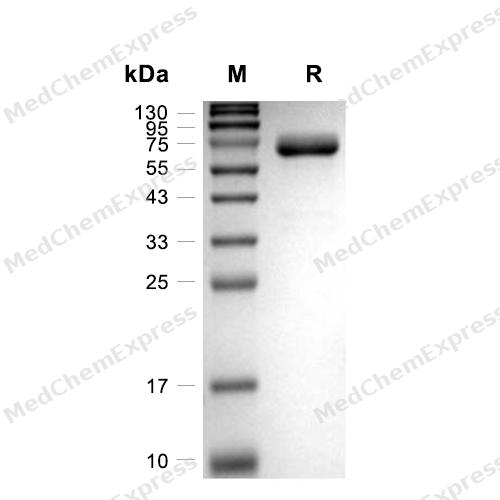
Purity - SDS-PAGE
-
Bioactivity - ELISA
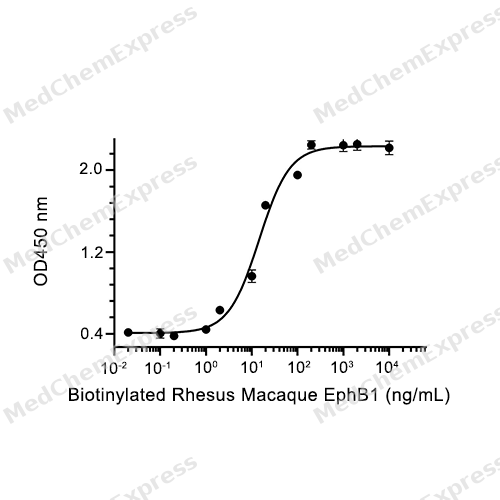
Bioactivity - ELISA


Technical Parameters
-
Species Rhesus Macaque
-
Source HEK293
-
Tag C-10*His
-
Accession
XP_001115263.1 (M18-P540)
-
Molecular Construction
-
N-term
-
EphB1 (M18-P540)
Accession # XP_001115263.1 -
His
-
C-term
-
-
Protein Length
Partial
-
Synonyms
EPHB1; ELK; Prev. EPHT2; EK6; Hek6; Receptor Protein-Tyrosine Kinase; Neuronally-Expressed EPH-Related Tyrosine Kinase; Eph Tyrosine Kinase 2; Tyrosine-Protein Kinase Receptor EPH-2; EPH Tyrosine Kinase 2; Ephrin Type-B Receptor 1; EphB1; EPH-Like Kinase
-
AA Sequence
MEETLMDTRTATAELGWTANPASGWEEVSGYDENLNTIRTYQVCNVFEPNQNNWLLTTFINRRGAHRIYTEMRFTVRDCSSLPNVPGSCKETFNLYYYETDSVIATKKSAFWSEAPYLKVDTIAADESFSQVDFGGRLMKVNTEVRSFGPLTRNGFYLAFQDYGACMSLLSVRVFFKKCPSIVQNFAVFPETMTGAESTSLVIARGTCIPNAEEVDVPIKLYCNGDGEWMVPIGRCTCKPGYEPENSVACKACPAGTFKASQEAEGCSHCPSNSRSPAEASPICTCRTGYYRADFDPPEVACTSVPSGPRNVISIVNETSIILEWHPPRETGGRDDVTYNIICKKCRADRRSCSRCDDNVEFVPRQLGLTECRVSISSLWAHTPYTFDIQAINGVSSKSPFPPQHVSVNITTNQAAPSTVPIMHQVSATMRSITLSWPQPEQPNGIILDYEIRYYEKEHNEFNSSMARSQTNTARIDGLRPGMVYVVQVRARTVAGYGKFSGKMCFQTLTDDDYKSELREQLP
-
Molecular Weight
Approximately 58-77 kDa, based on SDS-PAGE under reducing conditions, due to the glycosylation.
-
Glycosylation
Yes
-
Purity
≥ 95%, as determined by reducing SDS-PAGE.


Product Properties
Lyophilized powder.
Lyophilized from a 0.22 μm filtered solution of PBS, pH 7.4.
<1 EU/μg, determined by LAL method.
It is not recommended to reconstitute to a concentration less than 100 μg/mL in ddH2O. For long term storage it is recommended to add a carrier protein (0.1% BSA, 5% HSA, 10% FBS or 5% Trehalose).
Stored at -20°C for 2 years from date of receipt. After reconstitution, it is stable at 4°C for 1 week or -20°C for longer (with carrier protein). It is recommended to freeze aliquots at -20°C or -80°C for extended storage.
Room temperature in continental US; may vary elsewhere.


Documentation
-
Data Sheet (266 KB)
-
SDS (251 KB)
- English - EN (251 KB)
- Français - FR (251 KB)
- Deutsch - DE (251 KB)
- Norwegian - NO (251 KB)
- Español - ES (251 KB)
- Swedish - SV (251 KB)
- Italian - IT (251 KB)
- Korean - KR (251 KB)
- Portuguese - PT (251 KB)
-
Handling Instructions (2659 KB)


References
[1]. Vindis C, et al. EphB1 recruits c-Src and p52Shc to activate MAPK/ERK and promote chemotaxis. J Cell Biol. 2003 Aug 18;162(4):661-71. [Content Brief]
[2]. Stein E, et al. Nck recruitment to Eph receptor, EphB1/ELK, couples ligand activation to c-Jun kinase. J Biol Chem. 1998 Jan 16;273(3):1303-8. [Content Brief]
[3]. Kaur S, et al. Ephrin B/EphB in neuropathic pain: Role and molecular mechanisms. Fundam Clin Pharmacol. 2023 Jul 3. [Content Brief]
[4]. Xie Y, et al. EphB1 promotes the differentiation and maturation of dendritic cells in non-small cell lung cancer. Cancer Lett. 2023 Dec 7;582:216567. [Content Brief]

Calculators
Concentration (start) × Volume (start) = Concentration (final) × Volume (final)


 Powered by Bioz

