



FBLN1 Protein, Human (HEK293, His, Myc)

Based on 1 Customer Validation
FBLN1 Protein, Human (HEK293, His, Myc) is the recombinant human-derived FBLN1, expressed by HEK293 , with N-10*His, C-Myc labeled tag.
- Species: Human
- Source: HEK293
-
Storage:Stored at -20°C for 2 years from date of receipt. After reconstitution, it is stable at 4°C for 1 week or -20°C for longer (with carrier protein). It is recommended to freeze aliquots at -20°C or -80°C for extended storage.


To place orders, for customer services and technical support, please contact: MedChemExpress USA
Tel: 609-228-6898 E-mail: [email protected] [email protected]


-
 Biological Activity
-
Technical Parameters
-
Product Properties
- Documentation
- Help & FAQs




Biological Activity
Description
FBLN1 Protein, Human (HEK293, His, Myc) is the recombinant human-derived FBLN1, expressed by HEK293 , with N-10*His, C-Myc labeled tag.
Background
FBLN1 is a protein incorporated into fibronectin-containing matrix fibers within the extracellular matrix (ECM), potentially playing roles in cell adhesion and migration along ECM protein fibers. It contributes to certain developmental processes and the supramolecular organization of ECM architecture, particularly in basement membranes. Evidence suggests FBLN1 may act as a tumor suppressor, with implications in cellular transformation and tumor invasion. Additionally, its fibrinogen-binding capability and incorporation into clots indicate potential functions in haemostasis and thrombosis. by similar: FBLN1 might also significantly modulate the neurotrophic activities of APP, especially soluble APP.
Verified Bioactivity
Immobilized Human ITGA5-ITGB1 (HY-P73872) at 2 μg/mL (100 μL/well) can bind Biotinylated Human FBLN1 Protein, the ED50 for this effect is <2.5 μg/mL.
MCE Validation Data
-
Purity - SDS-PAGE
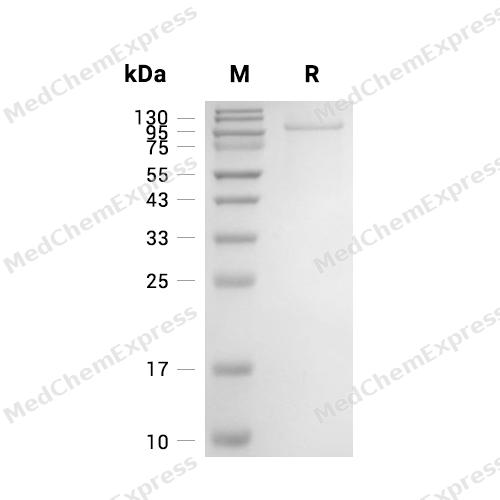
Purity - SDS-PAGE
-
Bioactivity - ELISA
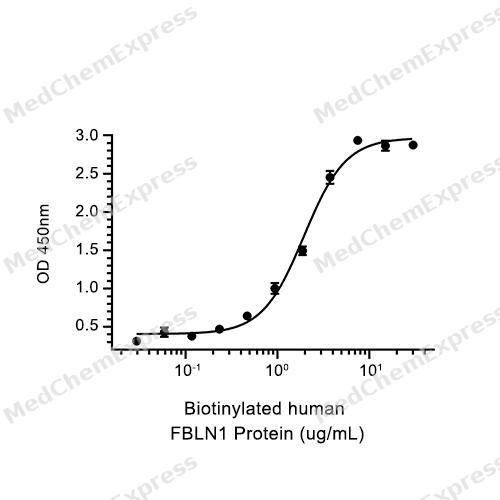
Bioactivity - ELISA


Technical Parameters
-
Species Human
-
Source HEK293
-
Tag N-10*His;C-Myc
-
Accession
P23142-1 (D30-F703)
-
Gene ID2192
-
Molecular Construction
-
N-term
-
10*His
-
FBLN1 (D30-F703)
Accession # P23142-1 -
Myc
-
C-term
-
-
Protein Length
Full Length of Isoform-1
-
Synonyms
FBLN1; FBLN; Fibulin 1; FIBL-1; Fibulin-1; FIBL1
-
AA Sequence
DVLLEACCADGHRMATHQKDCSLPYATESKECRMVQEQCCHSQLEELHCATGISLANEQDRCATPHGDNASLEATFVKRCCHCCLLGRAAQAQGQSCEYSLMVGYQCGQVFQACCVKSQETGDLDVGGLQETDKIIEVEEEQEDPYLNDRCRGGGPCKQQCRDTGDEVVCSCFVGYQLLSDGVSCEDVNECITGSHSCRLGESCINTVGSFRCQRDSSCGTGYELTEDNSCKDIDECESGIHNCLPDFICQNTLGSFRCRPKLQCKSGFIQDALGNCIDINECLSISAPCPIGHTCINTEGSYTCQKNVPNCGRGYHLNEEGTRCVDVDECAPPAEPCGKGHRCVNSPGSFRCECKTGYYFDGISRMCVDVNECQRYPGRLCGHKCENTLGSYLCSCSVGFRLSVDGRSCEDINECSSSPCSQECANVYGSYQCYCRRGYQLSDVDGVTCEDIDECALPTGGHICSYRCINIPGSFQCSCPSSGYRLAPNGRNCQDIDECVTGIHNCSINETCFNIQGGFRCLAFECPENYRRSAATLQQEKTDTVRCIKSCRPNDVTCVFDPVHTISHTVISLPTFREFTRPEEIIFLRAITPPHPASQANIIFDITEGNLRDSFDIIKRYMDGMTVGVVRQVRPIVGPFHAVLKLEMNYVVGGVVSHRNVVNVHIFVSEYWF
-
Molecular Weight
Approximately 80-100 kDa, based on SDS-PAGE under reducing conditions, due to the glycosylation.
-
Glycosylation
Yes
-
Purity
≥ 90%, as determined by reducing SDS-PAGE.


Product Properties
Lyophilized powder
Lyophilized from a 0.22 μm filtered solution of PBS, 6% Trehalose, pH 7.4.
<1 EU/μg, determined by LAL method.
It is not recommended to reconstitute to a concentration less than 100 μg/mL in ddH2O.
Stored at -20°C for 2 years from date of receipt. After reconstitution, it is stable at 4°C for 1 week or -20°C for longer (with carrier protein). It is recommended to freeze aliquots at -20°C or -80°C for extended storage.
Room temperature in continental US; may vary elsewhere.


Documentation
-
Data Sheet (239 KB)
-
SDS (252 KB)
- English - EN (252 KB)
- Français - FR (252 KB)
- Deutsch - DE (252 KB)
- Norwegian - NO (252 KB)
- Español - ES (252 KB)
- Swedish - SV (252 KB)
- Italian - IT (252 KB)
- Korean - KR (252 KB)
- Portuguese - PT (252 KB)
-
Handling Instructions (2659 KB)

Calculators
Concentration (start) × Volume (start) = Concentration (final) × Volume (final)


 Powered by Bioz

