



FCGRT-B2M Heterodimer Protein, Rat (HEK293, His)

Based on 1 Customer Validation
The FCGRT-B2M heterodimeric protein is a cell surface receptor that interacts with IgG and albumin and contributes to effective humoral immunity. FCGRT-B2M Heterodimer Protein, Rat (HEK293, His) is a recombinant protein dimer complex containing rat-derived FCGRT-B2M Heterodimer protein, expressed by HEK293 , with C-His labeled tag.
- Species: Rat
- Source: HEK293
-
Storage:Stored at -20°C for 2 years from date of receipt. After reconstitution, it is stable at 4°C for 1 week or -20°C for longer (with carrier protein). It is recommended to freeze aliquots at -20°C or -80°C for extended storage.


To place orders, for customer services and technical support, please contact: MedChemExpress USA
Tel: 609-228-6898 E-mail: [email protected] [email protected]


-
 Biological Activity
-
Technical Parameters
-
Product Properties
- Documentation
- Help & FAQs




Biological Activity
Description
The FCGRT-B2M heterodimeric protein is a cell surface receptor that interacts with IgG and albumin and contributes to effective humoral immunity. FCGRT-B2M Heterodimer Protein, Rat (HEK293, His) is a recombinant protein dimer complex containing rat-derived FCGRT-B2M Heterodimer protein, expressed by HEK293 , with C-His labeled tag.
Background
The FCGRT-B2M heterodimer protein serves as a crucial cell surface receptor facilitating the transfer of passive humoral immunity from the mother to the newborn. Recognizing the Fc region of monomeric immunoglobulin gamma, it selectively uptakes IgG from milk, particularly at the apical surface of the intestinal epithelium. The formed FcRn-IgG complexes undergo transcytosis across the intestinal epithelium, releasing IgG from FcRn into blood or tissue fluids. This process contributes significantly to effective humoral immunity by recycling IgG and extending its half-life in the circulation. Mechanistically, monomeric IgG binding to FcRn in acidic endosomes of endothelial and hematopoietic cells facilitates the recycling of IgG to the cell surface, releasing it into circulation. Notably, besides its role in IgG homeostasis, the FCGRT-B2M heterodimer also regulates the homeostasis of another abundant circulating protein, albumin/ALB, through interactions with albumin. The FcRn complex, consisting of two subunits, p51, and p14 (equivalent to beta-2-microglobulin), forms an MHC class I-like heterodimer, highlighting its pivotal role in immune and protein homeostasis.
Verified Bioactivity
Measured by its binding ability in a functional ELISA. When FCRN-B2M is immobilized at 2 µg/mL (100 µL/well), can bind Biotinylated Human lgG1. The ED50 for this effect is <200 ng/mL.
MCE Validation Data
-
Purity - SDS-PAGE
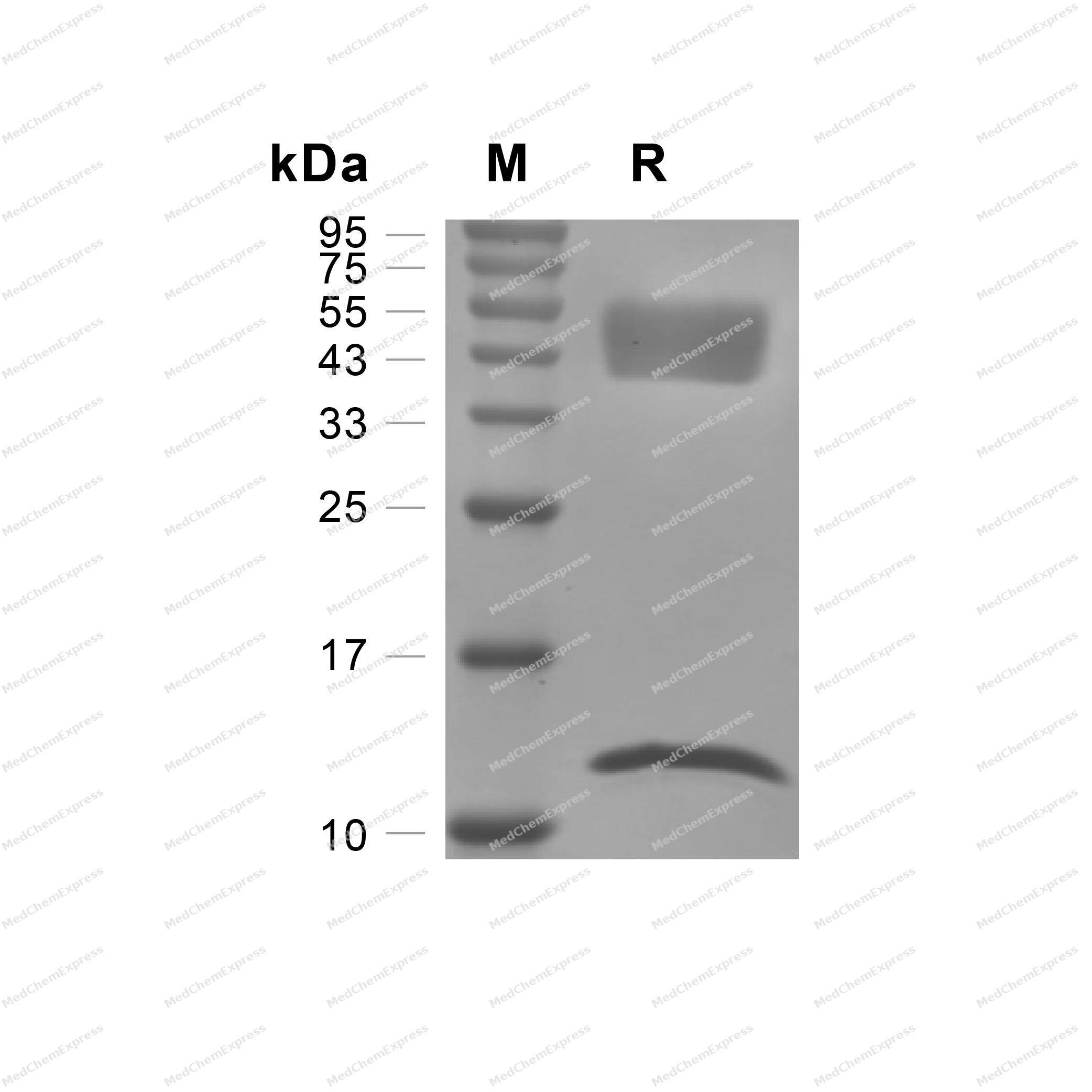
Purity - SDS-PAGE
-
Bioactivity - ELISA
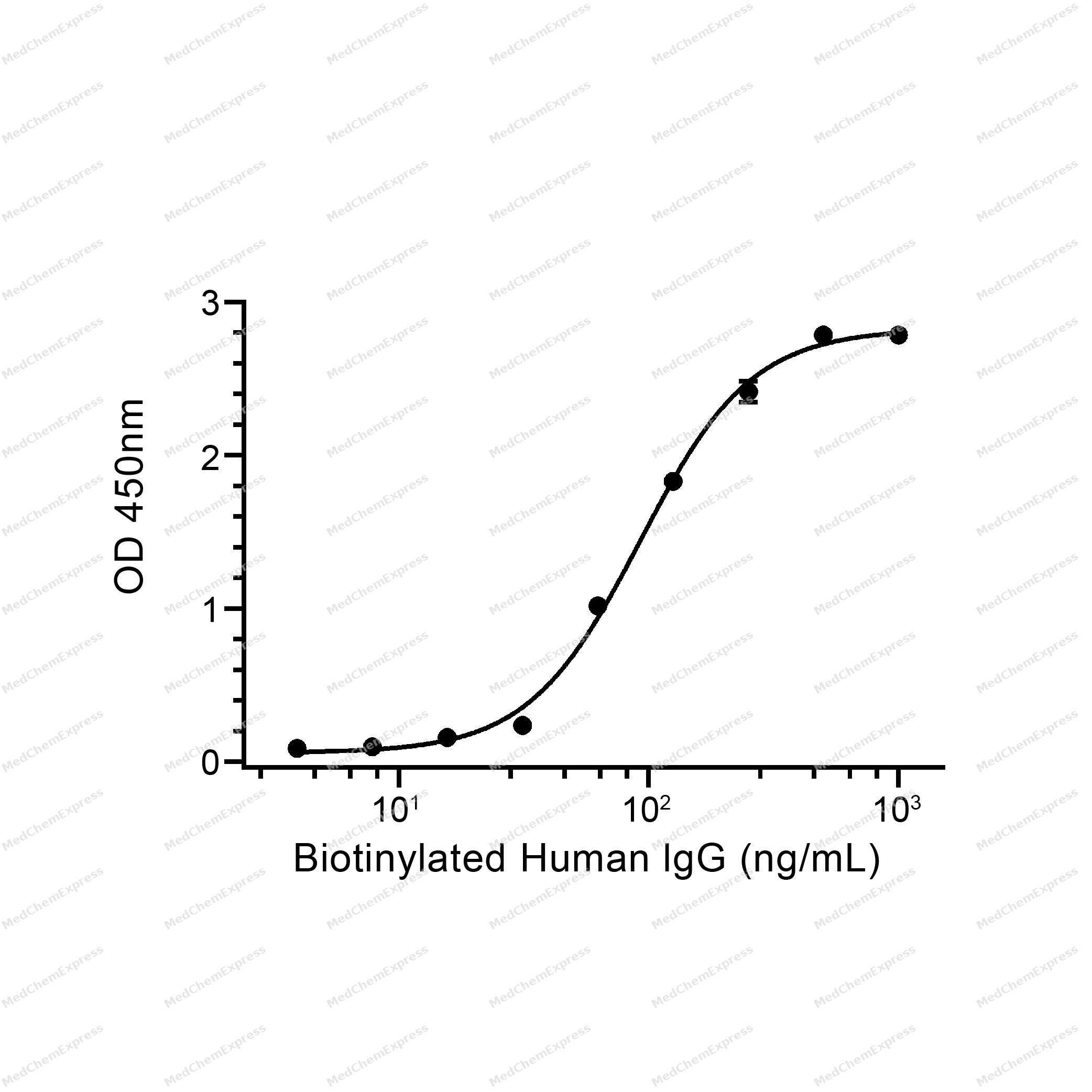
Bioactivity - ELISA


Technical Parameters
-
Species Rat
-
Source HEK293
-
Tag C-6*His
-
Accession
P13599 (A23-S298)&P07151 (I21-M119)
-
Gene ID29558&24223
-
Synonyms
FCGRT; Major Histocompatibility Complex Class I-Like Fc Receptor; Fc Gamma Receptor And Transporter; Neonatal Crystallizable Fc Receptor FcRn Splice Variant 6; Neonatal Fc Receptor; Neonatal Crystallizable Fc Receptor FcRn Splice Variant 5; FcRn; Neonatal
-
Predicted Molecular Mass
31 kDa & 11.6 kDa
-
Molecular Weight
Approximately 38-55 kDa & 12 kDa, based on SDS-PAGE under reducing conditions.
-
Glycosylation
Yes
-
Purity
≥ 95%, as determined by reducing SDS-PAGE.


Product Properties
Lyophilized powder.
Lyophilized from a 0.22 μm filtered solution of PBS, pH 7.4.
<1 EU/μg, determined by LAL method.
It is not recommended to reconstitute to a concentration less than 100 μg/mL in ddH2O. For long term storage it is recommended to add a carrier protein (0.1% BSA, 5% HSA, 10% FBS or 5% Trehalose).
Stored at -20°C for 2 years from date of receipt. After reconstitution, it is stable at 4°C for 1 week or -20°C for longer (with carrier protein). It is recommended to freeze aliquots at -20°C or -80°C for extended storage.
Room temperature in continental US; may vary elsewhere.


Documentation
-
Data Sheet (235 KB)
-
SDS (252 KB)
- English - EN (252 KB)
- Français - FR (252 KB)
- Deutsch - DE (252 KB)
- Norwegian - NO (252 KB)
- Español - ES (252 KB)
- Swedish - SV (252 KB)
- Italian - IT (252 KB)
- Korean - KR (252 KB)
- Portuguese - PT (252 KB)
-
Handling Instructions (2659 KB)

Calculators
Concentration (start) × Volume (start) = Concentration (final) × Volume (final)


 Powered by Bioz

