



Galectin-7/LGALS7 Protein, Human

Based on 1 Customer Validation
Galectin-7 (LGALS7), a protein with potential involvement in cell-cell and/or cell-matrix interactions crucial for normal growth control, serves as a pro-apoptotic factor. It functions intracellularly, playing a role upstream of JNK activation and cytochrome c release, thus contributing to apoptotic pathways. Galectin-7 exists as a monomer, highlighting its individual unit structure. Galectin-7/LGALS7 Protein, Human is the recombinant human-derived Galectin-7/LGALS7 protein, expressed by E. coli , with tag free.
- Species: Human
- Source: E. coli
-
Storage:Stored at -20°C for 2 years from date of receipt. After reconstitution, it is stable at 4°C for 1 week or -20°C for longer (with carrier protein). It is recommended to freeze aliquots at -20°C or -80°C for extended storage.


To place orders, for customer services and technical support, please contact: MedChemExpress USA
Tel: 609-228-6898 E-mail: [email protected] [email protected]


-
 Biological Activity
-
Technical Parameters
-
Product Properties
- Documentation
- Help & FAQs




Biological Activity
Description
Galectin-7 (LGALS7), a protein with potential involvement in cell-cell and/or cell-matrix interactions crucial for normal growth control, serves as a pro-apoptotic factor. It functions intracellularly, playing a role upstream of JNK activation and cytochrome c release, thus contributing to apoptotic pathways. Galectin-7 exists as a monomer, highlighting its individual unit structure. Galectin-7/LGALS7 Protein, Human is the recombinant human-derived Galectin-7/LGALS7 protein, expressed by E. coli , with tag free.
Background
Galectin-7, also known as LGALS7, is a protein potentially involved in critical cell-cell and/or cell-matrix interactions essential for normal growth control. Functioning as a pro-apoptotic protein, Galectin-7 operates intracellularly upstream of JNK activation and cytochrome c release, suggesting its role in apoptotic pathways. It exists as a monomer, and its involvement in cellular interactions and apoptotic processes underscores its significance in regulating cell growth and survival. Understanding the functions of Galectin-7 provides valuable insights into the intricate molecular mechanisms governing normal cellular processes and apoptotic signaling.
Verified Bioactivity
Measured in a cell proliferation assay using SH-SY5Y cells. The ED50 for this effect is 0.2176 μg/mL, corresponding to a specific activity is 4.596×10³ units/mg.
MCE Validation Data
-
Purity - SDS-PAGE
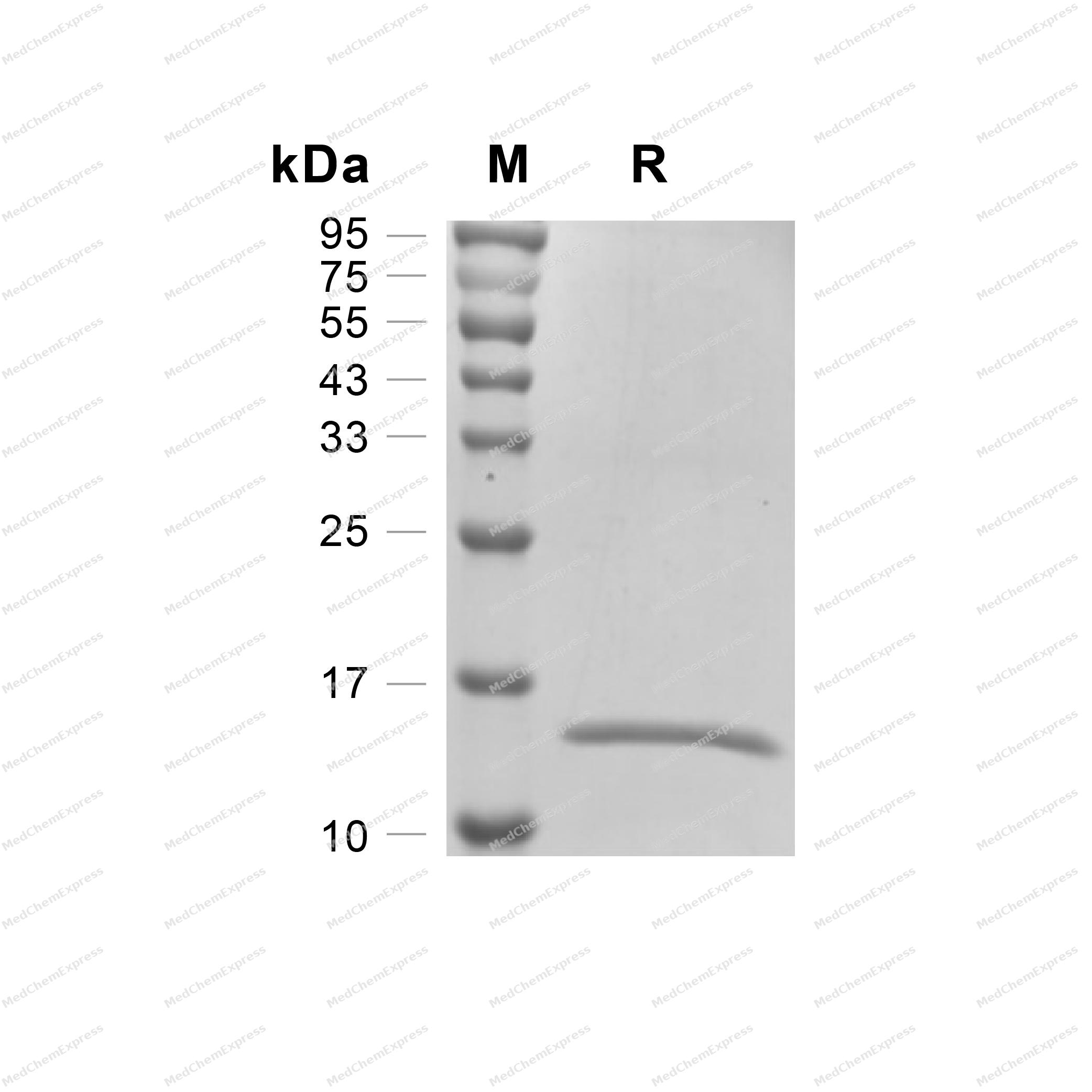
Purity - SDS-PAGE
-
Bioactivity - Cell-Based Assay
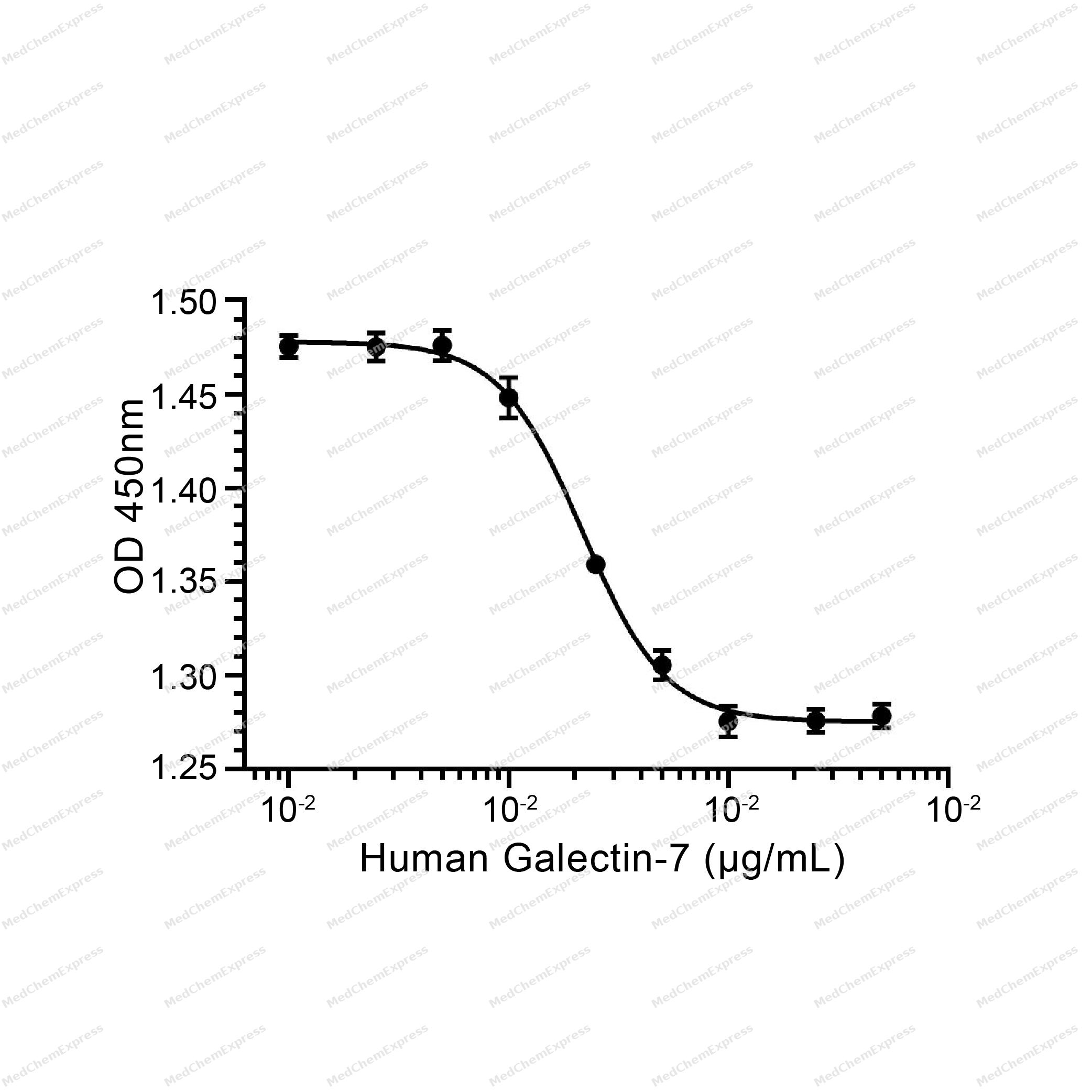
Bioactivity - Cell-Based Assay


Technical Parameters
-
Species Human
-
Source E. coli
-
Tag Tag Free
-
Accession
P47929 (M1-F136)
-
Molecular Construction
-
N-term
-
LGALS7 (M1-F136)
Accession # P47929 -
C-term
-
-
Protein Length
Full Length
-
Synonyms
LGALS7; Galectin-7; Galectin 7; TP53I1; LGALS7A; P53-Induced Gene 1 Protein; GAL7; HKL-14; PIG1; Gal-7; Lectin, Galactoside-Binding, Soluble, 7; PI7
-
AA Sequence
MSNVPHKSSLPEGIRPGTVLRIRGLVPPNASRFHVNLLCGEEQGSDAALHFNPRLDTSEVVFNSKEQGSWGREERGPGVPFQRGQPFEVLIIASDDGFKAVVGDAQYHHFRHRLPLARVRLVEVGGDVQLDSVRIF
-
Molecular Weight
Approximately 14 kDa, based on SDS-PAGE under reducing conditions.
-
Purity
≥ 95%, as determined by reducing SDS-PAGE.


Product Properties
Lyophilized powder
1.Lyophilized from a 0.22 μm filtered solution of 20 mM Tris-HCl, 150 mM NaCl, 1 mM EDTA, 5% Trehalose, pH 8.0
2.Lyophilized from a 0.22 μm filtered solution of 50 mM Tris-HCl, 300 mM NaCl, pH 8.0.
Please refer to the lot-specific COA for specific buffer information.
Note: For SPR assay, please replace the buffer. Primary amine components (e.g., Tris, imidazole) can affect protein-coupled chips.
<1 EU/μg, determined by LAL method.
It is not recommended to reconstitute to a concentration less than 100 μg/mL in ddH2O.
Stored at -20°C for 2 years from date of receipt. After reconstitution, it is stable at 4°C for 1 week or -20°C for longer (with carrier protein). It is recommended to freeze aliquots at -20°C or -80°C for extended storage.
Room temperature in continental US; may vary elsewhere.


Documentation
-
Data Sheet (236 KB)
-
SDS (252 KB)
- English - EN (252 KB)
- Français - FR (252 KB)
- Deutsch - DE (252 KB)
- Norwegian - NO (252 KB)
- Español - ES (252 KB)
- Swedish - SV (252 KB)
- Italian - IT (252 KB)
- Korean - KR (252 KB)
- Portuguese - PT (252 KB)
-
Handling Instructions (2659 KB)

Calculators
Concentration (start) × Volume (start) = Concentration (final) × Volume (final)


 Powered by Bioz

