



HAI-1 Protein, Mouse (HEK293, Fc)
Based on 1 Customer Validation
The HAI-1 protein is a multifaceted inhibitor that potently inhibits HGFAC and protects against serine proteases such as ST14/matriptase and TMPRSS13. Through its BPTI/Kunitz inhibitor 1 domain, HAI-1 cleverly coordinates inhibition, engaging in a delicate molecular dance with HGFAC and TMPRSS13. HAI-1 Protein, Mouse (HEK293, Fc) is the recombinant mouse-derived HAI-1 protein, expressed by HEK293 , with C-hFc labeled tag.
- Species: Mouse
- Source: HEK293
-
Storage:Stored at -20°C for 2 years from date of receipt. After reconstitution, it is stable at 4°C for 1 week or -20°C for longer (with carrier protein). It is recommended to freeze aliquots at -20°C or -80°C for extended storage.


To place orders, for customer services and technical support, please contact: MedChemExpress USA
Tel: 609-228-6898 E-mail: [email protected] [email protected]


-
 Biological Activity
-
Technical Parameters
-
Product Properties
- Documentation
- Help & FAQs




Biological Activity
Description
The HAI-1 protein is a multifaceted inhibitor that potently inhibits HGFAC and protects against serine proteases such as ST14/matriptase and TMPRSS13. Through its BPTI/Kunitz inhibitor 1 domain, HAI-1 cleverly coordinates inhibition, engaging in a delicate molecular dance with HGFAC and TMPRSS13. HAI-1 Protein, Mouse (HEK293, Fc) is the recombinant mouse-derived HAI-1 protein, expressed by HEK293 , with C-hFc labeled tag.
Background
HAI-1, a multifaceted protein, stands as a potent inhibitor in diverse cellular contexts. Notably, it acts as a robust inhibitor of HGFAC, exerting its regulatory influence on this pivotal factor. Functioning as a guardian against serine protease activities, HAI-1 demonstrates inhibitory effects on ST14/matriptase and TMPRSS13, skillfully wielding its BPTI/Kunitz inhibitor 1 domain. The intricate molecular ballet involves direct interactions with HGFAC and TMPRSS13, orchestrating a nuanced dance that not only inhibits but also promotes specific cellular processes. The interplay with TMPRSS13 underscores HAI-1's role in orchestrating the phosphorylation and cellular localization of this serine protease. In these multifaceted interactions, HAI-1 emerges as a versatile guardian, finely tuning the delicate balance of protease activities in cellular environments.
Verified Bioactivity
Measured by its ability to inhibit trypsin cleavage of a fluorogenic peptide substrate, Mca-RPKPVE-Nval-WRK(Dnp)-NH2 The IC50 value is 0.35 nM.
MCE Validation Data
-
Purity - SDS-PAGE
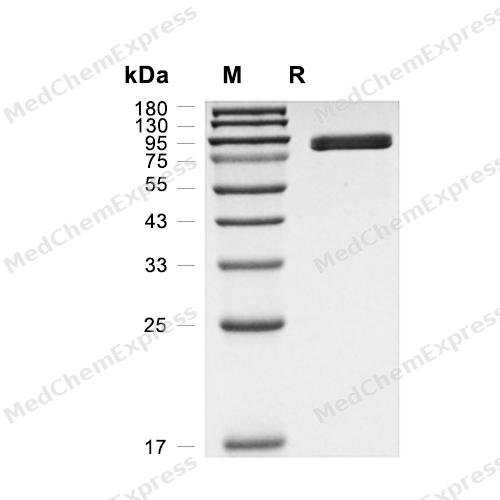
Purity - SDS-PAGE


Technical Parameters
-
Species Mouse
-
Source HEK293
-
Tag C-hFc
-
Accession
Q9R097 (E30-E443)
-
Molecular Construction
-
N-term
-
HAI-1 (E30-E443)
Accession # Q9R097 -
hFc
-
C-term
-
-
Protein Length
Partial
-
Synonyms
SPINT1; MANSC2; Serine Peptidase Inhibitor, Kunitz Type 1; HAI; HAI-1; Serine Protease Inhibitor, Kunitz Type 1; Hepatocyte Growth Factor Activator Inhibitor Type 1; HAI1; Kunitz-Type Protease Inhibitor 1
-
AA Sequence
ELPSAPAELPGGAACLSRFTSGVPSFVLDTEASVSNGATFLGSPTARRGWDCVRSCCTTQNCNLALVELQPDGGEDAISACFLMNCLYEQNFVCKFAPKEGFINYLTQELYRSYRELRTRGFGGSRIPRIWMGIDLKVQLQKPLVLNEADNTDWHLLQGDSDVRVERKRPEEVELWGLKEGTYLFQLTRTDSDQPEETANLTITVLTAKQTEDYCLASYKVGRCRGSFPRWYYDPKEQICKSFTFGGCLGNKNNYLREEECMLACKDVQGISPKRHHPVCSGSCHATQFRCSNGCCIDGFLECDDTPDCPDGSDEATCEKYTSGFDELQNIHFLSDKGYCAELPDTGFCKENIPRWYYNPFSERCARFTYGGCYGNKNNFEEEQQCLESCRGISKKDVFGLRREGSIPTVGSAE
-
Predicted Molecular Mass
72.5 kDa
-
Molecular Weight
Approximately 80-95 kDa, based on SDS-PAGE under reducing conditions, due to the glycosylation.
-
Glycosylation
Yes
-
Purity
≥ 95%, as determined by reducing SDS-PAGE.


Product Properties
Lyophilized powder.
Lyophilized from a 0.22 μm filtered solution of PBS, pH 7.4.
<1 EU/μg, determined by LAL method.
It is not recommended to reconstitute to a concentration less than 100 μg/mL in ddH2O. For long term storage it is recommended to add a carrier protein (0.1% BSA, 5% HSA, 10% FBS or 5% Trehalose).
Stored at -20°C for 2 years from date of receipt. After reconstitution, it is stable at 4°C for 1 week or -20°C for longer (with carrier protein). It is recommended to freeze aliquots at -20°C or -80°C for extended storage.
Room temperature in continental US; may vary elsewhere.


Documentation
-
Data Sheet (238 KB)
-
SDS (251 KB)
- English - EN (251 KB)
- Français - FR (251 KB)
- Deutsch - DE (251 KB)
- Norwegian - NO (251 KB)
- Español - ES (251 KB)
- Swedish - SV (251 KB)
- Italian - IT (251 KB)
- Korean - KR (251 KB)
- Portuguese - PT (251 KB)
-
Handling Instructions (2659 KB)

Calculators
Concentration (start) × Volume (start) = Concentration (final) × Volume (final)


 Powered by Bioz

