



Histone H3 Protein, Human (His)

Based on 1 Customer Validation
Histone H3 proteins are critical in nucleosomes, which compact DNA into chromatin and regulate DNA accessibility. Histone H3 Protein, Human (His) is the recombinant human-derived Histone H3 protein, expressed by E. coli , with N-His labeled tag.
- Species: Human
- Source: E. coli
-
Storage:Stored at -20°C for 2 years from date of receipt. After reconstitution, it is stable at 4°C for 1 week or -20°C for longer (with carrier protein). It is recommended to freeze aliquots at -20°C or -80°C for extended storage.


To place orders, for customer services and technical support, please contact: MedChemExpress USA
Tel: 609-228-6898 E-mail: [email protected] [email protected]


-
 Biological Activity
-
Technical Parameters
-
Product Properties
- Documentation
- Help & FAQs





Biological Activity
Description
Histone H3 proteins are critical in nucleosomes, which compact DNA into chromatin and regulate DNA accessibility. Histone H3 Protein, Human (His) is the recombinant human-derived Histone H3 protein, expressed by E. coli , with N-His labeled tag.
Background
Histone H3, a fundamental component of the nucleosome, serves as a linchpin in the intricate process of wrapping and compacting DNA into chromatin, which in turn restricts DNA accessibility to cellular machineries requiring DNA as a template. This histone, alongside its counterparts, assumes a pivotal role in pivotal cellular functions, including transcription regulation, DNA repair, DNA replication, and the maintenance of chromosomal stability. The regulation of DNA accessibility involves a sophisticated interplay of post-translational modifications collectively referred to as the histone code, coupled with the dynamic remodeling of nucleosomes. The nucleosome itself comprises a histone octamer, composed of two molecules each of H2A, H2B, H3, and H4, assembled in one H3-H4 heterotetramer and two H2A-H2B heterodimers. This octamer efficiently wraps approximately 147 base pairs of DNA, exemplifying its indispensable role in organizing chromatin structure and facilitating crucial genomic processes. Additionally, Histone H3 interacts with various cellular components such as TONSL, CHAF1A, CHAF1B, MCM2, and DNAJC9, further contributing to its multifaceted functions.
MCE Validation Data
-
Purity - SDS-PAGE
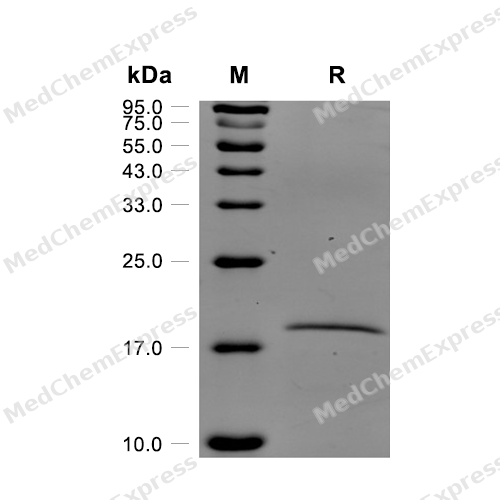
Purity - SDS-PAGE


Technical Parameters
-
Species Human
-
Source E. coli
-
Tag N-His
-
Accession
P68431 (A2-A136)
-
Molecular Construction
-
N-term
-
His
-
Histone H3 (M1-A136)
Accession # P68431 -
C-term
-
-
Protein Length
Full Length
-
Synonyms
H3C1; Histone H3/C; Prev. HIST1H3A; HIST1H3J; Prev. H3FA; HIST1H3I; H3/A; HIST1H3H; Histone Cluster 1 H3 Family Member A; HIST1H3G; H3 Histone Family, Member A; HIST1H3F; Histone Cluster 1, H3a; HIST1H3E; Histone 1, H3a; HIST1H3D; Histone H3.1; HIST1H3B;
-
AA Sequence
ARTKQTARKSTGGKAPRKQLATKAARKSAPATGGVKKPHRYRPGTVALREIRRYQKSTELLIRKLPFQRLVREIAQDFKTDLRFQSSAVMALQEACEAYLVGLFEDTNLCAIHAKRVTIMPKDIQLARRIRGERA
-
Molecular Weight
Approximately 18 kDa, based on SDS-PAGE under reducing conditions.
-
Purity
≥ 90%, as determined by reducing SDS-PAGE.


Product Properties
Lyophilized powder
1.Lyophilized from a 0.22 μm filtered solution of PBS, pH 7.4.
2.Lyophilized from a 0.22 μm filtered solution of 50 mM Tris-HCl, 300 mM NaCl, 200 mM arginine, pH 8.0.
Please refer to the lot-specific COA for specific buffer information.
Note: For SPR assay, please replace the buffer. Primary amine components (e.g., Tris, imidazole) can affect protein-coupled chips.
/
It is not recommended to reconstitute to a concentration less than 100 μg/mL in ddH2O. For long term storage it is recommended to add a carrier protein (0.1% BSA, 5% HSA, 10% FBS or 5% Trehalose).
Stored at -20°C for 2 years from date of receipt. After reconstitution, it is stable at 4°C for 1 week or -20°C for longer (with carrier protein). It is recommended to freeze aliquots at -20°C or -80°C for extended storage.
Room temperature in continental US; may vary elsewhere.


Documentation
-
Data Sheet (236 KB)
-
SDS (251 KB)
- English - EN (251 KB)
- Français - FR (251 KB)
- Deutsch - DE (251 KB)
- Norwegian - NO (251 KB)
- Español - ES (251 KB)
- Swedish - SV (251 KB)
- Italian - IT (251 KB)
- Korean - KR (251 KB)
- Portuguese - PT (251 KB)
-
Handling Instructions (2659 KB)

Calculators
Concentration (start) × Volume (start) = Concentration (final) × Volume (final)


 Powered by Bioz

