



HMGN1 Protein, Human
Based on 1 publication(s) in Google Scholar
The HMGN1 protein is a key player in the immune response, binding to the Fc region of immunoglobulin alpha and specifically promoting the production of cytokines. HMGN1 is intricately related to the Fc epsilon RI gamma 2 receptor, can induce tyrosine phosphorylation of gamma 2, and actively participates in the complex coordination of immune signaling pathways. HMGN1 Protein, Human is the recombinant human-derived HMGN1 protein, expressed by E. coli , with tag free.
- Species: Human
- Source: E. coli
-
Storage:Stored at -20°C for 2 years from date of receipt. After reconstitution, it is stable at 4°C for 1 week or -20°C for longer (with carrier protein). It is recommended to freeze aliquots at -20°C or -80°C for extended storage.


To place orders, for customer services and technical support, please contact: MedChemExpress USA
Tel: 609-228-6898 E-mail: [email protected] [email protected]


-
 Biological Activity
-
Technical Parameters
-
Product Properties
- Documentation
- Help & FAQs




Biological Activity
Description
The HMGN1 protein is a key player in the immune response, binding to the Fc region of immunoglobulin alpha and specifically promoting the production of cytokines. HMGN1 is intricately related to the Fc epsilon RI gamma 2 receptor, can induce tyrosine phosphorylation of gamma 2, and actively participates in the complex coordination of immune signaling pathways. HMGN1 Protein, Human is the recombinant human-derived HMGN1 protein, expressed by E. coli , with tag free.
Background
FCAR/CD89, a pivotal player in immune responses, exhibits the capability to bind to the Fc region of immunoglobulins alpha, facilitating various functions, notably cytokine production. This multifaceted protein is intricately associated with the Fc epsilon RI gamma 2 receptor, leading to the induction of tyrosine phosphorylation of gamma 2. Through these molecular interactions, FCAR/CD89 actively participates in the complex orchestration of immune signaling pathways, highlighting its role in mediating crucial aspects of the immune response.
Verified Bioactivity
Measured by its binding ability in a functional ELISA. Immobilized HMGN1 at 2 μg/mL (100 μL/well) can bind anti- HMGN1 Antibody. The ED50 for this effect is 57.03 ng/mL.
MCE Validation Data
-
Purity - SDS-PAGE
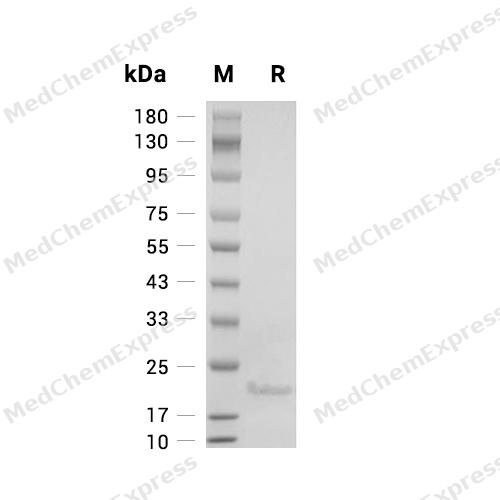
Purity - SDS-PAGE
-
Bioactivity - ELISA
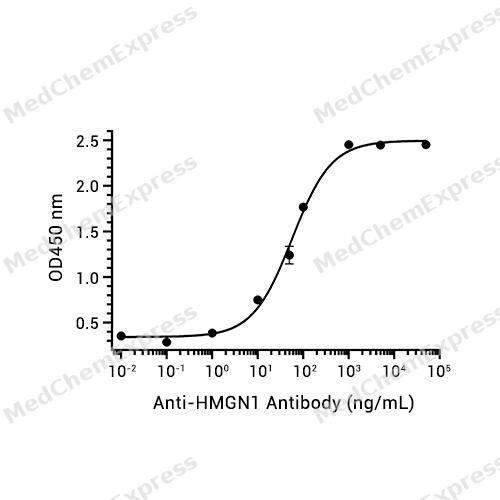
Bioactivity - ELISA


Publications (1)
-
Journal Impact Factor
-
Most Recent
-
J Genet Genomics
Chromatin-binding protein HMGN1 promotes HCC tumorigenesis via histone methylation-induced RALB transcriptional suppression. [Abstract]2026 Mar 13:S1673-8527(26)00079-2. PMID: 41833635


Technical Parameters
-
Species Human
-
Source E. coli
-
Tag Tag Free
-
Accession
P05114 (P2-D100)
-
Molecular Construction
-
N-term
-
HMGN1 (P2-D100)
Accession # P05114 -
C-term
-
-
Protein Length
Full Length
-
Synonyms
HMGN1; Non-Histone Chromosomal Protein HMG-14; Prev. HMG14; MGC104230; High Mobility Group Nucleosome-Binding Domain-Containing Protein 1; MGC117425; High-Mobility Group (Nonhistone Chromosomal) Protein 14; FLJ27265; High-Mobility Group Nucleosome Binding
-
AA Sequence
PKRKVSSAEGAAKEEPKRRSARLSAKPPAKVEAKPKKAAAKDKSSDKKVQTKGKRGAKGKQAEVANQETKEDLPAENGETKTEESPASDEAGEKEAKSD
-
Predicted Molecular Mass
10.5 kDa
-
Molecular Weight
Approximately 19 kDa, based on SDS-PAGE under reducing conditions.
-
Purity
≥ 95%, as determined by reducing SDS-PAGE.


Product Properties
Lyophilized powder.
Lyophilized from a 0.22 μm filtered solution of PBS, pH 7.4.
<1 EU/μg, determined by LAL method.
It is not recommended to reconstitute to a concentration less than 500 μg/mL in ddH2O. For long term storage it is recommended to add a carrier protein (0.1% BSA, 5% HSA, 10% FBS or 5% Trehalose).
Stored at -20°C for 2 years from date of receipt. After reconstitution, it is stable at 4°C for 1 week or -20°C for longer (with carrier protein). It is recommended to freeze aliquots at -20°C or -80°C for extended storage.
Room temperature in continental US; may vary elsewhere.


Documentation
-
Data Sheet (235 KB)
-
SDS (254 KB)
- English - EN (254 KB)
- Français - FR (254 KB)
- Deutsch - DE (254 KB)
- Norwegian - NO (254 KB)
- Español - ES (254 KB)
- Swedish - SV (254 KB)
- Italian - IT (254 KB)
- Korean - KR (254 KB)
- Portuguese - PT (254 KB)
-
Handling Instructions (2659 KB)

Calculators
Concentration (start) × Volume (start) = Concentration (final) × Volume (final)


 Powered by Bioz

