



IGF-I/IGF-1 Protein, Mouse (His)
Based on 5 publication(s) in Google Scholar
IGF-I/IGF-1 Protein, Mouse (His) is a mitogenic cytokine, binds to IGF type 1 receptor, and modulates growth in many tissues, such as nervous tissue, lymphoid tissue, reproductive tissue, smooth muscle, endothelium, and bone. IGF1 also mediates neuroprotective mechanism.
- Species: Mouse
- Source: E. coli
-
Storage:Stored at -20°C for 2 years from date of receipt. After reconstitution, it is stable at 4°C for 1 week or -20°C for longer (with carrier protein). It is recommended to freeze aliquots at -20°C or -80°C for extended storage.


To place orders, for customer services and technical support, please contact: MedChemExpress USA
Tel: 609-228-6898 E-mail: [email protected] [email protected]


-
 Biological Activity
-
Technical Parameters
-
Product Properties
- Documentation
- References
- Help & FAQs




Biological Activity
Description
IGF-I/IGF-1 Protein, Mouse (His) is a mitogenic cytokine, binds to IGF type 1 receptor, and modulates growth in many tissues, such as nervous tissue, lymphoid tissue, reproductive tissue, smooth muscle, endothelium, and bone. IGF1 also mediates neuroprotective mechanism.
Background
Insulin-like growth factor (IGF) system has been shown to modulate growth in many tissues, such as nervous tissue, lymphoid tissue, reproductive tissue, smooth muscle, endothelium, and bone. Insulin-like Growth factor-1 (IGF-I) is produced by osteoblasts, and its mitogenic effects are mediated by their binding to the IGF plasma membrane receptors. The IGF type 1 receptor binding to both IGF-I and IGF-II, is thought to be the predominate receptor involved in mediating the effects of these growth factors in most cell types, including osteoblasts[1]. Insulin-like growth factor-1 (IGF-1) is a neurotrophic factor capable of mediating neuroprotective and neuroplasticity mechanisms. Targeted overexpression of IGF-1 enhances the generation of hippocampal newborn neurons in brain-injured mice[2].
Verified Bioactivity
Measured in a serum-free cell proliferation assay using MCF-7 human breast cancer cells. The ED50 for this effect is 43.96 ng/mL. corresponding to a specific activity is 2.27×10⁴ units/mg.
MCE Validation Data
-
Bioactivity - Cell-Based Assay
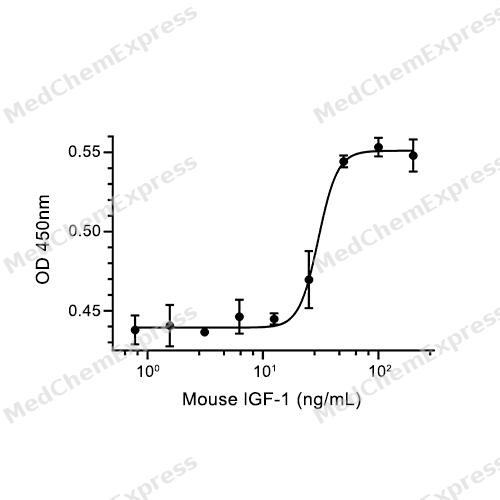
Bioactivity - Cell-Based Assay


Publications (5)
-
Journal Impact Factor
-
Most Recent
-
Life Sci
2025 Mar 1:364:123449. PMID: 39920984 -
-
J Cell Mol Med
Betulinic Acid Suppresses UBE2T Expression via MAPK/ERK Inhibition to Block FANCI and FANCD2 Monoubiquitination in Glioblastoma. [Abstract]2026 Jan;30(1):e71000. PMID: 41486508 -
Andrology
Insulin-like growth factor-1 promotes the testicular sperm production by improving germ cell survival and proliferation in high-fat diet-treated male mice. [Abstract]2025 Feb;13(2):342-358. PMID: 38639009 -
Tohoku J Exp Med
From Carbonic Anhydrase 12 to TGFβ1/Smad Pathway: A Key Mechanism for Isoorientin in Pulmonary Fibrosis Therapy. [Abstract]2026 Jan 22. PMID: 41565266


Technical Parameters
-
Species Mouse
-
Source E. coli
-
Tag C-6*His
-
Accession
P05017-1 (G49-A118)
-
Molecular Construction
-
N-term
-
IGF1 (G49-A118)
Accession # P05017-1 -
6*His
-
C-term
-
-
Protein Length
Full Length of Isoform-1
-
Synonyms
IGF1; Somatomedin-C; Insulin Like Growth Factor 1; IGF1A; IGF-I; MGF; Insulin-Like Growth Factor 1; Insulin-Like Growth Factor IB; Insulin-Like Growth Factor I; Insulin-Like Growth Factor-I; IGFI; Alternative Protein IGF1; IGF; Somatomedin C; Insulin-Like
-
AA Sequence
GPETLCGAELVDALQFVCGPRGFYFNKPTGYGSSIRRAPQTGIVDECCFRSCDLRRLEMYCAPLKPTKAA
-
Predicted Molecular Mass
10.2 kDa
-
Molecular Weight
Approximately 12 kDa, based on SDS-PAGE under reducing conditions.
-
Purity
≥ 95%, as determined by reducing SDS-PAGE.


Product Properties
Lyophilized powder.
Lyophilized from a 0.22 μm filtered solution of 20 mM NaAc, pH 4.5.
<1 EU/μg, determined by LAL method.
It is not recommended to reconstitute to a concentration less than 100 μg/mL in ddH2O. For long term storage it is recommended to add a carrier protein (0.1% BSA, 5% HSA, 10% FBS or 5% Trehalose).
Stored at -20°C for 2 years from date of receipt. After reconstitution, it is stable at 4°C for 1 week or -20°C for longer (with carrier protein). It is recommended to freeze aliquots at -20°C or -80°C for extended storage.
Room temperature in continental US; may vary elsewhere.


Documentation
-
Data Sheet (262 KB)
-
SDS (252 KB)
- English - EN (252 KB)
- Français - FR (252 KB)
- Deutsch - DE (252 KB)
- Norwegian - NO (252 KB)
- Español - ES (252 KB)
- Swedish - SV (252 KB)
- Italian - IT (252 KB)
- Korean - KR (252 KB)
- Portuguese - PT (252 KB)
-
Handling Instructions (2659 KB)


References
[1]. Richman C, et, al. Recombinant human insulin-like growth factor-binding protein-5 stimulates bone formation parameters in vitro and in vivo. Endocrinology. 1999 Oct;140(10):4699-705. [Content Brief]
[2]. Carlson SW, et, al. Central Infusion of Insulin-Like Growth Factor-1 Increases Hippocampal Neurogenesis and Improves Neurobehavioral Function after Traumatic Brain Injury. J Neurotrauma. 2018 Jul 1;35(13):1467-1480. [Content Brief]

Calculators
Concentration (start) × Volume (start) = Concentration (final) × Volume (final)


 Powered by Bioz

