



IGFBP-1 Protein, Rhesus Macaque (HEK293, His)

Based on 1 Customer Validation
IGFBP-1 Protein, a member of the insulin-like growth factor-binding protein (IGFBP) family, extends IGFs' half-life and modulates their growth-promoting effects on cell culture, inhibiting or stimulating these responses. Crucially, it alters the interaction between IGFs and their cell surface receptors and promotes cell migration. Notably versatile, IGFBP-1 shows equal binding affinity for both IGF1 and IGF2, underscoring its diverse role in modulating the biological activities of insulin-like growth factors. IGFBP-1 Protein, Rhesus Macaque (HEK293, His) is the recombinant Rhesus Macaque-derived IGFBP-1 protein, expressed by HEK293 , with C-His labeled tag.
- Species: Rhesus Macaque
- Source: HEK293
-
Storage:Stored at -20°C for 2 years from date of receipt. After reconstitution, it is stable at 4°C for 1 week or -20°C for longer (with carrier protein). It is recommended to freeze aliquots at -20°C or -80°C for extended storage.


To place orders, for customer services and technical support, please contact: MedChemExpress USA
Tel: 609-228-6898 E-mail: [email protected] [email protected]


-
 Biological Activity
-
Technical Parameters
-
Product Properties
- Documentation
- Help & FAQs




Biological Activity
Description
IGFBP-1 Protein, a member of the insulin-like growth factor-binding protein (IGFBP) family, extends IGFs' half-life and modulates their growth-promoting effects on cell culture, inhibiting or stimulating these responses. Crucially, it alters the interaction between IGFs and their cell surface receptors and promotes cell migration. Notably versatile, IGFBP-1 shows equal binding affinity for both IGF1 and IGF2, underscoring its diverse role in modulating the biological activities of insulin-like growth factors. IGFBP-1 Protein, Rhesus Macaque (HEK293, His) is the recombinant Rhesus Macaque-derived IGFBP-1 protein, expressed by HEK293 , with C-His labeled tag.
Background
Insulin-like growth factor-binding protein 1 (IGFBP-1), a member of the insulin-like growth factor-binding protein (IGFBP) family, contributes to the regulation of IGFs by extending their half-life and modulating their growth-promoting effects on cell culture, either inhibiting or stimulating these effects. This protein plays a crucial role in altering the interaction between IGFs and their cell surface receptors. Additionally, IGFBP-1 demonstrates the ability to promote cell migration, indicating its involvement in cellular processes beyond growth regulation. Notably, it exhibits equal binding affinity for both IGF1 and IGF2, highlighting its versatile role in modulating the biological activities of insulin-like growth factors[1].
Verified Bioactivity
Measured by its binding ability in a functional ELISA. When Recombinant Rhesus IGFBP1 Protein is immobilized at 10 µg/mL (100 µL/well) can bind Biotinylated Recombinant human IGF1. The ED50 for this effect is 81.21 ng/mL.
MCE Validation Data
-
Purity - SDS-PAGE
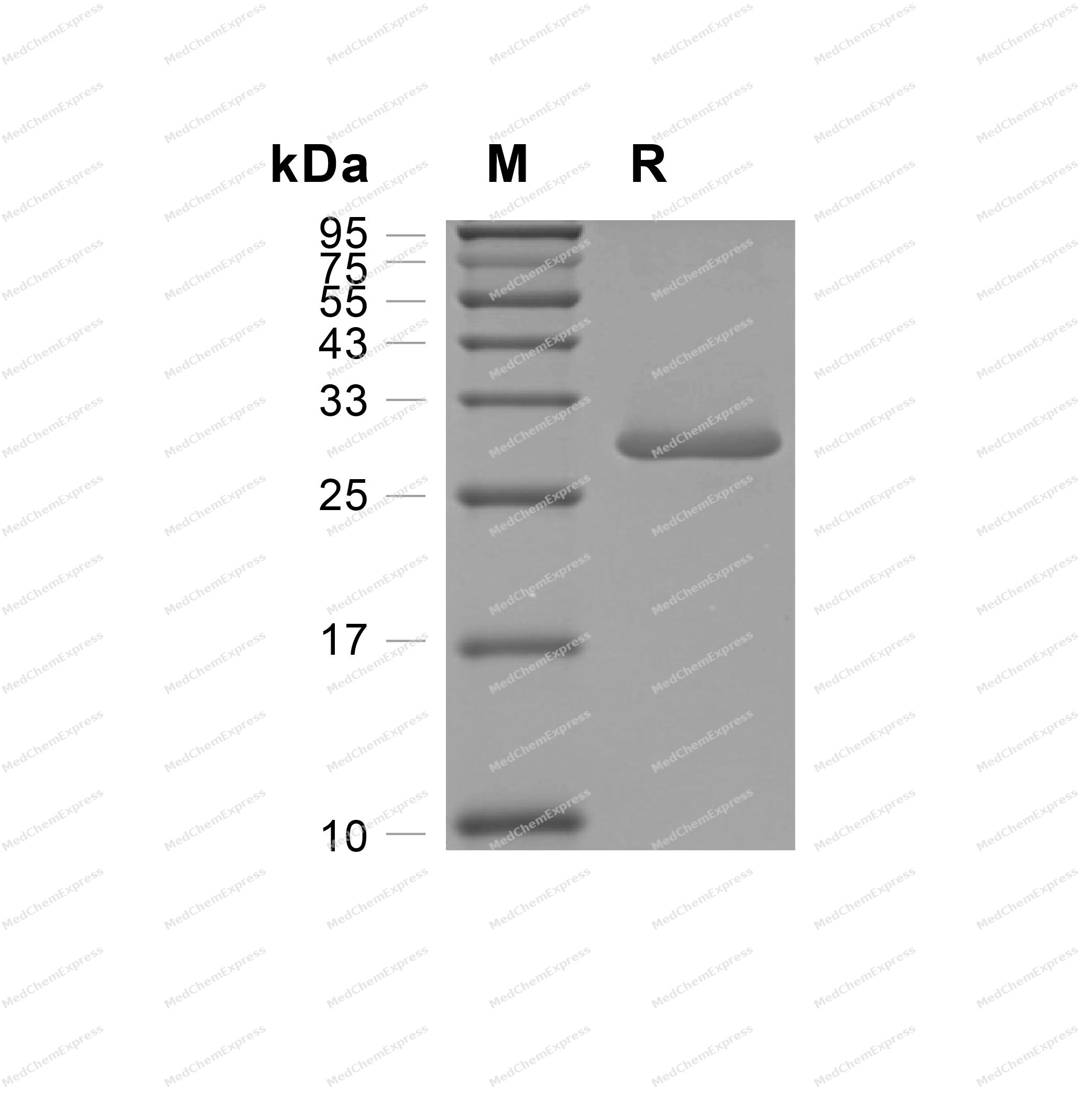
Purity - SDS-PAGE
-
Bioactivity - ELISA
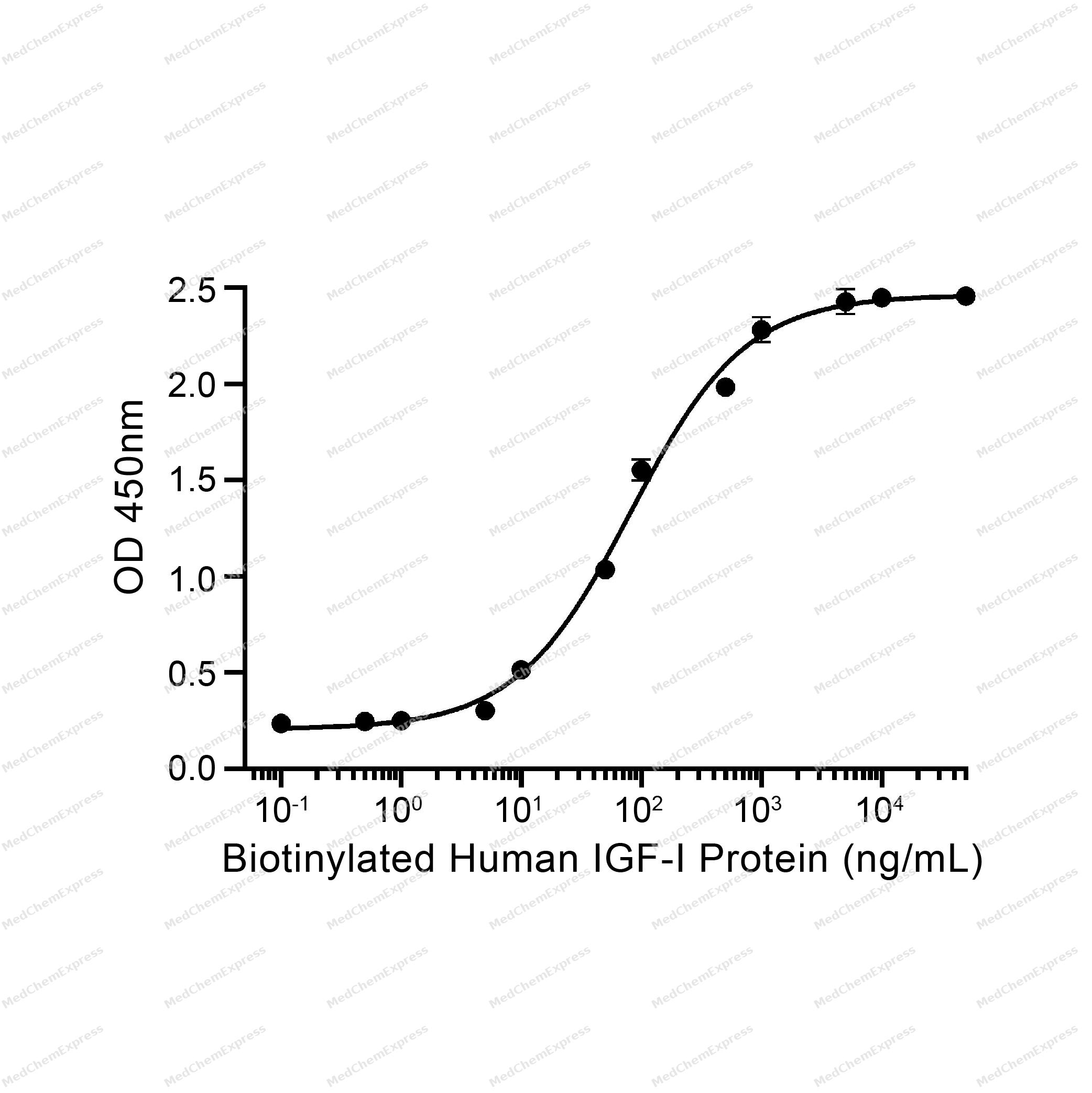
Bioactivity - ELISA


Technical Parameters
-
Species Rhesus Macaque
-
Source HEK293
-
Tag C-6*His
-
Accession
XP_001085935 (A48-N281)
-
Molecular Construction
-
N-term
-
IGFBP-1 (A48-N281)
Accession # XP_001085935 -
6*His
-
C-term
-
-
Protein Length
Partial
-
Synonyms
IGFBP1; Alpha-Pregnancy-Associated Endometrial Globulin; Prev. IBP1; Amniotic Fluid Binding Protein; PP12; Binding Protein-28; Insulin-Like Growth Factor-Binding Protein 1; Binding Protein-26; IGF-Binding Protein 1; Binding Protein-25; Placental Protein 1
-
AA Sequence
APWQCAPCSAEKLALCPPVPASCSEVTRSAGCGCCPMCALPLGAACGVATARCARGLSCRALPGEQQPLHALTRGQGACVQDSDASASNAEAAGSPESPESTEITEEELLDNFHLMAPSEEDHSTLWDAIGTYDSSKAVHVTNVKKWKEPCRIELYRVVESLTKAQETSGEDISKFYLPNCNKNGFYHSRQCETSLAGEERLCWCVYPWNGKRIPGSPEIRGDPNCQTYFNVQN
-
Predicted Molecular Mass
25.3 kDa
-
Molecular Weight
Approximately 30-35 kDa, based on SDS-PAGE under reducing conditions.
-
Purity
≥ 95%, as determined by reducing SDS-PAGE.


Product Properties
Lyophilized powder.
Lyophilized from a 0.22 μm filtered solution of PBS, pH 7.4.
<1 EU/μg, determined by LAL method.
It is not recommended to reconstitute to a concentration less than 100 μg/mL in ddH2O. For long term storage it is recommended to add a carrier protein (0.1% BSA, 5% HSA, 10% FBS or 5% Trehalose).
Stored at -20°C for 2 years from date of receipt. After reconstitution, it is stable at 4°C for 1 week or -20°C for longer (with carrier protein). It is recommended to freeze aliquots at -20°C or -80°C for extended storage.
Room temperature in continental US; may vary elsewhere.


Documentation
-
Data Sheet (237 KB)
-
SDS (254 KB)
- English - EN (254 KB)
- Français - FR (254 KB)
- Deutsch - DE (254 KB)
- Norwegian - NO (254 KB)
- Español - ES (254 KB)
- Swedish - SV (254 KB)
- Italian - IT (254 KB)
- Korean - KR (254 KB)
- Portuguese - PT (254 KB)
-
Handling Instructions (2659 KB)

Calculators
Concentration (start) × Volume (start) = Concentration (final) × Volume (final)


 Powered by Bioz

