



IL-18/IL-1F4 Protein, Porcine

Based on 1 Customer Validation
IL-18/IL-1F4 protein is a pro-inflammatory cytokine that is critical in epithelial barrier repair and coordinates immune responses involving Th1 cells and NK cells. IL-18 binds to IL18R1 and IL18RAP to form a ternary complex that activates NF-κ-B and triggers the synthesis of inflammatory mediators. IL-18/IL-1F4 Protein, Porcine is the recombinant Porcine-derived IL-18/IL-1F4 protein, expressed by E. coli , with tag free.
- Species: Porcine
- Source: E. coli
-
Storage:Stored at -20°C for 2 years from date of receipt. After reconstitution, it is stable at 4°C for 1 week or -20°C for longer (with carrier protein). It is recommended to freeze aliquots at -20°C or -80°C for extended storage.


To place orders, for customer services and technical support, please contact: MedChemExpress USA
Tel: 609-228-6898 E-mail: [email protected] [email protected]


-
 Biological Activity
-
Technical Parameters
-
Product Properties
- Documentation
- Help & FAQs




Biological Activity
Description
IL-18/IL-1F4 protein is a pro-inflammatory cytokine that is critical in epithelial barrier repair and coordinates immune responses involving Th1 cells and NK cells. IL-18 binds to IL18R1 and IL18RAP to form a ternary complex that activates NF-κ-B and triggers the synthesis of inflammatory mediators. IL-18/IL-1F4 Protein, Porcine is the recombinant Porcine-derived IL-18/IL-1F4 protein, expressed by E. coli , with tag free.
Background
IL-18, a pro-inflammatory cytokine, plays a crucial role in epithelial barrier repair and orchestrates polarized immune responses involving T-helper 1 (Th1) cells and natural killer (NK) cells. Upon binding to IL18R1 and IL18RAP, IL-18 forms a signaling ternary complex that activates NF-kappa-B, triggering the synthesis of inflammatory mediators. It synergizes with IL-12 to induce IFNG synthesis in Th1 cells and NK cells. Notably, IL-18 is involved in the transduction of inflammation downstream of pyroptosis, where its mature form is specifically released into the extracellular milieu by passing through the gasdermin-D (GSDMD) pore. At the plasma membrane, IL-18 forms a ternary complex with the ligand-binding receptor subunit IL18R1 and the signaling receptor subunit IL18RAP, initiating intracellular signaling. The interaction with the cargo receptor TMED10 facilitates IL-18's translocation from the cytoplasm into the endoplasmic reticulum-Golgi intermediate compartment (ERGIC) and subsequent secretion.
Verified Bioactivity
Measured by its ability to induce IFN-gamma secretion by KG-1 human acute myelogenous leukemia cells in the presence of TNF-alpha. The ED50 for this effect is 36.31 ng/mL in the presence of 15 pg/mL TNF-alpha, corresponding to a specific activity is 2.754×10⁴ U/mg.
MCE Validation Data
-
Purity - SDS-PAGE
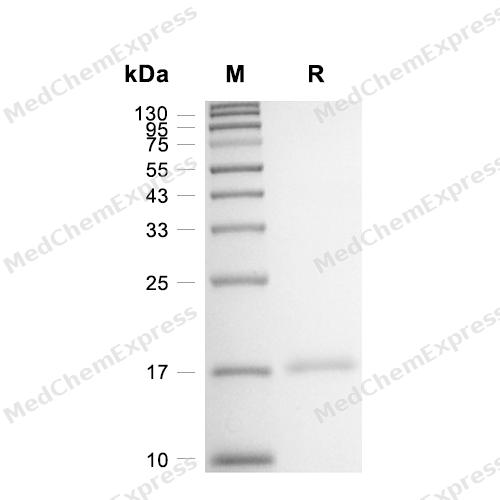
Purity - SDS-PAGE
-
Bioactivity - Cell-Based Assay
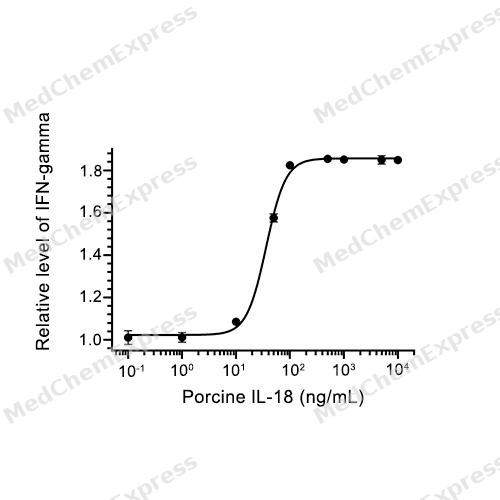
Bioactivity - Cell-Based Assay


Technical Parameters
-
Species Porcine
-
Source E. coli
-
Tag Tag Free
-
Accession
O19073 (Y36-N192)
-
Molecular Construction
-
N-term
-
IL-18 (Y36-N192)
Accession # O19073 -
C-term
-
-
Protein Length
Full Length of Mature Protein
-
Synonyms
IL18; Interleukin 18 (Interferon-Gamma-Inducing Factor); Interleukin 18; IFN-Gamma-Inducing Factor; IL-18; Interleukin-1 Gamma; IL1F4; Iboctadekin; IGIF; IL-1 Gamma; Interleukin-18; Interferon-Gamma-Inducing Factor; IL-1g; Interferon Gamma-Inducing Factor
-
AA Sequence
YFGKLEPKLSIIRNLNDQVLFINQGHQAVFEDMPDSDCSDNAPQTVFIIYMYKDSLTRGLAVTISVQCKKMSTLSCKNKTLSFKEMSPPDNIDDEGNDIIFFQRSVPGHDDKIQFESSLYKGYFLACKKENDLFKLILKEKDECGDKSIMFTVQNKN
-
Predicted Molecular Mass
18 kDa
-
Molecular Weight
Approximately 18 kDa, based on SDS-PAGE under reducing conditions.
-
Purity
≥ 95%, as determined by reducing SDS-PAGE.


Product Properties
Lyophilized powder.
Lyophilized from a 0.22 μm filtered solution of PBS, pH 7.4, 2 mM DTT, 8% trehalose.
<1 EU/μg, determined by LAL method.
It is not recommended to reconstitute to a concentration less than 100 μg/mL in ddH2O.
Stored at -20°C for 2 years from date of receipt. After reconstitution, it is stable at 4°C for 1 week or -20°C for longer (with carrier protein). It is recommended to freeze aliquots at -20°C or -80°C for extended storage.
Room temperature in continental US; may vary elsewhere.


Documentation
-
Data Sheet (236 KB)
-
SDS (252 KB)
- English - EN (252 KB)
- Français - FR (252 KB)
- Deutsch - DE (252 KB)
- Norwegian - NO (252 KB)
- Español - ES (252 KB)
- Swedish - SV (252 KB)
- Italian - IT (252 KB)
- Korean - KR (252 KB)
- Portuguese - PT (252 KB)
-
Handling Instructions (2659 KB)

Calculators
Concentration (start) × Volume (start) = Concentration (final) × Volume (final)


 Powered by Bioz

