



IL-20 Protein, Mouse (HEK293, His)
Based on 1 Customer Validation
IL-20 protein is secreted by monocytes and skin keratinocytes and is a proinflammatory cytokine critical for immune responses, inflammatory regulation, hematopoiesis, and epidermal cell differentiation. It enhances tissue remodeling and wound healing, maintaining epithelial integrity during infection. IL-20 Protein, Mouse (HEK293, His) is the recombinant mouse-derived IL-20 protein, expressed by HEK293 , with N-His labeled tag.
- Species: Mouse
- Source: HEK293
-
Storage:Stored at -20°C for 2 years from date of receipt. After reconstitution, it is stable at 4°C for 1 week or -20°C for longer (with carrier protein). It is recommended to freeze aliquots at -20°C or -80°C for extended storage.


To place orders, for customer services and technical support, please contact: MedChemExpress USA
Tel: 609-228-6898 E-mail: [email protected] [email protected]


-
 Biological Activity
-
Technical Parameters
-
Product Properties
- Documentation
- Help & FAQs




Biological Activity
Description
IL-20 protein is secreted by monocytes and skin keratinocytes and is a proinflammatory cytokine critical for immune responses, inflammatory regulation, hematopoiesis, and epidermal cell differentiation. It enhances tissue remodeling and wound healing, maintaining epithelial integrity during infection. IL-20 Protein, Mouse (HEK293, His) is the recombinant mouse-derived IL-20 protein, expressed by HEK293 , with N-His labeled tag.
Background
IL-20 Protein, a pro-inflammatory and angiogenic cytokine, is primarily secreted by monocytes and skin keratinocytes, and it serves crucial roles in immune responses, regulation of inflammatory responses, hemopoiesis, as well as epidermal cell and keratinocyte differentiation. This protein enhances tissue remodeling and wound-healing activities, playing a key role in maintaining the integrity of epithelial layers during infection and inflammatory responses. IL-20 Protein affects various actin-mediated functions in activated neutrophils, leading to the inhibition of phagocytosis, granule exocytosis, and migration. Its effects are exerted through the type I IL-20 receptor complex (IL20RA and IL20RB) or the type II IL-20 receptor complex (IL22RA1 and IL20RB). Furthermore, IL-20 Protein activates a range of signaling processes, including phosphorylations of JAK2 and STAT5, as well as the activation of serine and threonine kinases AKT and ERK1/2. In keratinocytes, it can activate STAT3 phosphorylation and transcriptional activity in a JAK2, ERK1/2, and p38 MAPK-dependent manner. IL-20 Protein forms a 1:1:1 heterotrimeric complex with its primary high-affinity heterodimeric receptor IL20RA/IL20RB.
Verified Bioactivity
Measured in a cell proliferation assay using BaF3 mouse pro-B cells transfected with human IL-20 R alpha and human IL-20 R beta. The ED50 for this effect is 1.358 ng/mL. Corresponding to a specific activity is 7.364×10⁵ units/mg.
MCE Validation Data
-
Purity - SDS-PAGE
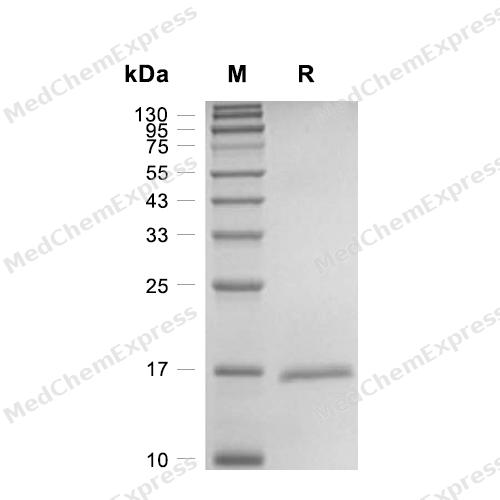
Purity - SDS-PAGE
-
Bioactivity - Cell-Based Assay
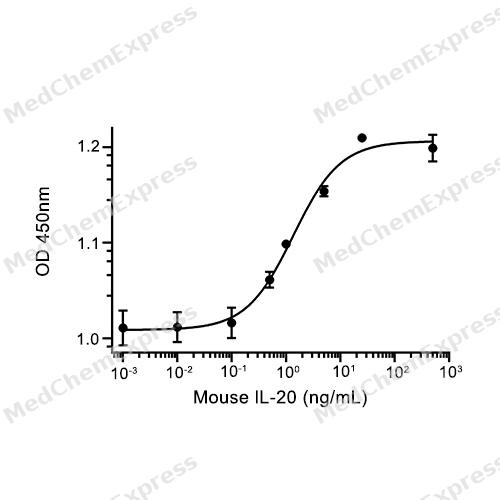
Bioactivity - Cell-Based Assay


Technical Parameters
-
Species Mouse
-
Source HEK293
-
Tag N-His
-
Accession
Q9JKV9 (L25-L176)
-
Molecular Construction
-
N-term
-
IL-2 (L25-L176)
Accession # Q9JKV9 -
His
-
C-term
-
-
Protein Length
Full Length of Mature Protein
-
Synonyms
IL20; Cytokine Zcyto10; Interleukin 20; Interleukin-20; ZCYTO10; Interleukin Family Protein; IL-20; Four Alpha Helix Cytokine; IL10D
-
AA Sequence
LKTLHLGSCVITANLQAIQKEFSEIRDSVQAEDTNIDIRILRTTESLKDIKSLDRCCFLRHLVRFYLDRVFKVYQTPDHHTLRKISSLANSFLIIKKDLSVCHSHMACHCGEEAMEKYNQILSHFIELELQAAVVKALGELGILLRWMEEML
-
Predicted Molecular Mass
19.5 kDa
-
Molecular Weight
Approximately 20-22 kDa, based on SDS-PAGE under reducing conditions, due to the glycosylation.
-
Purity
≥ 95%, as determined by Bis-Tris PAGE.


Product Properties
Lyophilized powder.
Lyophilized from a 0.22 μm filtered solution of PBS, pH 8.0, 8% trehalose.
<1 EU/μg, determined by LAL method.
It is not recommended to reconstitute to a concentration less than 100 μg/mL in ddH2O.
Stored at -20°C for 2 years from date of receipt. After reconstitution, it is stable at 4°C for 1 week or -20°C for longer (with carrier protein). It is recommended to freeze aliquots at -20°C or -80°C for extended storage.
Room temperature in continental US; may vary elsewhere.


Documentation
-
Data Sheet (237 KB)
-
SDS (251 KB)
- English - EN (251 KB)
- Français - FR (251 KB)
- Deutsch - DE (251 KB)
- Norwegian - NO (251 KB)
- Español - ES (251 KB)
- Swedish - SV (251 KB)
- Italian - IT (251 KB)
- Korean - KR (251 KB)
- Portuguese - PT (251 KB)
-
Handling Instructions (2659 KB)

Calculators
Concentration (start) × Volume (start) = Concentration (final) × Volume (final)


 Powered by Bioz

