



IL-21 Protein, Human (131a.a)

Based on 1 Customer Validation
IL-21 protein is an immunomodulatory cytokine that promotes the transition from innate immunity to adaptive immunity. It induces B cells to produce IgG(1) and IgG(3), harnessing an effective antibody response to fight viral infections. IL-21 Protein, Human (131a.a) is the recombinant human-derived IL-21 protein, expressed by E. coli , with tag free.
- Species: Human
- Source: E. coli
-
Storage:Stored at -20°C for 2 years from date of receipt. After reconstitution, it is stable at 4°C for 1 week or -20°C for longer (with carrier protein). It is recommended to freeze aliquots at -20°C or -80°C for extended storage.


To place orders, for customer services and technical support, please contact: MedChemExpress USA
Tel: 609-228-6898 E-mail: [email protected] [email protected]


-
 Biological Activity
-
Technical Parameters
-
Product Properties
- Documentation
- Help & FAQs




Biological Activity
Description
IL-21 protein is an immunomodulatory cytokine that promotes the transition from innate immunity to adaptive immunity. It induces B cells to produce IgG(1) and IgG(3), harnessing an effective antibody response to fight viral infections. IL-21 Protein, Human (131a.a) is the recombinant human-derived IL-21 protein, expressed by E. coli , with tag free.
Background
IL-21 Protein, a cytokine with immunoregulatory activity, serves as a pivotal mediator in orchestrating the interplay between innate and adaptive immunity. Notably, it induces the production of IgG(1) and IgG(3) in B-cells, emphasizing its role in shaping humoral immune responses. Additionally, IL-21 is intricately involved in the generation and maintenance of T follicular helper (Tfh) cells, playing a crucial part in the formation of germinal centers—an essential process in adaptive immunity. Collaborating with IL6, it contributes to the early generation of Tfh cells, proving critical for mounting an effective antibody response during acute viral infections. Furthermore, IL-21 may play a role in the proliferation and maturation of natural killer (NK) cells, particularly in synergy with IL15. Its regulatory influence extends to mature B- and T-cells, modulating their proliferation in response to activating stimuli. In concert with IL15 and IL18, IL-21 stimulates interferon gamma production in T-cells and NK cells, highlighting its multifaceted impact on immune responses. During T-cell-mediated immune responses, IL-21 exhibits the potential to inhibit dendritic cells (DC) activation and maturation, adding another layer to its regulatory repertoire.
Verified Bioactivity
Measured by its ability to enhance IFN-gamma secretion in NK-92 human natural killer lymphoma cells. The ED50 for this effect is 25.69 ng/mL, corresponding to a specific activity is 3.893×10⁴ U/mg.
MCE Validation Data
-
Purity - SDS-PAGE
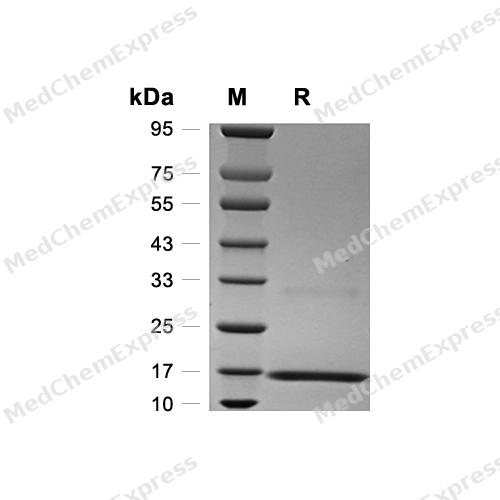
Purity - SDS-PAGE
-
Bioactivity - Cell-Based Assay
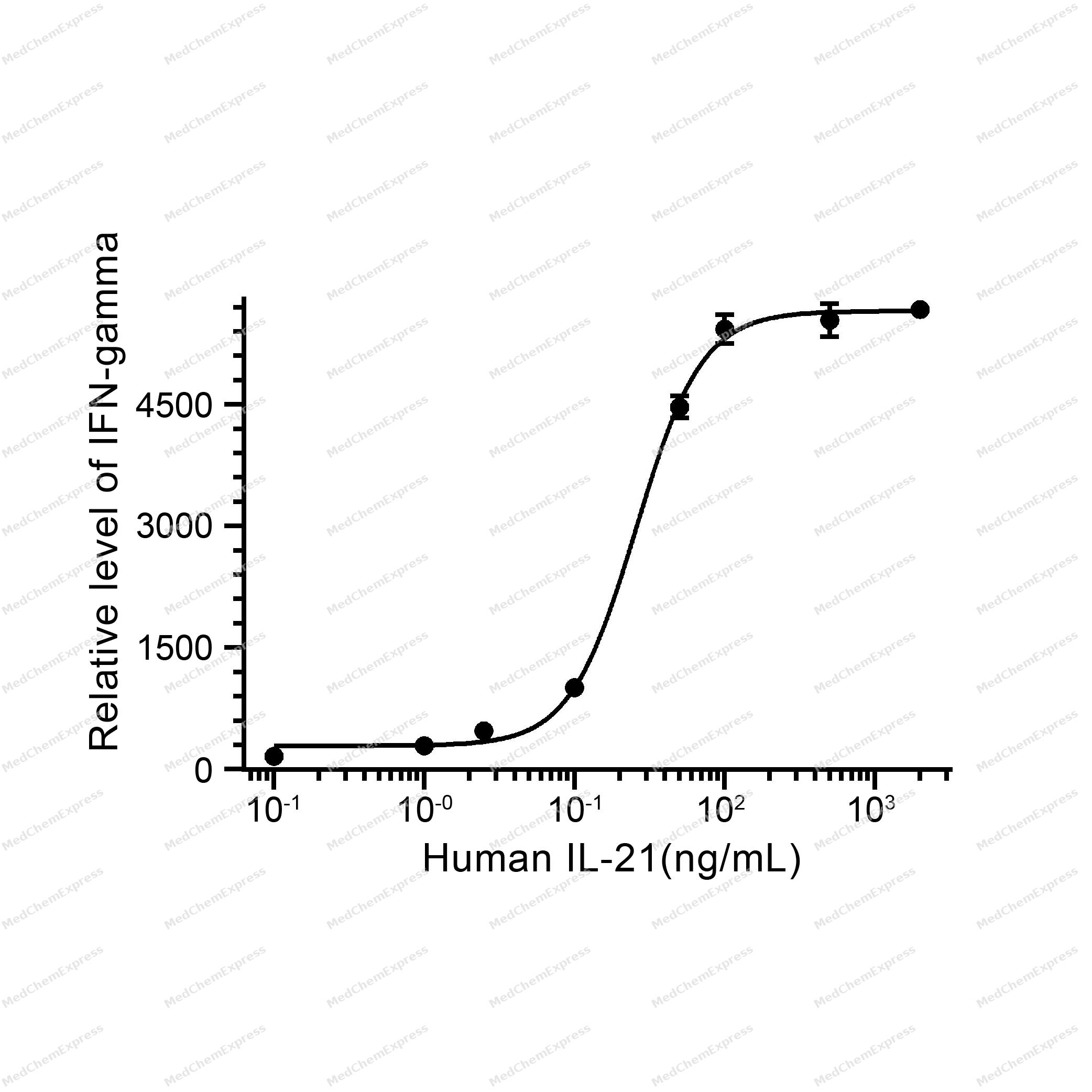
Bioactivity - Cell-Based Assay


Technical Parameters
-
Species Human
-
Source E. coli
-
Tag Tag Free
-
Accession
Q9HBE4-1 (H25-R155)
-
Gene ID59067
-
Molecular Construction
-
N-term
-
IL-21 (H25-R155)
Accession # Q9HBE4-1 -
C-term
-
-
Protein Length
Partial
-
Synonyms
IL21; Interleukin-21; Interleukin 21; Interleukin; IL-21; CVID11; Za11
-
AA Sequence
HKSSSQGQDRHMIRMRQLIDIVDQLKNYVNDLVPEFLPAPEDVETNCEWSAFSCFQKAQLKSANTGNNERIINVSIKKLKRKPPSTNAGRRQKHRLTCPSCDSYEKKPPKEFLERFKSLLQKMIHQHLSSR
-
Predicted Molecular Mass
15.3 kDa
-
Molecular Weight
Approximately 16 kDa, based on SDS-PAGE under reducing conditions.
-
Structure/Form
Monomer
-
Purity
≥ 95%, as determined by reducing SDS-PAGE.


Product Properties
Lyophilized powder.
Lyophilized from a 0.22 μm filtered solution of PBS, pH 7.4.
<1 EU/μg, determined by LAL method.
It is not recommended to reconstitute to a concentration less than 100 μg/mL in ddH2O. For long term storage it is recommended to add a carrier protein (0.1% BSA, 5% HSA, 10% FBS or 5% Trehalose).
Stored at -20°C for 2 years from date of receipt. After reconstitution, it is stable at 4°C for 1 week or -20°C for longer (with carrier protein). It is recommended to freeze aliquots at -20°C or -80°C for extended storage.
Room temperature in continental US; may vary elsewhere.


Documentation
-
Data Sheet (236 KB)
-
SDS (251 KB)
- English - EN (251 KB)
- Français - FR (251 KB)
- Deutsch - DE (251 KB)
- Norwegian - NO (251 KB)
- Español - ES (251 KB)
- Swedish - SV (251 KB)
- Italian - IT (251 KB)
- Korean - KR (251 KB)
- Portuguese - PT (251 KB)
-
Handling Instructions (2659 KB)

Calculators
Concentration (start) × Volume (start) = Concentration (final) × Volume (final)


 Powered by Bioz

