



IL-8/CXCL8 Protein, Cynomolgus (HEK293, His)

Based on 1 Customer Validation
IL-8/CXCL8 protein, a vital chemotactic factor, orchestrates inflammatory responses by attracting neutrophils, basophils, and T-cells to clear pathogens. It activates neutrophils and binds to CXCR1/CXCR2 receptors, initiating downstream signaling pathways. IL-8/CXCL8 homodimerizes, disrupted by tick evasin-3, and interacts with TNFAIP6, potentially regulating chemokine activity in the inflammatory microenvironment. IL-8/CXCL8 Protein, Cynomolgus (HEK293, His) is the recombinant cynomolgus-derived IL-8/CXCL8 protein, expressed by HEK293 , with N-His labeled tag.
- Species: Cynomolgus
- Source: HEK293
-
Storage:Stored at -20°C for 2 years from date of receipt. After reconstitution, it is stable at 4°C for 1 week or -20°C for longer (with carrier protein). It is recommended to freeze aliquots at -20°C or -80°C for extended storage.


To place orders, for customer services and technical support, please contact: MedChemExpress USA
Tel: 609-228-6898 E-mail: [email protected] [email protected]


-
 Biological Activity
-
Technical Parameters
-
Product Properties
- Documentation
- Help & FAQs




Biological Activity
Description
IL-8/CXCL8 protein, a vital chemotactic factor, orchestrates inflammatory responses by attracting neutrophils, basophils, and T-cells to clear pathogens. It activates neutrophils and binds to CXCR1/CXCR2 receptors, initiating downstream signaling pathways. IL-8/CXCL8 homodimerizes, disrupted by tick evasin-3, and interacts with TNFAIP6, potentially regulating chemokine activity in the inflammatory microenvironment. IL-8/CXCL8 Protein, Cynomolgus (HEK293, His) is the recombinant cynomolgus-derived IL-8/CXCL8 protein, expressed by HEK293 , with N-His labeled tag.
Background
IL-8/CXCL8 protein serves as a pivotal chemotactic factor, playing a central role in mediating inflammatory responses by attracting neutrophils, basophils, and T-cells to effectively clear pathogens and protect the host from infections. It also contributes significantly to neutrophil activation. Released in response to inflammatory stimuli, IL-8/CXCL8 exerts its effects by binding to G-protein-coupled receptors CXCR1 and CXCR2, primarily found in neutrophils, monocytes, and endothelial cells. The G-protein heterotrimer (alpha, beta, gamma subunits) constitutively binds to CXCR1/CXCR2 receptors, and activation by IL-8 leads to the release of beta and gamma subunits from Galpha (GNAI2 in neutrophils) and subsequent activation of downstream signaling pathways, including PI3K and MAPK pathways. IL-8/CXCL8 forms homodimers, and this dimerization is disrupted by tick evasin-3. Furthermore, IL-8/CXCL8 interacts with TNFAIP6 via its Link domain, and this interaction interferes with chemokine binding to glycosaminoglycans, suggesting a regulatory role in modulating chemokine activity within the inflammatory microenvironment.
Verified Bioactivity
Immobilized Human IL-8 at 1 μg/mL (100 μL/well) can bind Anti-IL-8 Antibody, The ED50 for this effect is 2.786 ng/mL.
MCE Validation Data
-
Purity - SDS-PAGE
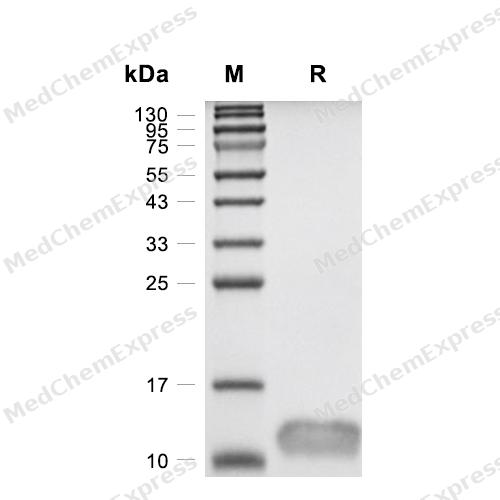
Purity - SDS-PAGE
-
Bioactivity - ELISA
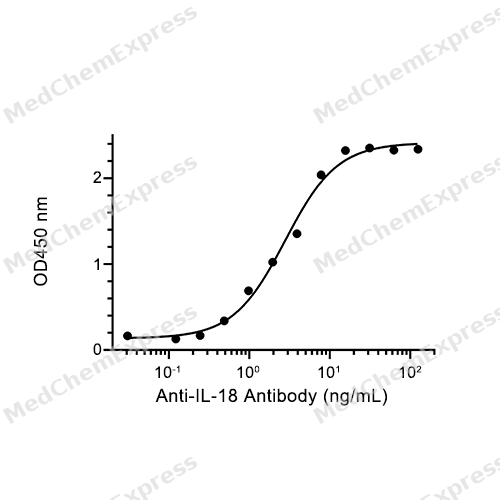
Bioactivity - ELISA


Technical Parameters
-
Species Cynomolgus
-
Source HEK293
-
Tag N-6*His
-
Accession
XP_005555144.1 (E21-P101)
-
Gene ID102127272
-
Molecular Construction
-
N-term
-
His
-
IL-8 (E21-P101)
Accession # XP_005555144.1 -
C-term
-
-
Protein Length
Full Length of C-X-C motif chemokine Chain
-
Synonyms
CXCL8; Lung Giant Cell Carcinoma-Derived Chemotactic Protein; Prev. IL8; Alveolar Macrophage Chemotactic Factor I; MDNCF; Tumor Necrosis Factor-Induced Gene 1; NAP-1; Neutrophil-Activating Peptide 1; MONAP; T-Cell Chemotactic Factor; GCP-1; Interleukin 8;
-
AA Sequence
EGAVLPRSAKELRCECIKTYSKPFHPKFIKELRVIESGPHCANTEIIVKLSDGRELCLDPKEPWVQRVVEKFVKRAENQNP
-
Predicted Molecular Mass
9.3 kDa
-
Molecular Weight
Approximately 11 kDa, based on SDS-PAGE under reducing conditions.
-
Purity
≥ 95%, as determined by reducing SDS-PAGE.


Product Properties
Lyophilized powder.
Lyophilized from a 0.22 μm filtered solution of PBS, pH 7.4.
<1 EU/μg, determined by LAL method.
It is not recommended to reconstitute to a concentration less than 100 μg/mL in ddH2O. For long term storage it is recommended to add a carrier protein (0.1% BSA, 5% HSA, 10% FBS or 5% Trehalose).
Stored at -20°C for 2 years from date of receipt. After reconstitution, it is stable at 4°C for 1 week or -20°C for longer (with carrier protein). It is recommended to freeze aliquots at -20°C or -80°C for extended storage.
Room temperature in continental US; may vary elsewhere.


Documentation
-
Data Sheet (236 KB)
-
SDS (251 KB)
- English - EN (251 KB)
- Français - FR (251 KB)
- Deutsch - DE (251 KB)
- Norwegian - NO (251 KB)
- Español - ES (251 KB)
- Swedish - SV (251 KB)
- Italian - IT (251 KB)
- Korean - KR (251 KB)
- Portuguese - PT (251 KB)
-
Handling Instructions (2659 KB)

Calculators
Concentration (start) × Volume (start) = Concentration (final) × Volume (final)


 Powered by Bioz

