



Jagged-1/JAG1 Protein, Rat (HEK293, His)
Based on 1 Customer Validation
Jagged-1/JAG1 protein is a ligand of multiple Notch receptors, mediates Notch signaling, affects cell fate decisions during hematopoiesis and enhances angiogenesis. It functions throughout mammalian cardiovascular development, regulates myoblast differentiation, and participates in the complex Notch signaling network through interactions with NOTCH1, NOTCH2, and NOTCH3. Jagged-1/JAG1 Protein, Rat (HEK293, His) is the recombinant rat-derived Jagged-1/JAG1 protein, expressed by HEK293.
- Species: Rat
- Source: HEK293
-
Storage:Stored at -20°C for 2 years from date of receipt. After reconstitution, it is stable at 4°C for 1 week or -20°C for longer (with carrier protein). It is recommended to freeze aliquots at -20°C or -80°C for extended storage.


To place orders, for customer services and technical support, please contact: MedChemExpress USA
Tel: 609-228-6898 E-mail: [email protected] [email protected]


-
 Biological Activity
-
Technical Parameters
-
Product Properties
- Documentation
- Help & FAQs




Biological Activity
Description
Jagged-1/JAG1 protein is a ligand of multiple Notch receptors, mediates Notch signaling, affects cell fate decisions during hematopoiesis and enhances angiogenesis. It functions throughout mammalian cardiovascular development, regulates myoblast differentiation, and participates in the complex Notch signaling network through interactions with NOTCH1, NOTCH2, and NOTCH3. Jagged-1/JAG1 Protein, Rat (HEK293, His) is the recombinant rat-derived Jagged-1/JAG1 protein, expressed by HEK293.
Background
Jagged-1 (JAG1) serves as a ligand for multiple Notch receptors, playing a pivotal role in mediating Notch signaling. It is implicated in cell-fate decisions during hematopoiesis and demonstrates the capacity to enhance fibroblast growth factor-induced angiogenesis in vitro. JAG1's involvement spans various stages of mammalian cardiovascular development, highlighting its significance in these processes. Additionally, it exerts an inhibitory effect on myoblast differentiation, suggesting its regulatory role in diverse cellular functions. Through interactions with NOTCH1, NOTCH2, and NOTCH3, JAG1 contributes to the intricate network of Notch signaling, underscoring its multifaceted role in cellular responses and developmental pathways.
Verified Bioactivity
Measured by the ability of the immobilized protein to enhance BMP-2 induced alkaline phosphatase activity in C3H10T1/2 mouse embryonic fibroblast cells. The ED50 for this effect is 1.264 μg/mL, corresponding to a specific activity is 791.1392 units/mg.
MCE Validation Data
-
Purity - SDS-PAGE
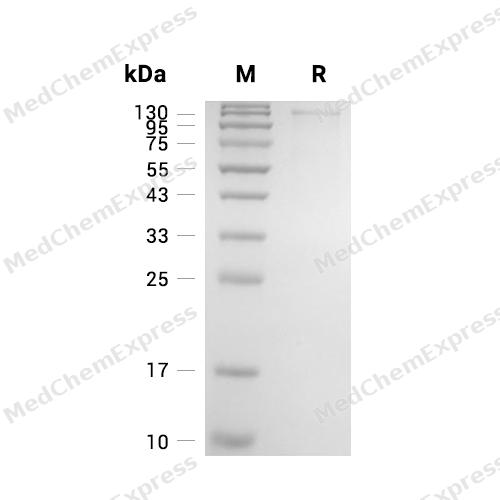
Purity - SDS-PAGE
-
Bioactivity - Cell-Based Assay

Bioactivity - Cell-Based Assay


Technical Parameters
-
Species Rat
-
Source HEK293
-
Tag C-6*His
-
Accession
Q63722 (S32-D1067, with substitutions GGARN56-60AE and DR63-64TLVRPY)
-
Gene ID29146
-
Protein Length
Partial Extracellular Domain
-
Synonyms
JAG1; Jagged 1; Prev. JAGL1; Alagille Syndrome; Prev. AGS; Jagged-1 Protein; HJ1; CD339 Antigen; CD339; Jagged1; AHD; CMT2HH; AWS; AGS1; Protein Jagged-1; DCHE; Jagged Canonical Notch Ligand 1; Delta-Like Protein
-
AA Sequence
SGQFELEILSMQNVNGELQNGNCCAEPGTLVRPYKCTRDECDTYFKVCLKEYQSRVTAGGPCSFGSGSTPVIGGNTFNLKASRGNDRNRIVLPFSFAWPRSYTLLVEAWDSSNDTIQPDSIIEKASHSGMINPSRQWQTLKQNTGIAHFEYQIRVTCDDHYYGFGCNKFCRPRDDFFGHYACDQNGNKTCMEGWMGPECNKAICRQGCSPKHGSCKLPGDCRCQYGWQGLYCDKCIPHPGCVHGTCNEPWQCLCETNWGGQLCDKDLNYCGTHQPCLNRGTCSNTGPDKYQCSCPEGYSGPNCEIAEHACLSDPCHNRGSCKETSSGFECECSPGWTGPTCSTNIDDCSPNNCSHGGTCQDLVNGFKCVCPPQWTGKTCQLDANECEAKPCVNARSCKNLIASYYCDCLPGWMGQNCDININDCLGQCQNDASCRDLVNGYRCICPPGYAGDHCERDIDECASNPCLNGGHCQNEINRFQCLCPTGFSGNLCQLDIDYCEPNPCQNGAQCYNRASDYFCKCPEDYEGKNCSHLKDHCRTTPCEVIDSCTVAMASNDTPEGVRYISSNVCGPHGKCKSESGGKFTCDCNKGFTGTYCHENINDCEGNPCTNGGTCIDGVNSYKCICSDGWEGAHCENNINDCSQNPCHYGGTCRDLVNDFYCDCKNGWKGKTCHSRDSQCDEATCNNGGTCYDEVDTFKCMCPGGWEGTTCNIARNSSCLPNPCHNGGTCVVNGDSFTCVCKEGWEGPICTQNTNDCSPHPCYNSGTCVDGDNWYRCECAPGFAGPDCRININECQSSPCAFGATCVDEINGYQCICPPGHSGAKCHEVSGRSCITMGRVILDGAKWDDDCNTCQCLNGRVACSKVWCGPRPCRLHKGHGECPNGQSCIPVLDDQCFVRPCTGAGECRSSSLQPVKTKCTSDSYYQDNCANITFTFNKEMMSPGLTTEHICSELRNLNILKNVSAEYSIYIACEPSLSANNEIHVAISAEDIRDDGNPVKEITDKIIDLVSKRDGNSSLIAAVAEVRVQRRPLKNRTD
-
Predicted Molecular Mass
114.2 kDa
-
Molecular Weight
Approximately 125-130 kDa, based on SDS-PAGE under reducing conditions, due to the glycosylation.
-
Glycosylation
Yes
-
Purity
≥ 90%, as determined by reducing SDS-PAGE.


Product Properties
Lyophilized powder.
Lyophilized from a 0.22 μm filtered solution of PBS, pH 7.4, 8% trehalose.
<1 EU/μg, determined by LAL method.
It is not recommended to reconstitute to a concentration less than 100 μg/mL in PBS.
Stored at -20°C for 2 years from date of receipt. After reconstitution, it is stable at 4°C for 1 week or -20°C for longer (with carrier protein). It is recommended to freeze aliquots at -20°C or -80°C for extended storage.
Room temperature in continental US; may vary elsewhere.


Documentation
-
Data Sheet (242 KB)
-
SDS (252 KB)
- English - EN (252 KB)
- Français - FR (252 KB)
- Deutsch - DE (252 KB)
- Norwegian - NO (252 KB)
- Español - ES (252 KB)
- Swedish - SV (252 KB)
- Italian - IT (252 KB)
- Korean - KR (252 KB)
- Portuguese - PT (252 KB)
-
Handling Instructions (2659 KB)

Calculators
Concentration (start) × Volume (start) = Concentration (final) × Volume (final)


 Powered by Bioz

