



Mesothelin Protein, Human (303a.a, HEK293, His)

Based on 1 Customer Validation
Mesothelin is a glycosylphosphatidylinositol-anchored cell-surface protein that may function as a cell adhesion protein, as cells overexpressing mesothelin have altered adhesive properties. Mesothelin is also a Megakaryocyte-potentiating factor (MPF) which potentiates megakaryocyte colony formation in vitro. Mesothelin may be related to cancer metastasis. Mesothelin Protein, Human (303a.a, HEK293, His) is the recombinant human-derived Mesothelin protein, expressed by HEK293 , with C-6*His labeled tag.
- Species: Human
- Source: HEK293
-
Storage:Stored at -20°C for 2 years from date of receipt. After reconstitution, it is stable at 4°C for 1 week or -20°C for longer (with carrier protein). It is recommended to freeze aliquots at -20°C or -80°C for extended storage.


To place orders, for customer services and technical support, please contact: MedChemExpress USA
Tel: 609-228-6898 E-mail: [email protected] [email protected]


-
 Biological Activity
-
Technical Parameters
-
Product Properties
- Documentation
- Help & FAQs




Biological Activity
Description
Mesothelin is a glycosylphosphatidylinositol-anchored cell-surface protein that may function as a cell adhesion protein, as cells overexpressing mesothelin have altered adhesive properties. Mesothelin is also a Megakaryocyte-potentiating factor (MPF) which potentiates megakaryocyte colony formation in vitro. Mesothelin may be related to cancer metastasis. Mesothelin Protein, Human (303a.a, HEK293, His) is the recombinant human-derived Mesothelin protein, expressed by HEK293 , with C-6*His labeled tag.
Background
Mesothelin is a glycosylphosphatidylinositol-anchored cell-surface protein that may function as a cell adhesion protein, as cells overexpressing mesothelin have altered adhesive properties. Mesothelin is overexpressed in epithelial mesotheliomas, ovarian cancers and in specific squamous cell carcinomas. Alternative splicing results in multiple transcript variants of Mesothelin. Mesothelin is also a Megakaryocyte-potentiating factor (MPF) which potentiates megakaryocyte colony formation in vitro[1][2].
Verified Bioactivity
1. Loaded Amatuximab (HY-P99006) on AHC2 biosensor, can bind Mesothelin Protein, Human (303a.a, HEK293, His) with an affinity constant of 6.469E-10 M as determined in BLI assay.
2. Loaded HPN536 (HY-P991088) on SA biosensor, can bind Mesothelin Protein, Human (303a.a, HEK293, His) with an affinity constant of 4.442E-10 M as determined in BLI assay.
3.Immobilized Recombinant Human Mesothelin (C-6His) at 2 μg/ml (100 μl/well) can bind Anti-Human Mesothelin mAb. The ED50 of Anti-Human Mesothelin mAb is 1.0-10.0 ng/mL.
MCE Validation Data
-
Bioactivity - BLI
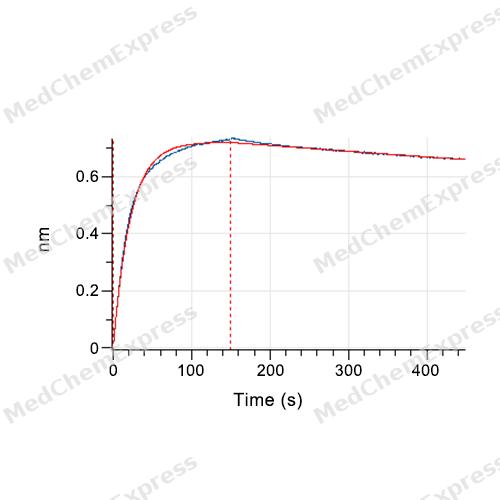
Bioactivity - BLI
-
Bioactivity - BLI
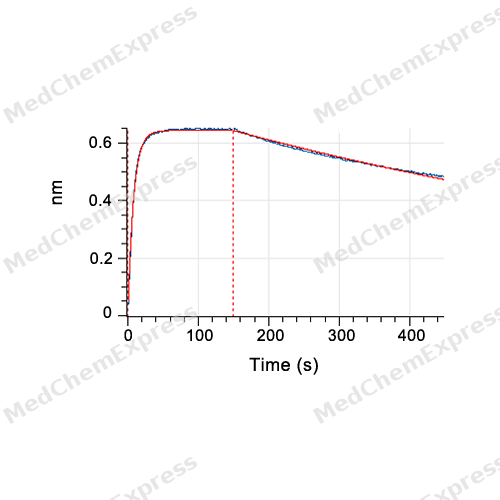
Bioactivity - BLI


Technical Parameters
-
Species Human
-
Source HEK293
-
Tag C-6*His
-
Accession
AAH09272.1 (E296-S598)
-
Molecular Construction
-
N-term
-
Mesothelin (E296-S598)
Accession # AAH09272.1 -
6*His
-
C-term
-
-
Protein Length
Full Length of Mesothelin, cleaved form Chain
-
Synonyms
MSLN; CAK1; Mesothelin; Soluble MPF Mesothelin Related Protein; MPF; Megakaryocyte Potentiating Factor; Pre-Pro-Megakaryocyte-Potentiating Factor; SMRP; CAK1 Antigen
-
AA Sequence
EVEKTACPSGKKAPEIDESLIFYKKWELEACVDAALLATQMDRVNAIPFTYEQLDVLKHKLDELYPQGYPESVIQHLGYLFLKMSPEDIRKWNVTSLETLKALLEVNKGHEMSPQVATLIDRFVKGRGQLDKDTLDTLTAFYPGYLCSLSPEELSSVPPSSIWAVRPQDLDTCDPRQLDVLYPKARLAFQNMNGSEYFVKIQSFLGGAPTEDLKALSQQNVSMDLATFMKLRTDAVLPLTVAEVQKLLGPHVEGLKAEERHRPVRDWILRQRQDDLDTLGLGLQGGIPNGYLVLDLSMQEALS
-
Predicted Molecular Mass
34.9 kDa
-
Molecular Weight
Approximately 35-50 kDa, based on SDS-PAGE under reducing conditions.
-
Glycosylation
Yes
-
Purity
≥ 95%, as determined by reducing SDS-PAGE.


Product Properties
Lyophilized powder
1.Lyophilized from a 0.22 μm filtered solution of PBS, pH 7.4.
2.Lyophilized from a 0.22 μm filtered solution of 20 mM Hepes-NaOH, 50 mM NaCl, 8% trehalose, 0.05% Tween 80, pH 8.0.
Please refer to the lot-specific COA for specific buffer information.
<1 EU/μg, determined by LAL method.
It is not recommended to reconstitute to a concentration less than 100 μg/mL in ddH2O. For long term storage it is recommended to add a carrier protein (0.1% BSA, 5% HSA, 10% FBS or 5% Trehalose).
Stored at -20°C for 2 years from date of receipt. After reconstitution, it is stable at 4°C for 1 week or -20°C for longer (with carrier protein). It is recommended to freeze aliquots at -20°C or -80°C for extended storage.
Room temperature in continental US; may vary elsewhere.


Documentation
-
Data Sheet (237 KB)
-
SDS (251 KB)
- English - EN (251 KB)
- Français - FR (251 KB)
- Deutsch - DE (251 KB)
- Norwegian - NO (251 KB)
- Español - ES (251 KB)
- Swedish - SV (251 KB)
- Italian - IT (251 KB)
- Korean - KR (251 KB)
- Portuguese - PT (251 KB)
-
Handling Instructions (2659 KB)

Calculators
Concentration (start) × Volume (start) = Concentration (final) × Volume (final)


 Powered by Bioz

