



MOG Protein, Human (HEK293, C-His)
Based on 1 publication(s) in Google Scholar
MOG proteins play a key role in homogeneous cell-to-cell adhesion, promoting important junctions. As a minor but integral component of myelin, it contributes to its underlying completion and maintenance. MOG Protein, Human (HEK293,C-His) is the recombinant human-derived MOG protein, expressed by HEK293 , with C-6*His labeled tag.
- Species: Human
- Source: HEK293
-
Storage:Stored at -20°C for 2 years from date of receipt. After reconstitution, it is stable at 4°C for 1 week or -20°C for longer (with carrier protein). It is recommended to freeze aliquots at -20°C or -80°C for extended storage.


To place orders, for customer services and technical support, please contact: MedChemExpress USA
Tel: 609-228-6898 E-mail: [email protected] [email protected]


-
 Biological Activity
-
Technical Parameters
-
Product Properties
- Documentation
- Help & FAQs




Biological Activity
Description
MOG proteins play a key role in homogeneous cell-to-cell adhesion, promoting important junctions. As a minor but integral component of myelin, it contributes to its underlying completion and maintenance. MOG Protein, Human (HEK293,C-His) is the recombinant human-derived MOG protein, expressed by HEK293 , with C-6*His labeled tag.
Background
MOG Protein plays a pivotal role in facilitating homophilic cell-cell adhesion, fostering essential connections between cells. As a minor yet integral component of the myelin sheath, MOG Protein is implicated in the potential completion and maintenance of this vital neural structure. Its influence extends beyond structural support, as it may also participate in mediating cell-cell communication. Notably, during microbial infections, MOG Protein serves as a receptor for the rubella virus, accentuating its multifaceted involvement in both physiological myelin function and pathological responses to viral challenges.
Verified Bioactivity
Measured in a cell proliferation assay using SH-SY5Y cells. The ED50 for this effect is <1.0 μg/mL, corresponding to a specific activity is approximately > 1.0×10³ units/mg.
MCE Validation Data
-
Purity - SDS-PAGE
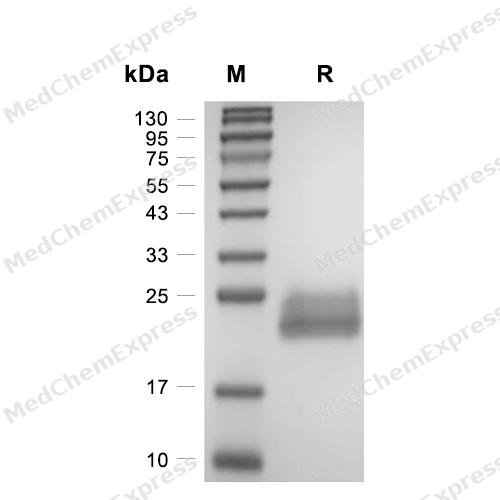
Purity - SDS-PAGE
-
Bioactivity - Cell-Based Assay
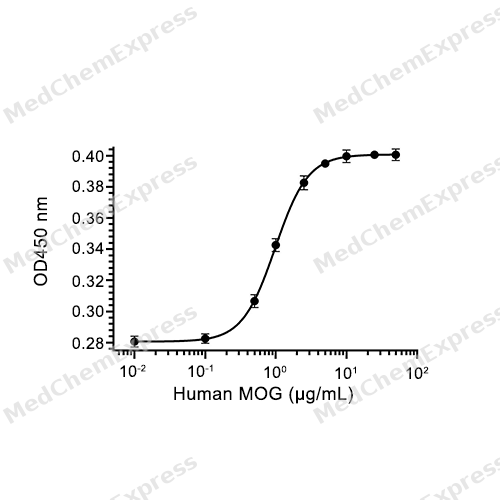
Bioactivity - Cell-Based Assay


Publications (1)
-
Journal Impact Factor
-
Most Recent
-
Cells
WHITE MATTER MATTERS: New Approach to the Brain's Hidden Half Using Circulating Oligodendrocyte-Derived Extracellular Vesicles. [Abstract]2025 Nov 12;14(22):1771. PMID: 41294823


Technical Parameters
-
Species Human
-
Source HEK293
-
Tag C-6*His
-
Accession
Q16653-1 (G30-G154)
-
Gene ID4340
-
Molecular Construction
-
N-term
-
MOG (G30-G154)
Accession # Q16653-1 -
6*His
-
C-term
-
-
Protein Length
Extracellular Domain
-
Synonyms
MOG; MOG Alpha-5; Myelin Oligodendrocyte Glycoprotein; MOG AluA; Myelin-Oligodendrocyte Glycoprotein; MOG AluB; BTNL11; MOGIG2; BTN6; NRCLP7; MOG Ig-AluB
-
AA Sequence
GQFRVIGPRHPIRALVGDEVELPCRISPGKNATGMEVGWYRPPFSRVVHLYRNGKDQDGDQAPEYRGRTELLKDAIGEGKVTLRIRNVRFSDEGGFTCFFRDHSYQEEAAMELKVEDPFYWVSPG
-
Molecular Weight
Approximately 20-24 kDa, based on SDS-PAGE under reducing conditions, due to the glycosylation.
-
Purity
≥ 95%, as determined by reducing SDS-PAGE.


Product Properties
Lyophilized powder
Lyophilized from a 0.22 μm filtered solution of PBS, pH 7.4, 5% trehalose, 5% mannitol and 0.01% Tween 80.
<1 EU/μg, determined by LAL method.
It is not recommended to reconstitute to a concentration less than 100 μg/mL in ddH2O.
Stored at -20°C for 2 years from date of receipt. After reconstitution, it is stable at 4°C for 1 week or -20°C for longer (with carrier protein). It is recommended to freeze aliquots at -20°C or -80°C for extended storage.
Room temperature in continental US; may vary elsewhere.


Documentation
-
Data Sheet (236 KB)
-
SDS (251 KB)
- English - EN (251 KB)
- Français - FR (251 KB)
- Deutsch - DE (251 KB)
- Norwegian - NO (251 KB)
- Español - ES (251 KB)
- Swedish - SV (251 KB)
- Italian - IT (251 KB)
- Korean - KR (251 KB)
- Portuguese - PT (251 KB)
-
Handling Instructions (2659 KB)

Calculators
Concentration (start) × Volume (start) = Concentration (final) × Volume (final)


 Powered by Bioz

