



NAA10/ARD1 Protein, Human (sf9)

Based on 1 Customer Validation
The NAA10/ARD1 protein is the catalytic subunit of the N-terminal acetyltransferase complex and has alpha acetyltransferase activity. NAA10/ARD1 affects vascular, hematopoietic, and neuronal growth and development. NAA10/ARD1 inhibits tumor cell migration, inhibits mTOR activity and cancer development. NAA10/ARD1 Protein, Human (sf9) is the recombinant human-derived NAA10/ARD1 protein, expressed by Sf9 insect cells , with tag free.
- Species: Human
- Source: Sf9 insect cells
-
Storage:Stored at -20°C for 2 years from date of receipt. After reconstitution, it is stable at 4°C for 1 week or -20°C for longer (with carrier protein). It is recommended to freeze aliquots at -20°C or -80°C for extended storage.


To place orders, for customer services and technical support, please contact: MedChemExpress USA
Tel: 609-228-6898 E-mail: [email protected] [email protected]


-
 Biological Activity
-
Technical Parameters
-
Product Properties
- Documentation
- Help & FAQs




Biological Activity
Description
The NAA10/ARD1 protein is the catalytic subunit of the N-terminal acetyltransferase complex and has alpha acetyltransferase activity. NAA10/ARD1 affects vascular, hematopoietic, and neuronal growth and development. NAA10/ARD1 inhibits tumor cell migration, inhibits mTOR activity and cancer development. NAA10/ARD1 Protein, Human (sf9) is the recombinant human-derived NAA10/ARD1 protein, expressed by Sf9 insect cells , with tag free.
Background
NAA10, the catalytic subunit of N-terminal acetyltransferase complexes, exhibits alpha (N-terminal) acetyltransferase activity, playing a crucial role in acetylating amino termini lacking initiator methionine. This activity holds significance in processes related to vascular, hematopoietic, and neuronal growth and development. In conjunction with NAA15, NAA10 displays epsilon (internal) acetyltransferase activity towards HIF1A, leading to its degradation and impacting cellular responses. Notably, NAA10 has diverse roles, repressing MYLK kinase activity through acetylation to inhibit tumor cell migration and stabilizing TSC2, thereby suppressing mTOR activity and impeding cancer development. Furthermore, NAA10 acetylates HSPA1A and HSPA1B at 'Lys-77,' enhancing their chaperone activity and promoting preferential binding to co-chaperone HOPX. Additional substrates include HIST1H4A, indicating a broad impact on cellular processes. Intriguingly, NAA10 acts as a negative regulator of sister chromatid cohesion during mitosis, underscoring its multifunctional role in cellular homeostasis.
MCE Validation Data
-
Purity - SDS-PAGE
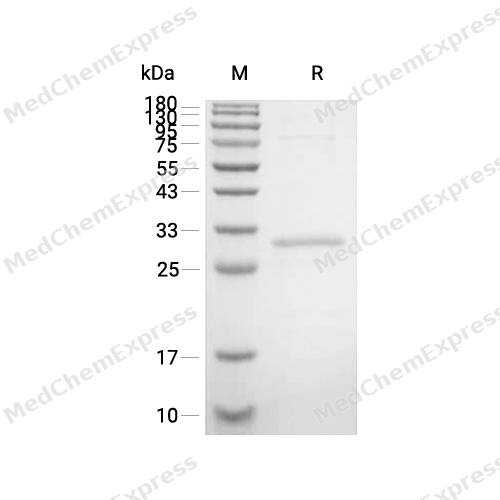
Purity - SDS-PAGE


Technical Parameters
-
Species Human
-
Source Sf9 insect cells
-
Tag Tag Free
-
Accession
P41227 (M1-S235)
-
Molecular Construction
-
N-term
-
NAA10 (M1-S235)
Accession # P41227 -
C-term
-
-
Protein Length
Full Length
-
Synonyms
NAA10; N(Alpha)-Acetyltransferase 10, NatA Catalytic Subunit; Prev. ARD1A; ARD1 Homolog A, N-Acetyltransferase (S. Cerevisiae); Prev. ARD1; ARD1 Homolog, N-Acetyltransferase (S. Cerevisiae); TE2; N-Acetyltransferase ARD1, Human Homolog Of; DXS707; ARD1 Ho
-
AA Sequence
MNIRNARPEDLMNMQHCNLLCLPENYQMKYYFYHGLSWPQLSYIAEDENGKIVGYVLAKMEEDPDDVPHGHITSLAVKRSHRRLGLAQKLMDQASRAMIENFNAKYVSLHVRKSNRAALHLYSNTLNFQISEVEPKYYADGEDAYAMKRDLTQMADELRRHLELKEKGRHVVLGAIENKVESKGNSPPSSGEACREEKGLAAEDSGGDSKDLSEVSETTESTDVKDSSEASDSAS
-
Predicted Molecular Mass
26.5 kDa
-
Molecular Weight
Approximately 31 kDa, based on SDS-PAGE under reducing conditions.
-
Purity
≥ 95%, as determined by reducing SDS-PAGE.


Product Properties
Lyophilized powder
Lyophilized from a 0.22 μm filtered solution of PBS, pH 7.4, 8% trehalose.
<1 EU/μg, determined by LAL method.
It is not recommended to reconstitute to a concentration less than 100 μg/mL in ddH2O.
Stored at -20°C for 2 years from date of receipt. After reconstitution, it is stable at 4°C for 1 week or -20°C for longer (with carrier protein). It is recommended to freeze aliquots at -20°C or -80°C for extended storage.
Room temperature in continental US; may vary elsewhere.


Documentation
-
Data Sheet (236 KB)
-
SDS (251 KB)
- English - EN (251 KB)
- Français - FR (251 KB)
- Deutsch - DE (251 KB)
- Norwegian - NO (251 KB)
- Español - ES (251 KB)
- Swedish - SV (251 KB)
- Italian - IT (251 KB)
- Korean - KR (251 KB)
- Portuguese - PT (251 KB)
-
Handling Instructions (2659 KB)

Calculators
Concentration (start) × Volume (start) = Concentration (final) × Volume (final)


 Powered by Bioz

