



NKG2A Protein, Mouse (HEK293, His)

Based on 1 Customer Validation
NKG2A Protein, a crucial immune inhibitory receptor, forms a complex with KLRD1 on lymphocyte subsets for self-nonself discrimination.Recognizing HLA-E loaded with self-peptides, it monitors MHC class I expression in healthy cells, promoting self-tolerance.NKG2A transmits signals through ITIMs, recruiting tyrosine phosphatases to counteractivate receptors.As a key inhibitor on NK cells, it regulates their functions, distinguishing harmless from pathogenic antigens.In the tumor microenvironment, NKG2A acts as an immune inhibitory checkpoint, contributing to cell exhaustion.During viral infection, it inhibits NK cell cytotoxicity, facilitating viral immune escape.NKG2A Protein, Mouse (HEK293, His) is the recombinant mouse-derived NKG2A protein, expressed by HEK293 , with N-His labeled tag.
- Species: Mouse
- Source: HEK293
-
Storage:Stored at -20°C for 2 years from date of receipt. After reconstitution, it is stable at 4°C for 1 week or -20°C for longer (with carrier protein). It is recommended to freeze aliquots at -20°C or -80°C for extended storage.


To place orders, for customer services and technical support, please contact: MedChemExpress USA
Tel: 609-228-6898 E-mail: [email protected] [email protected]


-
 Biological Activity
-
Technical Parameters
-
Product Properties
- Documentation
- Help & FAQs




Biological Activity
Description
NKG2A Protein, a crucial immune inhibitory receptor, forms a complex with KLRD1 on lymphocyte subsets for self-nonself discrimination.Recognizing HLA-E loaded with self-peptides, it monitors MHC class I expression in healthy cells, promoting self-tolerance.NKG2A transmits signals through ITIMs, recruiting tyrosine phosphatases to counteractivate receptors.As a key inhibitor on NK cells, it regulates their functions, distinguishing harmless from pathogenic antigens.In the tumor microenvironment, NKG2A acts as an immune inhibitory checkpoint, contributing to cell exhaustion.During viral infection, it inhibits NK cell cytotoxicity, facilitating viral immune escape.NKG2A Protein, Mouse (HEK293, His) is the recombinant mouse-derived NKG2A protein, expressed by HEK293 , with N-His labeled tag.
Background
NKG2A, an immune inhibitory receptor crucial for self-nonself discrimination, forms a complex with KLRD1 on cytotoxic and regulatory lymphocyte subsets, recognizing the non-classical major histocompatibility (MHC) class Ib molecule HLA-E loaded with self-peptides from the signal sequence of classical MHC class Ia molecules. This recognition allows cytotoxic cells to monitor MHC class I expression in healthy cells and promotes self-tolerance. Upon binding to HLA-E-peptide complexes, NKG2A transmits intracellular signals through two immunoreceptor tyrosine-based inhibition motifs (ITIMs), recruiting INPP5D/SHP-1 and INPPL1/SHP-2 tyrosine phosphatases to oppose signals from activating receptors. As a key inhibitory receptor on natural killer (NK) cells, NKG2A regulates their activation and effector functions, countering T cell receptor signaling on a subset of memory/effector CD8-positive T cells and distinguishing harmless from pathogenic antigens. In the HLA-E-rich tumor microenvironment, NKG2A acts as an immune inhibitory checkpoint, contributing to the progressive loss of effector functions in NK cells and tumor-specific T cells, a phenomenon known as cell exhaustion. Notably, during viral infection, NKG2A recognizes HLA-E in complex with human cytomegalovirus-derived peptides, inhibiting NK cell cytotoxicity and facilitating viral immune escape[1][2][3][4].
Verified Bioactivity
Measured by its binding ability in a functional ELISA. When Recombinant Mouse NKG2A is immobilized at 0.5 µg/mL (100 µL/well) can bind Biotinylated Recombinant human CD94 Protein. The ED50 for this effect is 0.5737 μg/mL
MCE Validation Data
-
Purity - SDS-PAGE
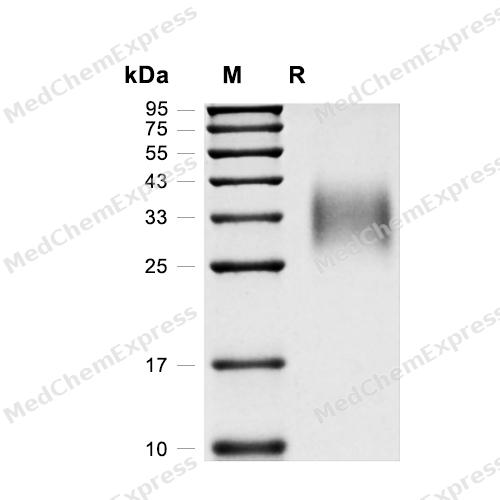
Purity - SDS-PAGE
-
Bioactivity - ELISA
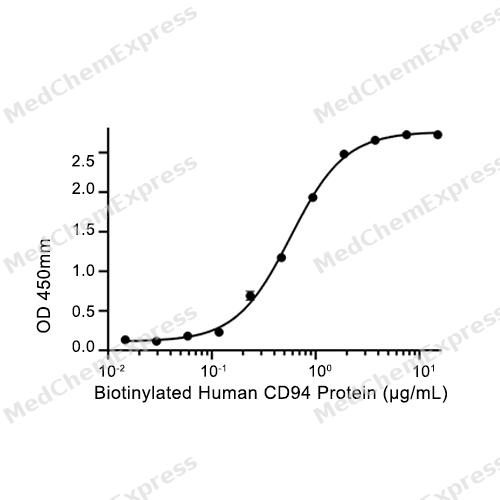
Bioactivity - ELISA


Technical Parameters
-
Species Mouse
-
Source HEK293
-
Tag N-His
-
Accession
Q9WU31 (A94-I244)
-
Gene ID16641
-
Molecular Construction
-
N-term
-
His
-
NKG2A (A94-I244)
Accession # Q9WU31 -
C-term
-
-
Protein Length
Extracellular Domain
-
Synonyms
KLRC1; NKG2-A/B-Activating NK Receptor; Prev. NKG2; NKG2-B; NKG2-A; NKG2A; CD159a; NKG2-A/B Type II Integral Membrane Protein; Killer Cell Lectin-Like Receptor Subfamily C, Member 1; Natural Killer Group Protein 2; NKG2-A/NKG2-B Type II Integral Membrane
-
AA Sequence
ATPYNEANAQINSSMTRTHRDINYTLSSAQPCPHCPKEWISYSHNCYFIGMERKSWNDSLVSCISKNCSLLHIDSEEEQDFLQSLSLVSWTGILRKGRGQPWVWKKDSIFKPKIAEILHDECNCAMMSASGLTADSCTTLHPYLCKCKFPI
-
Molecular Weight
Approximately 33-45 kDa, based on SDS-PAGE under reducing conditions, due to the glycosylation.
-
Purity
≥ 95%, as determined by reducing SDS-PAGE.


Product Properties
Lyophilized powder.
Lyophilized from a 0.22 μm filtered solution of PBS, pH 7.4.
<1 EU/μg, determined by LAL method.
It is not recommended to reconstitute to a concentration less than 100 μg/mL in ddH2O. For long term storage it is recommended to add a carrier protein (0.1% BSA, 5% HSA, 10% FBS or 5% Trehalose).
Stored at -20°C for 2 years from date of receipt. After reconstitution, it is stable at 4°C for 1 week or -20°C for longer (with carrier protein). It is recommended to freeze aliquots at -20°C or -80°C for extended storage.
Room temperature in continental US; may vary elsewhere.


Documentation
-
Data Sheet (237 KB)
-
SDS (251 KB)
- English - EN (251 KB)
- Français - FR (251 KB)
- Deutsch - DE (251 KB)
- Norwegian - NO (251 KB)
- Español - ES (251 KB)
- Swedish - SV (251 KB)
- Italian - IT (251 KB)
- Korean - KR (251 KB)
- Portuguese - PT (251 KB)
-
Handling Instructions (2659 KB)

Calculators
Concentration (start) × Volume (start) = Concentration (final) × Volume (final)


 Powered by Bioz

