



NOV/CCN3 Protein, Canine (HEK293, His)

Based on 1 Customer Validation
NOV/CCN3 Protein belongs to an emerging family of growth regulators referred under the CCN acronym. NOV/CCN3 Protein enables heparin and binding. NOV/CCN3 Protein is involved in cell adhesion and signal transduction. NOV/CCN3 Protein, Canine (HEK293, His) is the recombinant canine-derived NOV/CCN3 protein, expressed by HEK293 , with C-His labeled tag.
- Species: Canine
- Source: HEK293
-
Storage:Stored at -20°C for 2 years from date of receipt. After reconstitution, it is stable at 4°C for 1 week or -20°C for longer (with carrier protein). It is recommended to freeze aliquots at -20°C or -80°C for extended storage.


To place orders, for customer services and technical support, please contact: MedChemExpress USA
Tel: 609-228-6898 E-mail: [email protected] [email protected]


-
 Biological Activity
-
Technical Parameters
-
Product Properties
- Documentation
- Help & FAQs




Biological Activity
Description
NOV/CCN3 Protein belongs to an emerging family of growth regulators referred under the CCN acronym. NOV/CCN3 Protein enables heparin and binding. NOV/CCN3 Protein is involved in cell adhesion and signal transduction. NOV/CCN3 Protein, Canine (HEK293, His) is the recombinant canine-derived NOV/CCN3 protein, expressed by HEK293 , with C-His labeled tag.
Background
NOV/CCN3 Protein belongs to an emerging family of growth regulators referred under the CCN acronym. The CCN family now comprises six identified members with properties of both positive and negative regulators of cell growth, sharing a common multimodular organization. NOV/CCN3 Protein enables heparin and binding. NOV/CCN3 Protein is involved in cell adhesion and signal transduction[1][2][3].
Verified Bioactivity
Measured by its ability to mediate Balb/3T3 mouse embryonic fibroblast cell adhesion, rhNOV, immobilized at 10 µg/mL, will induce 62.85% adhesion on Balbc/3T3 cells (100 µL/well at 3 x 10⁴ cells/mL).
MCE Validation Data
-
Purity - SDS-PAGE
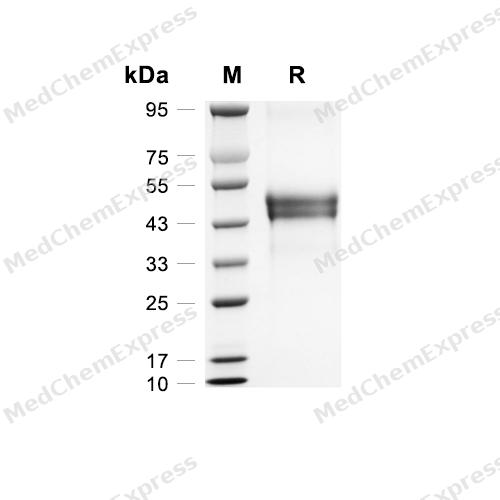
Purity - SDS-PAGE


Technical Parameters
-
Species Canine
-
Source HEK293
-
Tag C-6*His
-
Accession
J9P4N7 (Q29-M353)
-
Molecular Construction
-
N-term
-
CCN3 (Q29-M353)
Accession # J9P4N7 -
His
-
C-term
-
-
Protein Length
Partial
-
Synonyms
CCN3; Protein NOV Homolog; Prev. NOV; IBP-9; IGFBP9; Nephroblastoma-Overexpressed Gene Protein Homolog; Nephro Blastoma-Overexpressed Gene Protein Homolog; Nephroblastoma Overexpressed Gene; Insulin-Like Growth Factor-Binding Protein 9; NOVh; Nephroblasto
-
AA Sequence
QRCPTQCPARCAPTPPACAPGVRAVLDDCSCCLVCARQRGESCSPLQPCEESRGLFCDRRADPSAGGGICMAVEGDNCVFDGVIYQSGETFQPSCKYQCACRDGQIGCVPRCGEDLLLPQPDCPAPRKVEVPGECCEKWICDSNEKGELGGLALPAYRTEATLGVAVSDSGINCIEQTTEWSACSKSCGMGFSTRVTNRNPQCEMVKQTRLCMVRPCEQEHQQPADKKGKKCLRTTKSLKAIHLQFKNCTSLHTYKPRFCGVCSDGRCCTPHNTKTIQVEFQCSPGQIIKKPVMVIGTCTCHSNCPHNREAFLQELKPNTSRGEM
-
Molecular Weight
Approximately 40-47 kDa, based on SDS-PAGE under reducing conditions, due to the glycosylation.
-
Glycosylation
Yes
-
Purity
≥ 90%, as determined by reducing SDS-PAGE.


Product Properties
Lyophilized powder.
Lyophilized from a 0.22 μm filtered solution of PBS, pH 7.4.
<1 EU/μg, determined by LAL method.
It is not recommended to reconstitute to a concentration less than 100 μg/mL in ddH2O. For long term storage it is recommended to add a carrier protein (0.1% BSA, 5% HSA, 10% FBS or 5% Trehalose).
Stored at -20°C for 2 years from date of receipt. After reconstitution, it is stable at 4°C for 1 week or -20°C for longer (with carrier protein). It is recommended to freeze aliquots at -20°C or -80°C for extended storage.
Room temperature in continental US; may vary elsewhere.


Documentation
-
Data Sheet (237 KB)
-
SDS (251 KB)
- English - EN (251 KB)
- Français - FR (251 KB)
- Deutsch - DE (251 KB)
- Norwegian - NO (251 KB)
- Español - ES (251 KB)
- Swedish - SV (251 KB)
- Italian - IT (251 KB)
- Korean - KR (251 KB)
- Portuguese - PT (251 KB)
-
Handling Instructions (2659 KB)

Calculators
Concentration (start) × Volume (start) = Concentration (final) × Volume (final)


 Powered by Bioz

