



Nucleoprotein/NP Protein, Influenza B virus (His-SUMO)
Nucleoprotein (NP) protects viral RNA and serves as a replication template. Nucleoprotein/NP Protein, Influenza B virus (His-SUMO) is the recombinant Virus-derived Nucleoprotein/NP protein, expressed by E. coli , with N-SUMO, N-6*His labeled tag.
- Species: Virus
- Source: E. coli
-
Storage:Stored at -20°C for 2 years from date of receipt. After reconstitution, it is stable at 4°C for 1 week or -20°C for longer (with carrier protein). It is recommended to freeze aliquots at -20°C or -80°C for extended storage.


To place orders, for customer services and technical support, please contact: MedChemExpress USA
Tel: 609-228-6898 E-mail: [email protected] [email protected]


-
 Biological Activity
-
Technical Parameters
-
Product Properties
- Documentation
- Help & FAQs




Biological Activity
Description
Nucleoprotein (NP) protects viral RNA and serves as a replication template. Nucleoprotein/NP Protein, Influenza B virus (His-SUMO) is the recombinant Virus-derived Nucleoprotein/NP protein, expressed by E. coli , with N-SUMO, N-6*His labeled tag.
Background
Nucleoprotein/NP Protein plays a pivotal role in the influenza virus life cycle by encapsidating the negative strand viral RNA, shielding it from nucleases and forming the ribonucleoprotein (RNP) complex. This RNP serves as the template for both transcription and replication processes. To initiate an infectious cycle, the RNP must be localized in the host nucleus, a task complicated by its size, preventing diffusion through the nuclear pore complex. NP possesses at least two nuclear localization signals facilitating active RNP import into the nucleus through the cellular importin alpha/beta pathway. Later in infection, nuclear export of RNPs is orchestrated by viral proteins NEP interacting with M1, which binds nucleoproteins. There is a possibility that nucleoprotein directly binds to host exportin-1/XPO1, actively participating in RNPs nuclear export. M1's interaction with RNP conceals nucleoprotein's nuclear localization signals, but upon virion acidification driven by the M2 protein, M1 dissociates from the RNP, unveiling nucleoprotein's signals and guiding the RNP to the nucleus. Nucleoprotein homomultimerizes to form the nucleocapsid and may directly bind host exportin-1/XPO1. The intricate protein-RNA contacts involve electrostatic interactions between positively charged residues and the phosphate backbone, along with planar interactions between aromatic side chains and bases.
MCE Validation Data
-
Purity - SDS-PAGE
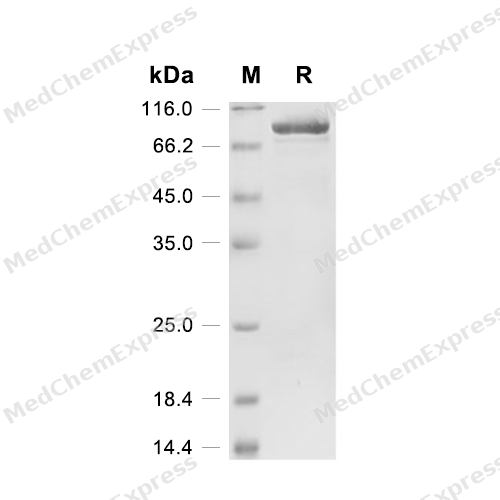
Purity - SDS-PAGE


Technical Parameters
-
Species Virus
-
Source E. coli
-
Tag N-SUMO;N-6*His
-
Accession
P04666 (M1-Y560)
-
Gene ID/
-
Molecular Construction
-
N-term
-
6*His-SUMO
-
Nucleoprotein (M1-Y560)
Accession # P04666 -
C-term
-
-
Protein Length
Full Length
-
Synonyms
NPNucleoprotein; Nucleocapsid protein; Protein N
-
AA Sequence
MSNMDIDGINTGTIDKTPEEIISGTSGATRPIIRPATLAPPSNKRTRNPSPERATTSSEADVGRKTQKKQTPTEIKKSVYNMVVKLGEFYNQMMVKAGLNDDMERNLIQNAHAVERILLAATDDKKTEFQKKKNARDVKEGKEEIDHNKTGGTFYKMVRDDKTIYFSPIRITFLKEEVKTMYKTTMGSDGFSGLNHIMIGHSQMNDVCFQRSKALKRVGLDPSLISTFAGSTLPRRSGATGVAIKGGGTLVAEAIRFIGRAMADRGLLRDIKAKTAYEKILLNLKNKCSAPQQKALVDQVIGSRNPGIADIEDLTLLARSMVVVRPSVASKVVLPISIYAKIPQLGFNVEEYSMVGYEAMALYNMATPVSILRMGDDAKDKSQLFFMSCFGAAYEDLRVLSALTGTEFKPRSALKCKGFHVPAKEQVEGMGAALMSIKLQFWAPMTRSGGNEVGGDGGSGQISCSPVFAVERPIALSKQAVRRMLSMNIEGRDADVKGNLLKMMNDSMAKKTNGNAFIGKKMFQISDKNKTNPVEIPIKQTIPNFFFGRDTAEDYDDLDY
-
Predicted Molecular Mass
77.6 kDa
-
Purity
≥ 90%, as determined by reducing SDS-PAGE.


Product Properties
Lyophilized powder.
<1.0 EU/μg, determined by LAL method.
It is not recommended to reconstitute to a concentration less than 100 μg/mL in ddH2O.
Stored at -20°C for 2 years from date of receipt. After reconstitution, it is stable at 4°C for 1 week or -20°C for longer (with carrier protein). It is recommended to freeze aliquots at -20°C or -80°C for extended storage.
Room temperature in continental US; may vary elsewhere.


Documentation
-
Data Sheet (238 KB)
-
SDS (251 KB)
- English - EN (251 KB)
- Français - FR (251 KB)
- Deutsch - DE (251 KB)
- Norwegian - NO (251 KB)
- Español - ES (251 KB)
- Swedish - SV (251 KB)
- Italian - IT (251 KB)
- Korean - KR (251 KB)
- Portuguese - PT (251 KB)
-
Handling Instructions (2659 KB)

Calculators
Concentration (start) × Volume (start) = Concentration (final) × Volume (final)


 Powered by Bioz

