



O-GlcNAcase/OGA Protein, B. thetaiotaomicron (His)

Based on 1 Customer Validation
O-GlcNAcase (OGA) is an enzyme responsible for the hydrolysis of glycosidic bonds in O-GlcNA acylated proteins. It exhibits its enzymatic activity in vitro by efficiently utilizing substrates such as p-nitrophenyl-β-GlcNAc and 4-methylumbelliferone-GlcNAc. O-GlcNAcase/OGA Protein, B. thetaiotaomicron (His) is the recombinant O-GlcNAcase/OGA protein, expressed by E. coli , with N-6*His labeled tag.
- Species: Others
- Source: E. coli
-
Storage:Stored at -20°C for 2 years from date of receipt. After reconstitution, it is stable at 4°C for 1 week or -20°C for longer (with carrier protein). It is recommended to freeze aliquots at -20°C or -80°C for extended storage.


To place orders, for customer services and technical support, please contact: MedChemExpress USA
Tel: 609-228-6898 E-mail: [email protected] [email protected]


-
 Biological Activity
-
Technical Parameters
-
Product Properties
- Documentation
- Help & FAQs




Biological Activity
Description
O-GlcNAcase (OGA) is an enzyme responsible for the hydrolysis of glycosidic bonds in O-GlcNA acylated proteins. It exhibits its enzymatic activity in vitro by efficiently utilizing substrates such as p-nitrophenyl-β-GlcNAc and 4-methylumbelliferone-GlcNAc. O-GlcNAcase/OGA Protein, B. thetaiotaomicron (His) is the recombinant O-GlcNAcase/OGA protein, expressed by E. coli , with N-6*His labeled tag.
Background
O-GlcNAcase (OGA) is an enzyme responsible for the hydrolysis of the glycosidic link in O-GlcNAcylated proteins. It exhibits its enzymatic activity in vitro by efficiently utilizing substrates like p-nitrophenyl-beta-GlcNAc and 4-methylumbelliferone-GlcNAc. OGA plays a crucial role in regulating O-GlcNAcylation, a post-translational modification that involves the attachment of N-acetylglucosamine (GlcNAc) to serine or threonine residues of proteins. By catalyzing the removal of O-GlcNAc groups, OGA contributes to the dynamic control of O-GlcNAcylation levels, thereby influencing various cellular processes such as signal transduction, gene expression, and protein stability. Further investigation is necessary to fully comprehend the complex regulatory mechanisms and physiological significance of OGA in cellular functions and disease pathways.
Verified Bioactivity
Measured by its ability to cleave a peptide substrate, 4-methylumbelliferyl-N-acetyl-beta-D-glucosaminide. Read at excitation and emission wavelengths of 365 nm and 445 nm. The specific activity is 3120.1541 pmol/min/µg, as measured under the described conditions.
MCE Validation Data
-
Purity - SDS-PAGE
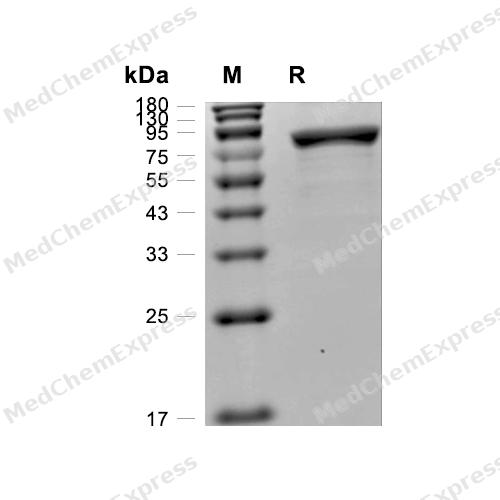
Purity - SDS-PAGE


Technical Parameters
-
Species Others
-
Source E. coli
-
Tag N-6*His
-
Accession
Q89ZI2 (Q22-K737)
-
Gene ID1074035
-
Molecular Construction
-
N-term
-
6*His
-
OGA (Q22-K737)
Accession # Q89ZI2 -
C-term
-
-
Protein Length
Full Length of Mature Protein
-
Synonyms
O-GlcNAcase BT_4395; EC:3.2.1.169; Beta-N-acetylglucosaminidase; Beta-N-acetylhexosaminidase; Beta-hexosaminidase; Hexosaminidase B; N-acetyl-beta-glucosaminidase; BT_4395
-
AA Sequence
QNVSLQPPPQQLIVQNKTIDLPAVYQLNGGEEANPHAVKVLKELLSGKQSSKKGMLISIGEKGDKSVRKYSRQIPDHKEGYYLSVNEKEIVLAGNDERGTYYALQTFAQLLKDGKLPEVEIKDYPSVRYRGVVEGFYGTPWSHQARLSQLKFYGKNKMNTYIYGPKDDPYHSAPNWRLPYPDKEAAQLQELVAVANENEVDFVWAIHPGQDIKWNKEDRDLLLAKFEKMYQLGVRSFAVFFDDISGEGTNPQKQAELLNYIDEKFAQVKPDINQLVMCPTEYNKSWSNPNGNYLTTLGDKLNPSIQIMWTGDRVISDITRDGISWINERIKRPAYIWWNFPVSDYVRDHLLLGPVYGNDTTIAKEMSGFVTNPMEHAESSKIAIYSVASYAWNPAKYDTWQTWKDAIRTILPSAAEELECFAMHNSDLGPNGHGYRREESMDIQPAAERFLKAFKEGKNYDKADFETLQYTFERMKESADILLMNTENKPLIVEITPWVHQFKLTAEMGEEVLKMVEGRNESYFLRKYNHVKALQQQMFYIDQTSNQNPYQPGVKTATRVIKPLIDRTFATVVKFFNQKFNAHLDATTDYMPHKMISNVEQIKNLPLQVKANRVLISPANEVVKWAAGNSVEIELDAIYPGENIQINFGKDAPCTWGRLEISTDGKEWKTVDLKQKESRLSAGLQKAPVKFVRFTNVSDEEQQVYLRQFVLTIEKK
-
Molecular Weight
Approximately 66-76 kDa, based on SDS-PAGE under reducing conditions.
-
Purity
≥ 95%, as determined by reducing SDS-PAGE.


Product Properties
Lyophilized powder.
Lyophilized from a 0.22 μm filtered solution of 50 mM Tris-HCl, 300 mM NaCl, pH 7.4.
Note: For SPR assay, please replace the buffer. Primary amine components (e.g., Tris, imidazole) can affect protein-coupled chips.
<1 EU/μg, determined by LAL method.
It is not recommended to reconstitute to a concentration less than 100 μg/mL in ddH2O. For long term storage it is recommended to add a carrier protein (0.1% BSA, 5% HSA, 10% FBS or 5% Trehalose).
Stored at -20°C for 2 years from date of receipt. After reconstitution, it is stable at 4°C for 1 week or -20°C for longer (with carrier protein). It is recommended to freeze aliquots at -20°C or -80°C for extended storage.
Room temperature in continental US; may vary elsewhere.


Documentation
-
Data Sheet (240 KB)
-
SDS (252 KB)
- English - EN (252 KB)
- Français - FR (252 KB)
- Deutsch - DE (252 KB)
- Norwegian - NO (252 KB)
- Español - ES (252 KB)
- Swedish - SV (252 KB)
- Italian - IT (252 KB)
- Korean - KR (252 KB)
- Portuguese - PT (252 KB)
-
Handling Instructions (2659 KB)

Calculators
Concentration (start) × Volume (start) = Concentration (final) × Volume (final)


 Powered by Bioz

