



OSM Protein, Human (209a.a)
Based on 1 Customer Validation
OSM Protein, Human (209a.a) is a polypeptide chain containing 209 amino acids. Oncostatin M is a cytokine belonging to the IL-6 family that has multiple functions in hematopoiesis, mesenchymal stem cell differentiation, liver regeneration, heart remodeling, nociception, inflammation and metabolism.
- Species: Human
- Source: E. coli
-
Storage:Stored at -20°C for 2 years from date of receipt. After reconstitution, it is stable at 4°C for 1 week or -20°C for longer (with carrier protein). It is recommended to freeze aliquots at -20°C or -80°C for extended storage.


To place orders, for customer services and technical support, please contact: MedChemExpress USA
Tel: 609-228-6898 E-mail: [email protected] [email protected]


-
 Biological Activity
-
Technical Parameters
-
Product Properties
- Documentation
- References
- Help & FAQs




Biological Activity
Description
OSM Protein, Human (209a.a) is a polypeptide chain containing 209 amino acids. Oncostatin M is a cytokine belonging to the IL-6 family that has multiple functions in hematopoiesis, mesenchymal stem cell differentiation, liver regeneration, heart remodeling, nociception, inflammation and metabolism.
Background
Oncostatin M is a cytokine belonging to the IL-6 family that has multiple functions in hematopoiesis, mesenchymal stem cell differentiation, liver regeneration, heart remodeling, nociception, inflammation and metabolism. The full-length Oncostatin M proteins contain between 239 and 263 amino acids which fold into a long-chain four helix-bundle protein with an up-up-down-down topology representative of all other IL-6 family cytokines. Human Oncostatin-M can bind to either the type I receptor complex consisting of gp130 and the LIFR (gp130/LIFRb) or the type II receptor complex consisting of gp130 and the OSMR (gp130/OSMRb). In the murine system Oncostatin-M has been shown to bind with high affinity only to the type II gp130/OSMRb complex[1][2]. Oncostatin-M binds to specific receptor complexes, then activates two major signaling pathways: Janus Kinase-Signal Transducers and Activators of Transcription (JAK-STAT) and Mitogen-Activated Protein Kinase (MAPK), to regulate downstream events[3].
Verified Bioactivity
The ED50 is <10 ng/mL as measured by TF-1 cells, corresponding to a specific activity of >1.0 × 10⁵ units/mg.
MCE Validation Data
-
Purity - SDS-PAGE
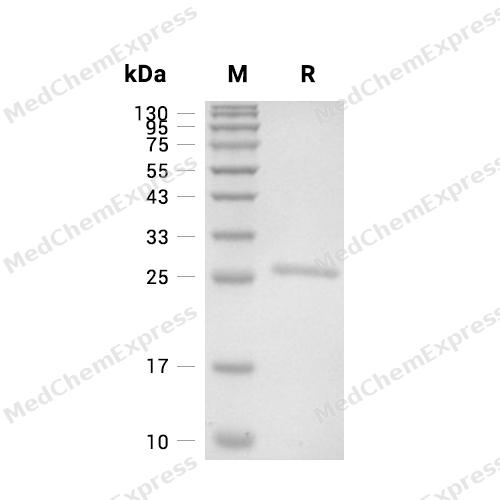
Purity - SDS-PAGE
-
Bioactivity - Cell-Based Assay
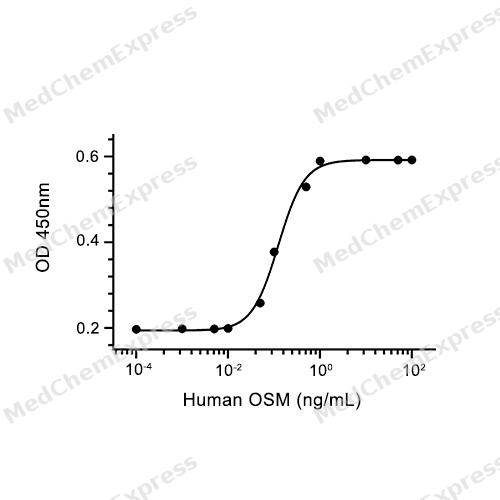
Bioactivity - Cell-Based Assay


Technical Parameters
-
Species Human
-
Source E. coli
-
Tag Tag Free
-
Accession
P13725 (A26-R234)
-
Molecular Construction
-
N-term
-
OSM (A26-R234)
Accession # P13725 -
C-term
-
-
Protein Length
Partial
-
Synonyms
OSM; Oncostatin-M; Oncostatin M; MGC20461
-
AA Sequence
AAIGSCSKEYRVLLGQLQKQTDLMQDTSRLLDPYIRIQGLDVPKLREHCRERPGAFPSEETLRGLGRRGFLQTLNATLGCVLHRLADLEQRLPKAQDLERSGLNIEDLEKLQMARPNILGLRNNIYCMAQLLDNSDTAEPTKAGRGASQPPTPTPASDAFQRKLEGCRFLHGYHRFMHSVGRVFSKWGESPNRSRRHSPHQALRKGVRR
-
Molecular Weight
Approximately 24 kDa, based on SDS-PAGE under reducing conditions.
-
Purity
≥ 95%, as determined by reducing SDS-PAGE.


Product Properties
Lyophilized powder
1.Lyophilized from a 0.22 μm filtered solution of PBS.
2.Lyophilized from a 0.22 μm filtered solution of PBS, pH 7.4, 8% trehalose.
Please refer to the lot-specific COA for specific buffer information.
<0.2 EU/μg, determined by LAL method.
It is not recommended to reconstitute to a concentration less than 100 μg/mL in ddH2O. For long term storage it is recommended to add a carrier protein (0.1% BSA, 5% HSA, 10% FBS or 5% Trehalose).
Stored at -20°C for 2 years from date of receipt. After reconstitution, it is stable at 4°C for 1 week or -20°C for longer (with carrier protein). It is recommended to freeze aliquots at -20°C or -80°C for extended storage.
Room temperature in continental US; may vary elsewhere.


Documentation
-
Data Sheet (263 KB)
-
SDS (251 KB)
- English - EN (251 KB)
- Français - FR (251 KB)
- Deutsch - DE (251 KB)
- Norwegian - NO (251 KB)
- Español - ES (251 KB)
- Swedish - SV (251 KB)
- Italian - IT (251 KB)
- Korean - KR (251 KB)
- Portuguese - PT (251 KB)
-
Handling Instructions (2659 KB)


References
[1]. Hermanns HM, et al. Oncostatin M and interleukin-31: Cytokines, receptors, signal transduction and physiology. Cytokine Growth Factor Rev. 2015 Oct;26(5):545-58. [Content Brief]
[2]. Gómez-Lechón MJ, et al. Oncostatin M: signal transduction and biological activity. Life Sci. 1999;65(20):2019-30. [Content Brief]
[3]. Chen SH, et al. Oncostatin M: a pleiotropic cytokine in the central nervous system. Cytokine Growth Factor Rev. 2004 Oct;15(5):379-91. [Content Brief]

Calculators
Concentration (start) × Volume (start) = Concentration (final) × Volume (final)


 Powered by Bioz

