



PGD2 Synthase/PTGDS Protein, Rat (HEK293, His)

Based on 1 Customer Validation
The PGD2 synthase/PTGDS protein converts PGH2 to PGD2, which regulates smooth muscle and inhibits platelet aggregation.It affects central nervous system functions including sedation, NREM sleep, and potential anti-apoptotic effects on oligodendrocytes.PGD2 Synthase/PTGDS Protein, Rat (HEK293, His) is the recombinant rat-derived PGD2 Synthase/PTGDS protein, expressed by HEK293 , with C-His, C-6*His labeled tag.
- Species: Rat
- Source: HEK293
-
Storage:Stored at -20°C for 2 years from date of receipt. After reconstitution, it is stable at 4°C for 1 week or -20°C for longer (with carrier protein). It is recommended to freeze aliquots at -20°C or -80°C for extended storage.


To place orders, for customer services and technical support, please contact: MedChemExpress USA
Tel: 609-228-6898 E-mail: [email protected] [email protected]


-
 Biological Activity
-
Technical Parameters
-
Product Properties
- Documentation
- Help & FAQs




Biological Activity
Description
The PGD2 synthase/PTGDS protein converts PGH2 to PGD2, which regulates smooth muscle and inhibits platelet aggregation.It affects central nervous system functions including sedation, NREM sleep, and potential anti-apoptotic effects on oligodendrocytes.PGD2 Synthase/PTGDS Protein, Rat (HEK293, His) is the recombinant rat-derived PGD2 Synthase/PTGDS protein, expressed by HEK293 , with C-His, C-6*His labeled tag.
Background
The PGD2 Synthase, also known as PTGDS protein, is a key enzymatic player in diverse physiological processes. It catalyzes the conversion of PGH2 to PGD2, a prostaglandin essential for smooth muscle contraction/relaxation and a potent inhibitor of platelet aggregation. Beyond its vascular functions, PTGDS is intricately involved in various central nervous system (CNS) activities, including sedation, NREM sleep, and PGE2-induced allodynia, and may exert an anti-apoptotic role in oligodendrocytes. The protein exhibits a broad substrate-binding capacity, interacting with small non-substrate lipophilic molecules like biliverdin, bilirubin, retinal, retinoic acid, and thyroid hormone, potentially acting as a scavenger for harmful hydrophobic molecules and functioning as a secretory retinoid and thyroid hormone transporter. PTGDS is implicated in the development and maintenance of blood barriers, including the blood-brain, blood-retina, blood-aqueous humor, and blood-testis barriers, highlighting its significance in barrier function. Moreover, it plays pivotal roles in both the maturation and maintenance of the central nervous system and the male reproductive system. Additionally, PTGDS participates in PLA2G3-dependent mast cell maturation, where PLA2G3, secreted by immature mast cells, acts upstream to PTGDS to synthesize PGD2. This, in turn, promotes mast cell maturation and degranulation via PTGDR, indicating its involvement in immune responses and cellular maturation.
Verified Bioactivity
Measured by its ability to catalyse the conversion of PGH2 to PGD2. The specific activity is 5.6394 pg/min/µg that incubate at 25°C for 1 minutes.
MCE Validation Data
-
Purity - SDS-PAGE
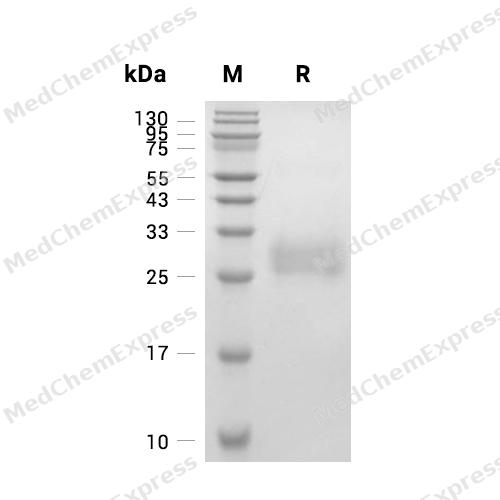
Purity - SDS-PAGE


Technical Parameters
-
Species Rat
-
Source HEK293
-
Tag C-6*His
-
Accession
P22057/NP_037147.1 (Q25-E189)
-
Molecular Construction
-
N-term
-
PTGDS (Q25-E189)
Accession # P22057/NP_037147.1 -
6*His
-
C-term
-
-
Protein Length
Full Length of Mature Protein
-
Synonyms
PTGDS; PGD2 Synthase; Prostaglandin D2 Synthase; Cerebrin-28; L-PGDS; PGDS2; PGDS; PDS; Glutathione-Independent PGD Synthase; Testis Tissue Sperm-Binding Protein Li 63n; Prostaglandin-H2 D-Isomerase; Prostaglandin D2 Synthase (21kD, Brain); Lipocalin-Type
-
AA Sequence
QGHDTVQPNFQQDKFLGRWYSAGLASNSSWFREKKELLFMCQTVVAPSTEGGLNLTSTFLRKNQCETKVMVLQPAGVPGQYTYNSPHWGSFHSLSVVETDYDEYAFLFSKGTKGPGQDFRMATLYSRAQLLKEELKEKFITFSKDQGLTEEDIVFLPQPDKCIQE
-
Molecular Weight
Approximately 26-29 kDa, based on SDS-PAGE under reducing conditions, due to the glycosylation.
-
Glycosylation
Yes
-
Purity
≥ 95%, as determined by reducing SDS-PAGE.


Product Properties
Lyophilized powder.
Lyophilized from a 0.22 μm filtered solution of PBS, pH 7.4.
<1 EU/μg, determined by LAL method.
It is not recommended to reconstitute to a concentration less than 100 μg/mL in ddH2O. For long term storage it is recommended to add a carrier protein (0.1% BSA, 5% HSA, 10% FBS or 5% Trehalose).
Stored at -20°C for 2 years from date of receipt. After reconstitution, it is stable at 4°C for 1 week or -20°C for longer (with carrier protein). It is recommended to freeze aliquots at -20°C or -80°C for extended storage.
Room temperature in continental US; may vary elsewhere.


Documentation
-
Data Sheet (237 KB)
-
SDS (251 KB)
- English - EN (251 KB)
- Français - FR (251 KB)
- Deutsch - DE (251 KB)
- Norwegian - NO (251 KB)
- Español - ES (251 KB)
- Swedish - SV (251 KB)
- Italian - IT (251 KB)
- Korean - KR (251 KB)
- Portuguese - PT (251 KB)
-
Handling Instructions (2659 KB)

Calculators
Concentration (start) × Volume (start) = Concentration (final) × Volume (final)


 Powered by Bioz

